Understanding the Importance of Process Automation Reliability
Learn about the role of reliable automation in creating safe, consistent work operations to help teams avoid breakdowns that impact quality and compliance.

Learn about the role of reliable automation in creating safe, consistent work operations to help teams avoid breakdowns that impact quality and compliance.
Published 28 Apr 2026
Article by
6 min read
Process automation reliability refers to the consistency and dependability of automated systems and processes when performing tasks without human intervention. It is a critical factor in ensuring that automated processes in place deliver the expected outcomes accurately and efficiently over time.
Having reliable automated processes involves regular maintenance, regularly testing systems, and employing robust technologies that can efficiently adapt to changes within the operating environment.
Designing and maintaining reliable automated processes creates a dependable operational backbone that supports productivity, quality, and continuous improvement across the organization.
Listed below are some of the key benefits of achieving high reliability in process automation:
Reduced downtime and operational disruptions: Reliable automation minimizes failures, breakdowns, and unexpected breakdowns, helping teams maintain steady operations and avoid costly interruptions.
Consistent quality and fewer errors: Good automated processes reduce variability and human error, ensuring outputs meet quality standards and customer expectations every time.
Higher productivity and efficiency: When automated workflows run dependably, work moves forward without delays or rework, allowing teams to concentrate on higher-value work and maximize capacity.
Lower operational costs and waste: Reliable automation reduces rework and unnecessary maintenance to improve resource utilization and deliver measurable cost savings.
Greater confidence in operational data: Dependable automated processes produce accurate, consistent data that leaders can trust when making decisions about performance, maintenance, and improvement.
Better scalability and operational resilience: Establishing a dependable automation process makes it easier to scale operations without increasing risk or disruptions, helping organizations adapt to growth and changing demands while maintaining control.
Safety is about preventing harm by ensuring processes do not lead to hazardous conditions, even if that means stopping operations.
Reliability, on the other hand, focuses on keeping automated processes running consistently and as intended over time.
In a well-designed automation environment, safety and reliability reinforce each other. Having reliable equipment reduces the chance of triggering safety incidents, while strong safety controls ensure that anticipated system failures do not escalate into serious harm.
Aspect | Safety | Reliability |
Main objective | Risk prevention | High uptime and dependable operation |
Failure concern | Dangerous or catastrophic outcomes | Any failure that affects performance or availability |
Typical response to failure | Fail-safe action, often requiring a shutdown | Continue operating if possible, and avoid unnecessary stops |
Key metrics | Probability of failure on demand, risk levels | Uptime, availability, mean time between failures |
Design priority | Fault tolerance and protective safeguards | Durability, maintainability, and operational stability |
How it supports operations | Prevents accidents and compliance violations | Supports productivity, efficiency, and predictable output |
Several key factors can influence the reliability of process automation. These include:
Design and integration: Several key factors influence the reliability of process automation, including how well the system’s architecture and connectivity enable components to work seamlessly together. It also considers support for modular upgrades and integration with existing equipment and processes.
Hardware and software components: Process automation reliability depends on choosing high-quality components, including properly matched sensors and controllers, and keeping software current and secure to prevent unexpected failures and production downtime.
Environment and conditions: Process automation reliability is influenced by operating conditions such as temperature, dust, power fluctuations, and electromagnetic interference, making environmental monitoring and protection essential to maintain accuracy and prevent premature equipment wear.
Maintenance and inspection: Regular preventive maintenance, including routine cleaning, calibration, testing, and a process quality audit, helps catch issues early and prevents disruptive, unplanned automation outages.
Training and support: Workforce knowledge, operational competency, and access to technical assistance shape how effectively personnel interact with automation systems and respond to irregularities.
Continuous improvement: The best automation improves over time through performance data, operator feedback, and structured refinement based on real-world results.
The following metrics help teams evaluate whether automation is dependable, stable, and fit for long-term operational use.
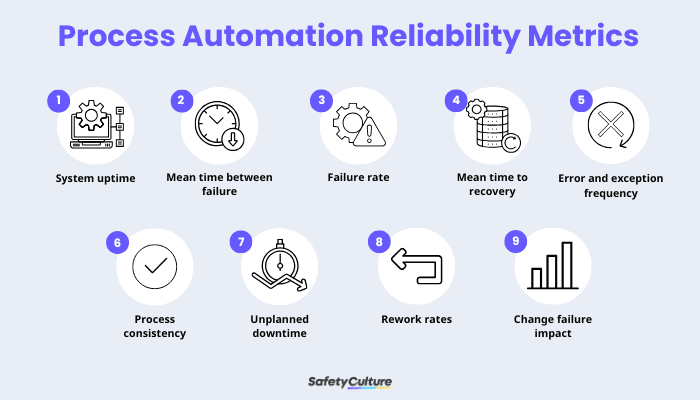
System uptime and availability: Measures how often automated processes are operational and accessible. High uptime indicates stable automation that supports continuous operations.
Mean Time Between Failures (MTBF): Tracks the average time an automated process runs before a failure occurs. A higher MTBF indicates more dependable, resilient automation.
Failure rate: Identifies how frequently automated workflows fail within a given period. Monitoring failure rates helps highlight weak points in process design or execution.
Mean Time to Recovery (MTTR): Measures how quickly automation recovers after a failure. Shorter recovery times indicate stronger operational reliability and support readiness.
Error and exception frequency: Tracks how often automated processes generate errors, exceptions, or noncompliance that requires manual intervention. Fewer exceptions indicate more stable, predictable automation.
Process consistency: Evaluates whether automated outputs remain uniform over time. Consistent results indicate reliable execution without performance drift.
Unplanned downtime incidents: Captures unexpected disruptions caused by system, process, or integration issues. Reduced unplanned downtime is a key indicator of reliable automation.
Rework and retry rates: Measures the frequency of automated task rework caused by failures or incomplete execution. Lower rework rates reflect higher automation dependability.
Change failure impact: Assesses how process changes or updates affect automation performance. Well-designed automation sustains consistent performance despite ongoing improvements.
A structured, risk-aware approach ensures workflows remain stable, predictable, and easy to sustain as operational demands evolve. Here are some best practices to consider when designing automated process workflows:
Start with clear process mapping: Define process goals, inputs, outputs, dependencies, and handoffs before automation begins. Clear visibility into how work flows reduces design gaps that often lead to reliability issues later.
Identify failure risks early: Evaluate where and how a workflow could fail during normal and abnormal conditions. Addressing high-risk steps early improves reliability before automation goes live.
Design workflows to be modular: Break down automation designs into smaller, self-contained components rather than large, tightly coupled sequences. Modular design simplifies testing, troubleshooting, and future changes without disrupting the entire process.
Build in a fail-safe and fallback logic: Design workflows to respond with safety in mind when errors occur—such as pausing execution, triggering alerts, or reverting to a known safe state. Controlled failure handling prevents minor issues from escalating into system-wide disruptions.
Standardize logic and communication paths: Use consistent rules, data structures, and interfaces across automated steps. Standardization reduces misalignment between systems and improves long-term workflow stability.
Test repeatedly before full rollout: Validate workflows through staged testing and controlled releases. Incremental testing helps uncover reliability issues early, when fixes are less disruptive and less costly.
Embed monitoring and alerting: Design workflows with built-in visibility into performance, errors, and exceptions. Real-time monitoring enables faster response and supports proactive reliability management.
Define ownership and escalation paths: Assign clear responsibility for monitoring, maintaining, and updating automated workflows. Clear ownership enables faster and more consistent issue resolution.
Plan for maintenance and continuous improvement: Treat automation as a living system that requires updates, reviews, and refinement. Regular assessments and controlled changes help maintain reliability as processes and conditions change.
SafetyCulture is a mobile-first operations platform adopted across industries such as manufacturing, mining, construction, retail, and hospitality. It’s designed to equip leaders and working teams with the knowledge and tools to do their best work—to the safest and highest standard.
Streamline processes, eliminate bottlenecks, enhance resource utilization, and build an agile and scalable infrastructure with SafetyCulture. Strive for operational excellence to boost competitive advantage, foster sustainable growth, and deliver long-term value.
✓ Save time and reduce costs
✓ Stay on top of risks and incidents
✓ Boost productivity and efficiency
✓ Enhance communication and collaboration
✓ Discover improvement opportunities
✓ Make data-driven business decisions
In this article