
How to Conduct Effective AHAs for Safer Work Environments
Explore this guide to Active Hazard Analysis (AHA): from real-time risk detection to predictive safety tools, to significantly improve your safety strategy today.
Published 27 Jun 2025
Article by
6 min read
What is Activity Hazard Analysis?
Activity Hazard Analysis (AHA) is a proactive safety management technique that continuously monitors operational activities to identify, evaluate, and mitigate potential risks and observed hazards in real-time before they cause serious injuries or grave environmental impact. This shifts the focus from reactive to predictive safety practices, especially in high-risk tasks and permit-required operations.
Importance and Benefits
Analyzing activity hazards was initially influenced by the Occupational Safety and Health Administration’s (OSHA) job hazard analysis framework. However, because this is a task-specific and more detailed assessment, the US Army Corps of Engineers also mandated it.
Over time, breaking down a specific activity or task into individual steps to carefully identify risks and their corresponding controls has become a best practice, delivering the following benefits:
Improved hazard identification and control – Because AHA is focused on inspecting workplace hazards in real-time, managers can immediately pinpoint issues and make the necessary adjustments to correct them.
Reduced incidents and accompanying costs – Proactive incident prevention systems lower injury rates and cut costs associated with hospitalization, compensation claims, and downtimes.
Enhanced regulatory compliance – Because AHA is focused on continuous operational hazard tracking, it also demonstrates due diligence in meeting industry-specific safety standards.
Improved employee morale and productivity – Active safety management, wherein workers are involved in planning and implementing strategies, leads to higher employee engagement.
Strengthened safety culture – Continuous safety monitoring is a collaborative process that encourages dialogue between employees and management. When everyone works together to uphold safety, success is guaranteed.
Mitigate Health and Safety Risks
Proactively assess, identify, and track potential hazards before they become issues to reduce workplace incidents and injuries.
Different Types of Hazard Analyses
Safety managers, site supervisors, operations leads, and compliance officers sometimes struggle to recognize the distinction between the different methodologies in analyzing existing hazards and potential risks in the workplace. Below is a simple table that characterizes each:
Type | Primary Focus | Safety-centricity | Application |
Job Hazard Analysis (JHA) | Analyzes the relationship between the worker, tasks, tools, and environment to identify hazards in each step of the job | Yes | Before starting a new job, after incidents, for process and equipment change |
Job Safety Analysis (JSA) | Systematic evaluation of job tasks to identify unsafe practices | Yes | Routinely conducted for all job tasks |
Job Safety and Environmental Analysis (JSEA) | Identifying and mitigating safety and environmental risks associated with job tasks | Yes | For jobs with potential environmental impact |
Activity Hazard Analysis (AHA) | Systematic hazard identification for specific steps in activities and projects | Yes | For military, government, and large construction projects; complex, multi-step activities |
Job Task Analysis (JTA) | Breaks down job roles into tasks to define skill, training, and hazard identification | Not always | For job design and training; as a precursor to JHA or JSA |
Task Hazard Analysis (THA) | Similar to JHA and AHA, but often used for non-routine tasks | Yes | For maintenance, repair, and other non-standard activities |
Process Hazard Analysis (PHA) | Identifies hazards associated with industrial processes | Yes | Process-focused, especially those with complex or hazardous workflows |
Create your own Job Safety Analysis checklist
Build from scratch or choose from our collection of free, ready-to-download, and customizable templates.
The Full Activity Hazard Analysis Process
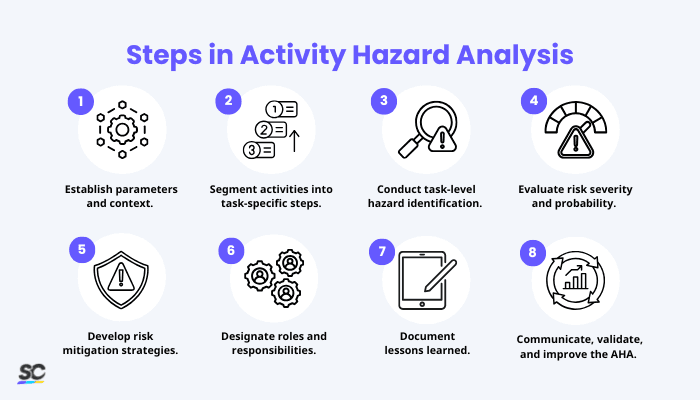
AHA in safety management is effective only when it’s carried out methodically. Rushing through the steps can confuse responsibilities, leading to missed hazards and ineffective controls. Here’s the complete activity hazard analysis process, together with the most crucial components to consider:
Steps in Activity Hazard Analysis
Step 1: Establish work parameters and operational context.
Defining the scope of work sets the foundation for real-time hazard detection. It enables the team to anticipate specific risks based on the task and environmental conditions. Accurate scoping makes it easier to identify hazards.
Step 2: Segment activities into task-specific steps.
Breaking the job into sequential tasks allows for continuous monitoring. Each phase presents unique hazards to be tracked in real-time. Accurate data collection is vital, and better accomplished when combining in-person observations and digital tools.
Step 3: Conduct task-level hazard identification.
After breaking tasks down, the next step involves determining all possible hazards associated with each. Predictive risk monitoring is an important component used in this stage, anticipating how hazards could emerge or evolve, based on safety trends, historical data, and current environmental conditions.
Step 4: Evaluate risk severity and probability.
Determine the risk levels by utilizing human judgment (e.g., talking to frontline workers) and system-generated insights (e.g., data from hazard analysis software, Internet of Things (IoT) sensors, and wearables). This blended approach improves the accuracy of risk assessment and accountability.
Step 5: Develop and assign hazard controls and risk mitigation strategies.
Control measures should be specific, achievable, and matched to the severity of the risks. Apply the hierarchy of controls, prioritizing permanent solutions over temporary fixes. The goal is to reduce hazards and increase safety on the ground through informed, real-time decisions.
Step 6: Designate roles and responsibilities.
Each control should be owned by someone—a team member, a supervisor, or a safety officer. Clear responsibility assignments ensure that safety actions won’t get overlooked or delayed, whether this is a simple office hazard or a grave danger in a high-risk site. Collaboration is vital in this step, ensuring accountability and follow-through.
Step 7: Document lessons learned.
Post-task reviews and incident debriefs should be incorporated into the AHA. Capturing lessons learned enhances predictive accuracy, improves safety systems, and ensures long-term cultural change.
Step 8: Communicate, validate, and continuously improve the AHA.
AHA isn’t a static safety plan. Documents should be revisited when conditions change or tasks shift. Regular review and proper hazard communication reinforce awareness, support continuous improvement, and refine risk models over time.
Overcoming Challenges
Safety efforts can be overshadowed by various obstacles, which can be difficult to overcome. Get to know these challenges and learn the best practices to get them under control:
Limited worker engagement – On top of resistance to new initiatives, teams may view AHA as paperwork rather than a vital safety tool. Involving frontliners in decision-making processes prevents this problem.
Insufficient training – Often due to a lack of resources, team members won’t be able to contribute to the initiative when they don’t know how to conduct it. Getting leadership buy-in is vital to gaining adequate funding.
Inconsistent execution across teams – Different departments or sites may use varying formats or skip critical steps. Standardized AHA templates can help ensure each stage is accomplished correctly.
Time constraints and productivity pressure – When project timelines are prioritized over safety, injuries will occur. It’s best to integrate AHA planning into the scheduling process.
Lack of follow-through on control measures – Sometimes, employees document hazards but fail to address them. Progress tracking should be non-negotiable to ensure the job is completed.
Efficiently Conduct Activity Hazard Analysis with SafetyCulture
Why Use SafetyCulture?
SafetyCulture is a mobile-first operations platform adopted across industries such as manufacturing, mining, construction, retail, and hospitality. It’s designed to equip leaders and working teams with the knowledge and tools to do their best work—to the safest and highest standard.
Acquire accurate data by utilizing digital templates while monitoring activities, observing worker behavior, and identifying hazards on the ground. Improve collaboration among teams and across sites by centralizing communication, assigning controls, tracking progress, and recordkeeping. Enhance the effectiveness of the activity hazard analysis, resulting in regulatory compliance and a stronger safety culture through a unified platform.
✓ Save time and reduce costs ✓ Stay on top of risks and incidents ✓ Boost productivity and efficiency ✓ Enhance communication and collaboration ✓ Discover improvement opportunities ✓ Make data-driven business decisions
FAQs About Activity Hazard Analysis
Related articles
Risk Assessment
Safety

The Ultimate Guide to Asset Risk Assessment
Learn how asset risk assessment improves safety, reliability, and maintenance by identifying risks and preventing costly equipment failures.
Risk Assessment
Safety

A Comprehensive Guide to Risk-Benefit Analysis
Learn how risk-benefit analysis helps teams evaluate trade-offs, document residual risk, and support safer operational decisions.
Equipment Safety
Retail

Forklift Safety
Learn about the basics on forklift safety, forklift operator requirements, safety hazards and tips, and digital forklift tools.