Types and Strategies for Multi Warehouse Management
See how coordinating multiple warehouse locations can improve inventory accuracy, streamline operations, and boost overall supply chain efficiency.

See how coordinating multiple warehouse locations can improve inventory accuracy, streamline operations, and boost overall supply chain efficiency.
Published 28 Apr 2026
Article by
7 min read
Multi-warehouse management is the process of overseeing and coordinating operations across multiple warehouses or distribution centers. It involves bringing inventory data from different locations into a unified system, so businesses can track stock levels in real time, minimize storage costs, and place products where they're most needed.
A well-designed multi-warehouse setup improves control, efficiency, and responsiveness across all storage locations. With the proper warehouse management structure in place, businesses can stay flexible as demand grows while keeping operations consistent.
Other benefits include:
Faster delivery and lower shipping costs: Storing products closer to customers shortens delivery routes, reduces transportation expenses, and supports faster fulfillment, even for expedited orders.
Higher customer satisfaction: Reliable deliveries boosts trust. With multiple locations fulfilling orders, disruptions in one area are less likely to impact the overall customer experience.
Better market expansion opportunities: A distributed warehouse network makes it easier to enter new regions without investing in physical stores. It supports gradual growth and improves reach into international or emerging markets more effectively.
Stronger business continuity: Spreading inventory across several facilities reduces disruption-related risks. If one warehouse experiences delays or outages, others can step in to keep operations moving.
More efficient inventory control: Multi-location setups improve demand allocation, safety stock placement, and inventory accuracy. This helps maintain balanced stock levels while lowering carrying costs.
Greater scalability and operational flexibility: Businesses can add new warehouses or use temporary storage during peak seasons, enabling growth without overwhelming existing facilities.
Designs for multi-warehouse networks vary based on cost targets, customer expectations, and operational capacity. Understanding these structures helps businesses choose a model that best supports efficiency and long-term growth.
Below are the main types of multi-warehouse networks and what each model offers:
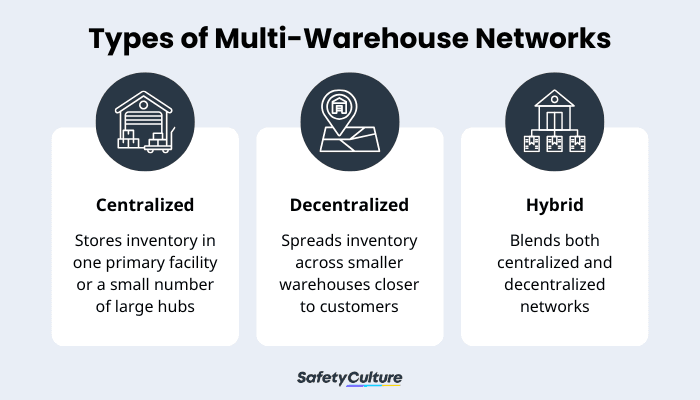
In a centralized model, most inventory is stored in one primary facility or a small number of large hubs serving wide geographic areas. This setup prioritizes consistency, cost control, and simplified operations.
Benefits:
Lower storage and operational expenses
Easier oversight of stock and workflows
Better suitability for automation and process standardization
Common approaches:
Dropshipping: Avoids the need for holding inventory, aligning well with a single central supply source.
Third-party logistics (3PL) providers: Many 3PLs operate large central hubs that allow brands to centralize inventory without owning facilities.
A decentralized approach spreads inventory across several smaller warehouses located closer to customers. This structure improves delivery speed and reduces dependence on a single facility.
Benefits:
Faster order fulfillment and improved customer experience
Lower risk from regional disruptions
More accurate stocking based on local demand trends
Common approaches:
Regional warehouses: Strategically placed sites supporting defined geographic zones.
Urban warehousing: Facilities located in or near major cities to speed up last-mile delivery.
Micro-fulfillment centers: Small, tech-driven hubs placed designed for rapid processing in high-density areas.
A hybrid model blends both centralized and decentralized networks. Businesses maintain a central hub for bulk storage alongside regional or local warehouses for faster fulfillment.
Benefits:
Balanced cost efficiency and delivery speed
Greater adaptability during demand changes
Stronger operational continuity across multiple regions
Common approaches:
On-demand warehousing: Temporary or seasonal storage added alongside permanent central or regional hubs.
Third-party logistics (3PL) providers: Often used as a hybrid add-on for regional expansion or overflow capacity.
Micro-fulfillment centers: Can complement central warehouses by handling fast-moving urban orders.
While having multiple warehouses can offer many benefits, it also introduces new challenges. Below are some of the common issues that companies face when managing multiple warehouses and how they’re typically addressed:
As stock moves between locations, discrepancies can easily occur due to manual updates, cycle count errors, or items stored in the wrong locations. These gaps can lead to stockouts, excess inventory, or delayed orders.
Solution:
Use a warehouse inventory management system that updates stock movements in real time, so all sites use the same data.
Different warehouses often follow different processes or timelines. This lack of alignment can slow order routing and create inefficiencies during inter-warehouse transfers.
Solution:
Standardize workflows across all sites and connect systems under a single platform to ensure smooth coordination and consistent execution.
Running multiple facilities increases costs related to rent, labor, utilities, and transportation. Poor stock allocation can also tie up capital in one location while others face shortages.
Solution:
Regularly review data on demand patterns, stock movement, and transport routes to improve inventory placement and reduce excess spending.
Without clear routing rules, choosing the right warehouse to fulfill each order can become complex. It can result in incorrect shipments, substitutions, compliance issues, or inconsistent service levels.
Solution:
Implement rules-based order routing within your system to automatically select the best fulfillment location based on proximity, stock availability, and service requirements.
Miscommunication between warehouses can delay decisions and cause duplicate or incorrect inventory actions. It becomes more common when teams rely on disconnected tools.
Solution:
Use a centralized communication platform, an integrated Order Management System (OMS), or a Warehouse Management System (WMS) to keep everyone informed and aligned in real time.
Differences in team sizes, skill levels, and workload distribution can create uneven productivity and bottlenecks. Supervising and scheduling across multiple sites adds another layer of difficulty.
Solution:
Adopt workforce management system tools to track productivity, assign tasks, and balance workloads across sites.

In just five months, they raised over 550 actions in SafetyCulture, closing 96% and significantly improving company standards.
More facilities mean more points of vulnerability—whether from unauthorized access, theft, or data security risks tied to disconnected systems.
Solution:
Apply consistent security standards across all warehouses and use systems with strong access controls and monitoring.
Managing multiple warehouses can be a challenge, but the right strategies make it more manageable and rewarding. Here are some tips to help you effectively manage your multi-warehouse operations:
Use a unified system for real-time visibility: A single platform for inventory and orders reduces blind spots across locations. It helps teams make faster decisions and prevent delays caused by outdated or disconnected data.
Set clear stocking rules for every warehouse: Set minimums, maximums, and replenishment triggers for each site based on demand patterns at each location. It ensures warehouses stock the right products in the right quantities and reduces unnecessary transfers.
Standardize processes across all facilities: Consistent workflows for receiving, picking, packing, and cycle counting make daily operations predictable and easier to manage. They also shorten training time and improve accuracy, especially when teams move between sites.
Leverage automation to reduce manual tasks: Tools such as barcode scanning, automated replenishment, and smart order routing help reduce repetitive tasks and errors. Automation enables growth without significantly increasing labor or operational complexity.
Optimize warehouse layouts for faster movement: Arrange storage zones based on how frequently products move and how orders are picked. A streamlined warehouse layout improves picking speeds and reduces time spent walking on the floor.
Establish strong communication channels between sites: Use structured routines, such as daily updates or shared dashboards, to keep teams aligned across locations. Strong communication reduces delays, duplicate work, or missed inventory actions.
Track performance using location-level metrics: Measure fulfillment accuracy, order cycle time, and space utilization for each warehouse to understand how sites compare. These insights make it easier to identify issues early and provide targeted support.
Maintain close coordination with suppliers: Share demand forecasts and restock schedules with suppliers to ensure timely replenishment. Better alignment reduces stockouts and keeps inventory flowing smoothly.
Review your strategy regularly and adjust quickly: Market conditions and customer expectations are constantly changing. Regular reviews allow you to refine your distribution plan, adjust inventory, and modify warehouse locations as needed.
SafetyCulture is a mobile-first operations platform adopted across industries such as manufacturing, mining, construction, retail, and hospitality. It’s designed to equip leaders and working teams with the knowledge and tools to do their best work—to the safest and highest standard.
Streamline processes, eliminate bottlenecks, enhance resource utilization, and build an agile and scalable infrastructure with SafetyCulture. Strive for operational excellence to boost competitive advantage, foster sustainable growth, and deliver long-term value.
✓ Save time and reduce costs
✓ Stay on top of risks and incidents
✓ Boost productivity and efficiency
✓ Enhance communication and collaboration
✓ Discover improvement opportunities
✓ Make data-driven business decisions