A Guide to Advanced Metering Infrastructure
Learn what advanced metering infrastructure is, its benefits, and the key components that make these systems work.
Learn what advanced metering infrastructure is, its benefits, and the key components that make these systems work.
Published 23 Feb 2026
Article by
5 min read
Advanced Metering Infrastructure (AMI) is an integrated system of meters and information management tools used to remotely collect usage data in real time. It uses communication technology like broadband connections, cellular networks, and radio communication to transmit data from smart meters to a utility’s central system for analysis, billing, and operational decision-making. These systems also support two-way communication, allowing utilities to monitor system conditions and control service functions more efficiently.
Automated Meter Reading (AMR) refers to technology that enables one-way data collection, where usage data is automatically captured. While this improves billing accuracy and reduces manual meter reading, AMR often requires drive-by or in-person readers for data collection. Communication is also limited, as AMR technology is independent from infrastructure networks and needs personnel intervention to retrieve data.
On the other hand, AMI combines smart meters with two-way communications networks, data management systems, and analytics platforms. This broader infrastructure provides real-time monitoring, remote service actions, outage detection, demand response, and deeper operational insights that automated metering alone cannot support.
Having AMI offers various benefits to utility management and efficiency, as it facilitates data collection from meters without constant supervision. Utility systems worldwide are seeing a shift toward AMI and smart metering, with global adoption predicted to surpass 3 billion by 2030. Below are some of the other ways utilities can benefit from AMI:
AMI reduces operational costs by automating meter readings, eliminating manual labor, and lowering vehicle and fuel expenses. Real-time data collected from automated systems improves billing accuracy and speeds up leak detection and theft identification. This helps optimize utility asset management by using detailed usage and performance data.
Access to detailed usage records helps customers understand consumption patterns and make informed decisions to control costs. Time-of-use pricing programs encourage shifting usage away from peak periods, lowering demand on utility systems. Demand response capabilities allow coordinated adjustments during peak events, benefiting both customers and utilities.
Near-real-time visibility into system conditions allows quicker identification and localization of outages. Faster diagnostics reduce restoration times and enable remote confirmation that service has been restored. Continuous monitoring also enhances safety by detecting tampering, abnormal conditions, and potential system failures early.
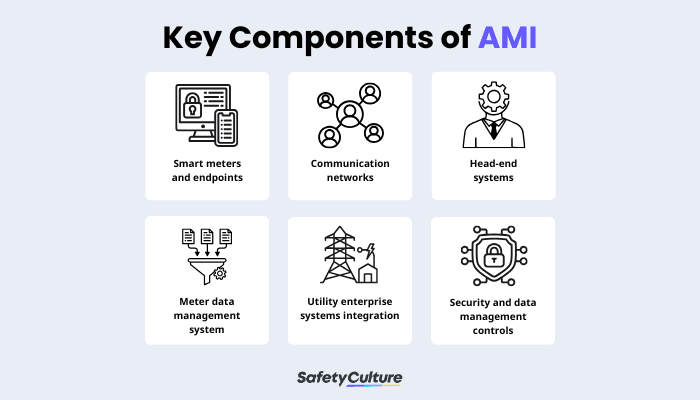
While AMI systems may seem complex, understanding their key components is a great way to maximize the benefits they offer. It is important to note that certain AMI systems may have different features from others depending on the needs of the area. However, most systems will have the following key components in them to maintain functionality:
Smart meters measure utility usage (electricity, water, or gas) at frequent intervals and record detailed consumption data. Unlike traditional meters, they support automated data collection and can enable remote functions such as connect/disconnect and tamper detection.
The communication network transfers data between smart meters and the utility, using technologies such as RF mesh, cellular, or fixed wireless systems. It enables reliable, secure, and often two-way data exchange for real-time monitoring and control.
The head-end system manages communication with a large volume of meters, collecting raw meter data and monitoring device status. It also handles commands sent from the utility to meters, such as firmware updates or service actions.
This data management system validates, stores, and processes large volumes of meter data before it is used for billing, analytics, or reporting. It ensures data accuracy and integrates meter information with other utility systems.
AMI connects with billing, outage management, customer information, and asset management systems. This integration allows meter data to support operations, customer services, planning, and regulatory reporting.
Security components protect meter data and communications through encryption, authentication, and access controls. These measures help ensure data privacy, system integrity, and compliance with industry regulations.
AMI software and data analytics transform raw meter data into actionable insights for utilities. These platforms support real-time visibility, operational optimization, regulatory reporting, and data-driven decision-making across the utility enterprise. Here is how these systems accomplish that.
Head-end systems manage communication with smart meters, collecting usage data and sending commands such as configuration updates or remote service actions. Meter Data Management Systems (MDMS) validate, store, and process this data, ensuring accuracy before it is used for billing, analytics, and reporting. Together, they form the core data backbone of an AMI deployment.
AMI platforms can integrate with IoT sensors to monitor pressure, flow, voltage, temperature, and other asset conditions in near real time. When connected to utility asset management systems, this data supports predictive maintenance, faster fault detection, and improved lifecycle management. The result is better system reliability and reduced unplanned downtime.
AMI systems require strong cybersecurity controls to protect sensitive customer and operational data. Encryption, authentication, role-based access, and continuous monitoring help prevent unauthorized access and data breaches. Privacy protections and compliance with regulations are also critical to maintaining customer trust and regulatory alignment.
SafetyCulture is a mobile-first operations platform adopted across industries such as manufacturing, mining, construction, retail, and hospitality. It’s designed to equip leaders and working teams with the knowledge and tools to do their best work—to the safest and highest standard.
Streamline processes, eliminate bottlenecks, enhance resource utilization, and build an agile and scalable infrastructure with SafetyCulture. Strive for operational excellence to boost competitive advantage, foster sustainable growth, and deliver long-term value.
✓ Save time and reduce costs
✓ Stay on top of risks and incidents
✓ Boost productivity and efficiency
✓ Enhance communication and collaboration
✓ Discover improvement opportunities
✓ Make data-driven business decisions