Soap Manufacturing
Learn what soap manufacturing is, how it works, and best practices to improve the process within the team.
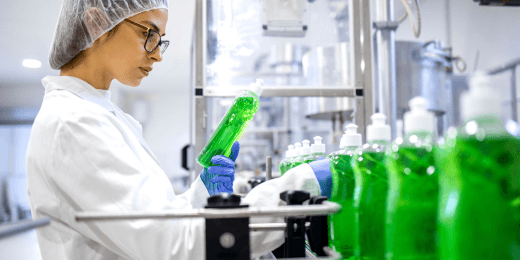
Learn what soap manufacturing is, how it works, and best practices to improve the process within the team.
Published 28 Apr 2026
Article by
7 min read
Soap manufacturing is the process of converting fats and oils into soap through chemical reactions like saponification. It involves blending raw materials, heating and mixing them, then refining the mixture to get the desired texture, scent, and cleaning properties. The final product is molded, cured, and packaged for consumer or industrial use.
Soap manufacturers use different processes to produce their products. Each process has its advantages and drawbacks, and teams must select one that works best for their goals. Here are some of the main methods that soap manufacturers use.
The full-boiled process is a traditional industrial method where fats and alkali are boiled in large kettles for extended periods. The mixture undergoes repeated washing and salting out, which separates pure soap from impurities and excess water. This creates a high-quality, uniform soap base that’s ready for finishing and fragrance blending.
The continuous process uses automated reactors that keep temperature, mixing, and chemical balance steady, so saponification can proceed without interruption. Oils, alkali, and additives flow through the system in a controlled stream, producing consistent soap with far greater efficiency than batch methods. This approach is common in large factories because it reduces labor, energy use, and production time.
The semi-boiled process partially heats the mixture of fats and alkali, allowing saponification to occur without a full boil. It requires less time and equipment than full-boiled methods while still producing a stable, uniform soap. The soap is poured into molds to finish curing and results in a smoother texture and quicker turnaround.
Certain raw materials are staples in soap production, though many companies adjust their recipes to create unique products. That said, it’s important for teams to find reliable sources of high-quality raw materials to protect the quality of the finished soap.
Fats and oils are the primary raw materials that react with alkalis to form soap through saponification. They can come from animal sources like tallow or vegetable sources like coconut, palm, and olive oils. The type and blend of oils influence hardness, lather, and moisturizing properties.
Alkalis like sodium hydroxide for bar soap or potassium hydroxide for liquid soap trigger the chemical reaction that converts fats and oils into soap. Their purity and concentration directly affect the consistency and safety of the finished product. Proper handling and accurate measurement help ensure complete saponification and avoid leftover caustic material.
Additives improve the soap’s appearance, performance, or fragrance. They may include colorants, essential oils, exfoliants, or preservatives. These ingredients are typically added after the main saponification reaction to preserve their properties. Manufacturers use additives to differentiate products and meet specific needs, such as moisture retention or antibacterial effects.
Water dissolves the alkali to create the lye solution that starts saponification. It also helps control viscosity and blend all ingredients evenly. Some formulations use additional solvents, such as alcohol or glycerin, to adjust texture, transparency, or curing time.
On top of high-quality raw materials, teams need the right equipment for the job. The scale and type of equipment can vary by production size, but some tools remain staples across most operations. These include the following:
A saponification kettle or reactor is the main vessel where fats and alkalis are mixed and heated to trigger the soap-forming reaction. These tanks are designed to handle high temperatures and chemical exposure. Their capacity and automation level determine how efficiently large batches or continuous flows of soap can be produced.
Mixers and agitators ensure that oils, alkalis, water, and additives blend evenly. Stable agitation prevents separation and helps maintain the correct reaction conditions throughout the batch. Industrial soap manufacturers rely on variable-speed systems to control texture, reaction rate, and product quality.
Drying equipment removes excess water from the soap base, turning it into a stable, solid form suitable for further processing. Vacuum spray dryers or drum dryers are often used in large-scale operations because they help achieve a uniform moisture level. Without proper drying, the soap may be too soft, sticky, or unstable for molding.
A soap plodder, also called an extruder, compresses and refines dried soap into a homogeneous, smooth mass. It pushes the soap through a die to form bars or noodles for stamping. This step improves texture, density, and appearance.
Molds shape liquid or semi-solid soap into bars, while stamping machines imprint logos, weights, or brand marks. These tools give the final product its distinctive shape and professional presentation. High-volume manufacturers use automated molds and presses to maintain speed and uniformity.
While the exact details of the process differ from company to company, most teams follow similar steps in finishing and packaging soap. Below are things that teams can expect during this stage of production:
Milling and refining – The dried soap base is blended and refined through rollers or plodders to improve texture, smoothness, and consistency.
Extrusion and cutting – The refined soap is extruded into continuous bars and cut into uniform pieces.
Stamping and shaping – Each bar is pressed with molds or stamping machines for its final shape, size, and branding.
Quality inspection – Finished bars are checked for weight, hardness, appearance, and defects.
Packaging and labeling – Soap bars are wrapped, boxed, or sealed, labeled with product information, and prepared for shipment.
Harness frontline insights, digital workflows, and seamless communication to boost efficiency and productivity across all manufacturing sites.
Soap manufacturing comes with several challenges that teams must prepare for early. These can include production roadbumps, manpower issues, and process controls. Understanding and preparing for the following challenges helps keep the process as smooth as possible:
Getting uniform texture, hardness, and appearance across batches can be difficult because slight variations in temperature, ingredient purity, or mixing can affect the final product. Teams must carefully monitor reaction conditions to prevent defects like soft bars, uneven coloring, or incomplete saponification. Continuous quality testing adds time and cost but is essential for product reliability.
Fats, oils, and additives can vary by source, season, or supplier. These differences can impact how they behave during saponification and affect product performance. Manufacturers often adjust formulations and processing parameters regularly to maintain consistent results.
Soap manufacturing involves caustic alkalis, high temperatures, and chemical additives—all of which pose safety risks. Teams need strong safety protocols, equipment maintenance, and worker training to prevent accidents. They also need to follow regulatory standards for labeling, ingredient disclosure, and product safety, which adds administrative and compliance challenges.
Build from scratch or choose from our collection of free, ready-to-download, and customizable templates.
Here are some best practices teams can apply to support smoother, more consistent soap production:
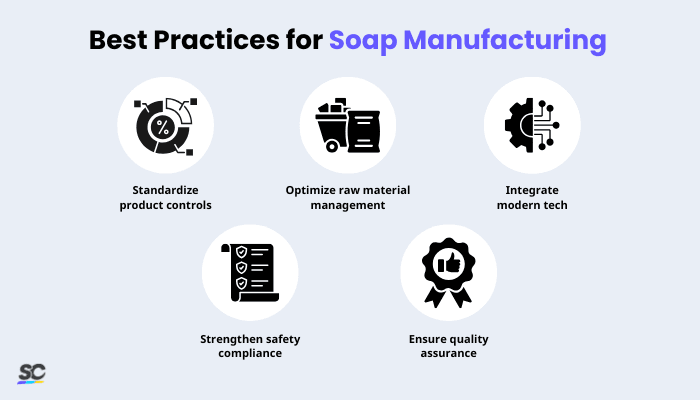
Best Practices for Soap Manufacturing
Using fixed formulations and precise controls helps ensure each batch of soap meets quality, texture, and performance expectations. Careful monitoring of temperature, mixing speeds, and ingredient ratios reduces defects. Documented procedures also make results easier to repeat.
Sourcing high-quality fats, oils, and additives and regularly testing their purity help limit variability. Building strong supplier relationships and maintaining proper storage conditions improve reliability and consistency.
Digital sensors, automated mixers, and real-time monitoring tools help control critical variables like temperature, moisture, and viscosity. These technologies reduce manual error and give teams clearer visibility into production throughput and performance.
Consistent safety training, proper handling of alkalis, and routine equipment inspections help reduce risks in the production environment. Clear labeling and documentation ensure products meet legal compliance requirements and help protect both workers and consumers.
Testing soap at different production stages helps teams catch issues before packaging. Standardized checkpoints and digital records improves traceability and accuracy, which reduces production delays and rework.
SafetyCulture is a mobile-first operations platform adopted across industries such as manufacturing, mining, construction, retail, and hospitality. It’s designed to equip leaders and working teams with the knowledge and tools to do their best work—to the safest and highest standard.
Streamline processes, eliminate bottlenecks, enhance resource utilization, and build an agile and scalable infrastructure with SafetyCulture. Strive for operational excellence to boost competitive advantage, foster sustainable growth, and deliver long-term value. ✓ Save time and reduce costs ✓ Stay on top of risks and incidents ✓ Boost productivity and efficiency ✓ Enhance communication and collaboration ✓ Discover improvement opportunities ✓ Make data-driven business decisions
In this article