Behind the Scenes: How Building Safety Inspectors Keep Buildings Safe
Discover how building safety inspectors help safeguard quality and compliance across every structure.
Discover how building safety inspectors help safeguard quality and compliance across every structure.
Published 5 May 2026
Article by
5 min read
A building safety inspector refers to someone whose job is to ensure safety compliance across different worksites or establishments. They review construction work to ensure it’s structurally secure and follows all necessary codes, specifications, and regulations.
Building safety inspectors not only ensure the worksites meet local and national building codes and regulations, but they also ensure that everyone in the building remains protected through thorough site inspection practices that identify and address potential hazards before they become risks. According to the US Bureau of Labor Statistics (BLS), their duties also include the following:
Evaluate and approve building plans that meet required standards.
Conduct periodic worksite visits to monitor and ensure overall compliance.
Administer diagnostic tests to detect problems like leaks, water damage, or faulty components.
Issue violation notices and stop-work directives when worksites fail to meet compliance standards.
Keep daily inspection records for future tracking and compliance.
Record findings, both results and observations, in writing.
These duties are often shared across different types of building safety inspectors, with each one focusing on a specific area of expertise to ensure full compliance and protection. These are some of the different types of building safety inspectors:
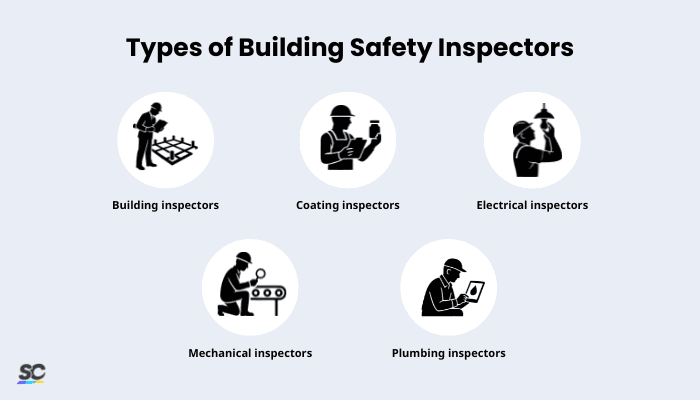
Building inspectors: Assess the structural quality, architectural requirements, and overall safety of buildings. This type of inspector may vary in specialty.
Coating inspectors: Check and ensure the exterior paint and coatings on bridges, pipelines, and large holding tanks are the proper protective layers and are thoroughly applied correctly.
Electrical inspectors: Examine a building’s electrical systems to ensure compliance and proper functioning. These often include new and existing systems that may require verification for safety and integration with other building components.
Mechanical inspectors: Assess Heating, Ventilation, Air Conditioning, and Refrigeration (HVACR) systems and equipment to ensure they're properly installed and function well in accordance with the electrical aspect of the building.
Plumbing inspectors: Oversee the installation of systems that ensure safe drinking water, proper industrial piping, and sanitary waste disposal.
Build from scratch or choose from our collection of free, ready-to-download, and customizable templates.
According to the International Code Council (ICC), building safety inspectors or “code officials” as they call them, are important in construction because they’re the ones responsible for protecting public health, safety, and welfare through:
ensuring the structure of each building is safe, hygienic, and overall habitable for anyone who enters;
preventing accidents and losses by promoting the proper enforcement of codes that help reduce these risks by catching errors very early on within the construction process;
promoting oversight by regularly reviewing building plans before, during, and after construction, as well as issuing permits, and conducting multiple inspections at key stages of the process to ensure they remain compliant; and finally,
providing guidance and interpretation of complex codes when builders or designers are uncertain about highly complex and technical requirements needed for the process to continue.
In the US, regulations and standards regarding building safety inspectors vary a bit since there’s no specific nationwide regulatory framework. Licensing and training requirements are set at the state or even local level. According to the US Congressional Research Service, buildings in the US are generally required to comply with the set of building codes specific to their region. This includes rules about materials used, structural and fire safety, plumbing and electrical systems, design, etc.
Most major states like California, New York, and Washington adopt versions of the International Building Code (IBC) and related codes, and just modify them according to the different needs of their specific regions. State and local inspectors then enforce these codes during construction and building maintenance.
When it comes to licensing or certification for building inspectors, requirements also differ by state. Some states require it, while others only require experience or on-the-job training. States like Texas, Missouri, and Kansas often require ICC certifications (Building Inspector, Plans Examiner, etc.), local civil service exams, and trade qualifications for inspectors employed by their municipalities.
In contrast, other states have comprehensive statewide certification programs to ensure inspectors meet uniform training standards, while a few states leave requirements largely up to individual cities or counties.
Ensure visibility over lone workers and manage their quality and safety with our digital solutions, built for and trusted by lone workers and leaders globally.
Building inspectors often work in isolated areas where hazards, such as falls, structural instability, confined spaces, or hazardous materials, are common. That’s why having dependable lone-working technology is critical, with features like the following:
Man-down system: Detects falls automatically and raises an alert if motion stops unexpectedly, helping responders act even if the inspector can’t.
SOS panic buttons: Trigger discreet help via Bluetooth panic buttons, raising a silent alarm without unlocking a phone and escalating to the right contacts.
Two-way audio or push-to-talk: Coordinate swift assistance via automated escalation calls/SMS.
24/7 location tracking: Supervise where inspectors are with live location tracking on a real‑time map to ensure constant coverage if emergencies happen.
Timed check-ins: Prompt quick responses with timed check‑ins and configurable thresholds that auto‑trigger a panic when a check‑in or job completion is missed.
Real-time documentation: Capture evidence in context by recording photos, notes, and hazards on mobile through inspections and reporting tools for a centralized repository.
SafetyCulture is a mobile-first operations platform adopted across industries such as manufacturing, mining, construction, retail, and hospitality. It’s designed to equip leaders and working teams with the knowledge and tools to do their best work—to the safest and highest standard.
Stay connected with your team and manage lone worker risks through location sharing and discreet panic alerts that can escalate to emergency services. Foster a culture of safety and transparency by enabling constant communication with lone workers, allowing them to perform tasks with configurable durations and check-ins.
Save time and reduce costs
Stay on top of risks and incidents
Boost productivity and efficiency
Enhance communication and collaboration
Discover improvement opportunities
Make data-driven business decisions