
Project Health Checks: Ensuring Project Success Through Evaluation
Explore this practical guide to project health checks, including key components and best practices that deliver successful outcomes.

Published 21 Nov 2025
Article by
7 min read
What is a Project Health Check?
A project health check is a structured, objective review conducted to see if a project is on track. It evaluates performance across critical areas, such as timelines, cost control, risk exposure, and stakeholder alignment. By identifying inefficiencies and their root causes and then implementing corrective actions, the project stays aligned with set goals and expectations.
Why is a Project Health Check Important?
Numerous research and industry reports show that as many as 70% of projects fail to meet their original objectives. Some frequently miss their planned timelines, while others exceed allocated budgets. While implementing a robust project management framework is essential, continuous oversight and review are required to guarantee the following outcomes:
Early detection of issues - Project reviews help identify potential problems before they escalate. Teams can effectively address emerging risks and challenges through regular assessment of the initiative's performance.
Improved stakeholder communication - Conducting these structured assessments facilitates transparent dialogue among all stakeholders. By providing objective updates on the project's status, teams can effectively manage expectations and foster trust.
Efficient resource optimization - Evaluating the effort helps identify areas where resources are underutilized or overextended. Managers can strategically plan and allocate funds, personnel, and equipment for maximum efficiency.
Maintained alignment with objectives - The performance review ensures that current tasks remain aligned with the project’s original strategic goals. This focus is crucial to guarantee the team’s delivery of the intended business value.
Continuous improvement - The project management health check allows teams to learn from past experiences and refine their processes. Implementing the identified best practices subsequently leads to better outcomes in future endeavors.
Achieve operational excellence
Cultivate a culture of excellence with our digital solutions that enhance efficiency, agility, and continuous improvement across all operations.
What are the Key Components of a Project Health Check?
A project portfolio health check provides leaders with a clear snapshot of a project's performance. Managers can better monitor and uncover blind spots if they know where to start looking.
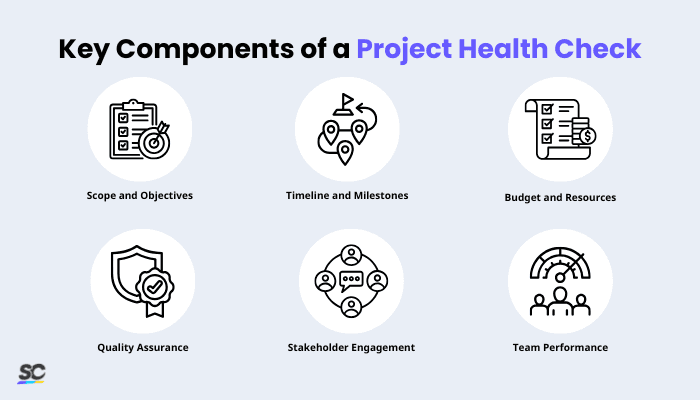
Key Components of a Project Health Check
Scope and objectives
This component in the business health check defines what the project is expected to deliver and the specific outcomes it should achieve. By assessing the scope, workers at every organizational level can remain focused, prevent unnecessary workload, and minimize delays.
Timeline and milestones
A healthy project schedule reflects smooth progress. Reviewing the timeline enables managers to proactively identify scheduling risks, ineffective resource allocation, and misaligned priorities that could lead to delays, bottlenecks, or unmanaged dependencies.
Budget and resources
Budget overruns and resource shortages are major project risks. By carefully reviewing the financial status and evaluating resource allocation, teams can complete tasks efficiently while controlling costs.
Quality assurance
High-quality outputs strengthen the project's credibility. Meticulously conducting quality assurance tests prevents costly revisions, customer dissatisfaction, and expensive regulatory issues. This also embeds the concept of continuous improvement in the company’s culture, ensuring all future projects meet or exceed expectations.
Stakeholder engagement
Stakeholders should be informed, involved, and aligned with the project's goals and progress. Overlooking this often results in resistance, conflicting expectations, and delayed approvals. These can derail even the most well-executed projects.
Team performance
A high-performing team is the backbone of a project's success. By evaluating team productivity, skill alignment, workload distribution, morale, communication, and collaboration, the company can resolve issues that could affect output, quality, delivery, and overall project stability.
Create your own Business Health Check template
Build from scratch or choose from our collection of free, ready-to-download, and customizable templates.
What Tools or Methodologies are Used for Project Health Checks?
A project health check is only as strong as the tools and methods behind it. Using structured frameworks during the health check turns inspection reports into actionable insights that help leaders make adjustments or take corrective actions. Here are the answers to one of the most pressing project health check questions companies have:
Standardized checklist and templates - Predefined forms, questionnaires, and assessment guides help teams consistently evaluate the different elements mentioned above. This is the most common tool used to cross industries, from healthcare to retail.
Kepner-Tregoe analytical method - This structured decision-making and problem-solving methodology analyzes root causes to evaluate risks and select the best corrective action. KT worksheets are valuable in fast-paced production environments.
PMBOK Guide - A globally recognized framework from the Project Management Institute (PMI), this compares actual progress to baselines or best practices. This provides structured oversight for large, complex projects, such as those in construction.
Balanced scorecard -This strategic performance tool evaluates projects from four angles: financial performance, customer impact, internal processes, and organizational learning. This is often used in retail, where several factors (e.g., customer satisfaction, staff efficiency, revenue impact) work together.
Independent audits or reviews - A third-party evaluator or expert can help assess performance and verify documentation objectively. This is very helpful in finance and banking, where independent reviews are crucial in maintaining transparency with diverse stakeholders.
Project management software and dashboards - Digital tools are used to track schedules, budgets, risks, workflows, and team performance in real time. Data can be logged in one minute and then analyzed and visualized in the next, helping managers make the right decision at a particular time.
How Do You Conduct a Project Health Check?
Projects don't just fail because of poor initial concepts. Failures occur due to unnoticed issues that compound and escalate over time. Preventing this requires the careful implementation of this simple-to-follow project health check process:
Step 1: Define scope and objectives.
Clarify what the health check will cover (e.g., budget, timeline, risks, etc.) and set specific goals for the review. As aforementioned, this ensures focus because all parties agree on what "project health" means.
Step 2: Collect data thoroughly.
Accurate, complete data is the backbone of any reliable assessment. Gather all relevant information to gain a realistic look at the project and prevent surprises later. Crucial information can be taken from these sources:
Reports
Schedules
Key performance indicators
Risk logs
Financial data
Minutes of the meetings
Stakeholder feedback
Step 3: Involve key stakeholders.
Project sponsors, team leads, customers, and vendors often see issues that reports don't reveal. Their involvement increases transparency that builds trust and ensures that the health check reflects operational realities rather than assumptions. Capture their opinions through these channels:
Meetings
Surveys
Interviews
Step 4: Analyze findings and identify gaps.
By recognizing patterns in performance and risk data, managers can pinpoint the root cause of project issues rather than just treating the symptoms. This systematic approach prevents issues from worsening by clarifying the internal advantages and limitations of the project while simultaneously highlighting external opportunities and threats, which aids faster and more accurate decision-making.
Step 5: Present clear recommendations.
The outcome of this project deep dive must not be merely a report filed and forgotten. It must serve as the basis for actionable recommendations, enabling leadership to strategically allocate the resources necessary for effective corrective action or the continuation of targeted improvements.
Step 6: Implement improvements.
Leaders must take immediate and necessary action on the recommendations. Tracking the progress of these actions is crucial, not just in ensuring accountability but also in preventing the recurrence of identified problems. These are some specific examples of what needs to be done:
Targeted resource allocation
Strengthened stakeholder engagement
Enhanced project management training
Step 7: Schedule regular follow-ups.
It is easier to ascertain that initiatives remain on track until completion with ongoing oversight. Conducting periodic reviews helps track progress, validate the effectiveness of corrective actions, and continuously re-evaluate risks.
Conduct Efficient Project Health Checks with SafetyCulture
Why use SafetyCulture?
SafetyCulture is a mobile-first operations platform adopted across industries such as manufacturing, mining, construction, retail, and hospitality. It’s designed to equip leaders and working teams with the knowledge and tools to do their best work—to the safest and highest standard.
Streamline project health checks by enabling consistent data collection from multiple stakeholders, tracking project metrics, identifying risks, and facilitating collaborative corrective actions. Conduct project health checks through customizable digital inspection templates, real-time issue tracking, and comprehensive reporting. Monitor project health parameters, promote accountability, and implement corrective actions swiftly using a unified platform.
✓ Save time and reduce costs
✓ Stay on top of risks and incidents
✓ Boost productivity and efficiency
✓ Enhance communication and collaboration
✓ Discover improvement opportunities
✓ Make data-driven business decisions
FAQs About Project Health Checks
In this article
- What is a Project Health Check?
- Why is a Project Health Check Important?
- What are the Key Components of a Project Health Check?
- What Tools or Methodologies are Used for Project Health Checks?
- How Do You Conduct a Project Health Check?
- Conduct Efficient Project Health Checks with SafetyCulture
- FAQs About Project Health Checks
Related articles
Operations
Business Processes

Mastering Workflow Orchestration for Operational Excellence
Learn everything about workflow orchestration, its benefits, common tools, and best practices for efficient enterprise process management.
Operations
Performance Evaluation

Conducting Business Health Checks for Long-Term Success
Learn what a business check is, its benefits, and how to conduct one effectively. Discover key components and relevant laws for your region.
Operations
Business Processes

Implementing Value Management for Better Business Outcomes
Explore value management, its principles, benefits, and helpful strategies to drive peak performance and cost-efficiency.