Published 21 Nov 2025
Article by
6 min read
What is an Organizational Health Checklist?
An organizational health checklist is a structured tool designed to evaluate a company’s overall wellness, performance, and functionality. By systematically reviewing key areas, organizations can gain a clear understanding of their internal strengths and weaknesses. This serves as a diagnostic framework for identifying patterns and implementing targeted improvements for long-term sustainability and productivity.
Importance of an Organizational Health Assessment
An organizational health checklist lays the foundation for sustainable growth by embedding health and performance monitoring into everyday business practice. Here are the benefits of implementing this in your organization:
Enhances employee engagement and retention
By assessing factors like leadership effectiveness, workplace culture, and employee voice, the organizational health assessment tool helps uncover engagement issues before they escalate. Higher engagement is directly linked to better organizational outcomes, including lower turnover and higher performance.This is particularly relevant in sectors like retail or healthcare, where attrition costs can be high and employee morale directly impacts customer or patient experience.
Improves operational efficiency and productivity
A comprehensive checklist enables mid-level managers to identify friction points in process workflows, leadership bottlenecks, or cultural obstacles that slow down production or service delivery. According to official productivity data from the US Bureau of Labor Statistics (BLS), labor productivity in the non-farm business sector increased by 3.3% in Q2 2025, underscoring the importance of efficiency metrics. By embedding this into an organizational health checklist, managers in manufacturing or corporate services can more proactively pinpoint areas where resource usage, staffing alignment, or process redesign are required.
Facilitates stronger compliance adherence and risk management
By including dedicated checkpoints for compliance, regulatory frameworks, safety parameters, and risk controls, an organizational health survey ensures that business continuity, safety managers, and compliance leads capture weaknesses before they turn into incidents. Promoting a positive compliance culture is shown to enhance reputation and reduce remediation costs.In high-risk industries like healthcare or manufacturing, such early detection of compliance gaps can make the difference between smooth operations and regulatory fines or shutdowns.
Fosters a healthier workplace culture and leadership alignment
The organizational health survey’s focus on leadership effectiveness, culture, and employee-manager relationships promotes alignment between frontline teams and departmental heads or business continuity functions. Studies show that organizational culture positively correlates with performance outcomes and operational vitality. For mid-level managers, this translates into clearer strategic alignment, fewer cultural blind spots, and a stronger foundation for sustainable business health.
Enables data-driven decision-making and continuous improvement
Because the organizational health checklist provides a structured and repeatable framework, it enables managers to collect data over time, compare key areas, and track improvements. This structure supports a culture of accountability, allowing organizations to prioritize investments based on evidence rather than intuition. Ultimately, by identifying both strengths and weaknesses in one place, managers can allocate resources more strategically and ensure the long-term health of the business.
What Should Be Included in an Organizational Health Checklist?
An effective organizational health assessment covers key components that shape a company’s overall well-being and performance. Understanding the following key areas helps ensure your checklist delivers meaningful insights and measurable outcomes:
Workplace culture
Operational efficiency
Leadership effectiveness
Employee engagement
Risk management
Sample Organizational Health Assessment Report
Check this example for a clear overview of how assessment results are summarized and visualized in a structured PDF report format. It highlights key metrics, insights, and action areas that help organizations evaluate performance, track progress, and drive continuous improvement across various operational pillars.
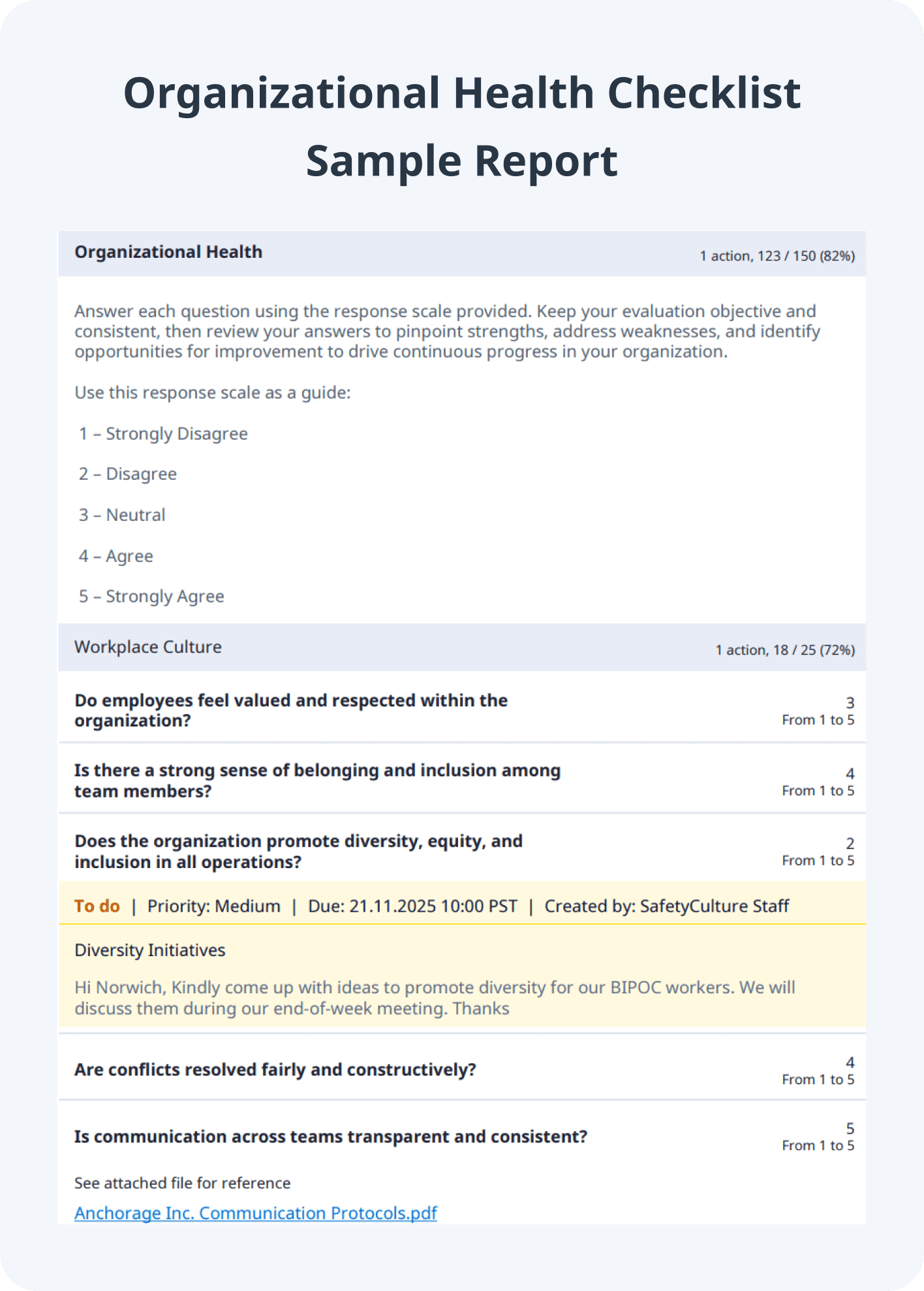
Preview Organizational Health PDF Report
How to Create an Organizational Health Checklist
More than just a measurement tool, an organizational health assessment acts as a continuous improvement guide, promoting accountability and strategic alignment throughout all levels of an organization. Here’s a guide that you can use to put together this effective document:
1. Define your purpose and scope.
Clarify why you’re building the organizational health checklist. Your goal can range from improving retention to reducing safety incidents. Decide whether it will be organization-wide or tailored by site, department, or region. A crisp scope prevents bloat and keeps the checklist decision-ready.
2. Choose core pillars and outcomes.
Include these essential pillars to map to your goals: Workplace Culture, Operational Efficiency, Leadership Effectiveness, Employee Engagement, Compliance Adherence, and Risk Management. For each pillar, write a straightforward outcome statement such as “Decision-making is data-driven and inclusive.” This ensures every item ties back to a measurable business result.
3. Set a scoring model and thresholds.
Consider using a simple scale such as 0–4 or 1–5. Then, establish clear anchors (e.g., 1 – Strongly Disagree, 3 – Neutral, 5 – Strongly Agree). Consistent scoring turns subjective observations into comparable metrics across teams and periods.
4. Draft high-impact checklist items.
Create concise questions per pillar that test behaviors and systems, not opinions. Examples of question items include the following:
Culture: “Employees feel valued and respected within the organization.”
Operational Efficiency: “The organization adapts quickly to market or internal changes.”
Leadership: “Leaders demonstrate integrity and accountability in their decisions.”
Write each item so a neutral reviewer could answer it by observing evidence. Lastly, enable the reviewer to attach proof to substantiate the responses.
5. Involve cross-functional reviewers early.
Pilot draft items with representatives from operations, Human Resources (HR), compliance, safety, risk, quality, and finance. Ask:
“Is this observable?”
“Is the wording unambiguous?”
“What evidence proves this?”
Early feedback boosts adoption and reduces back-and-forth later.
6. Build the assessment cadence and roles.
Set a realistic rhythm: monthly pulse (10–15 min), quarterly deep dive, and annual full review. Assign an owner for each pillar and a coordinator to compile results. Publish a calendar so teams can prepare data in advance and avoid checklist fatigue.
7. Create a simple scoring sheet and roll-up view.
Use a one-page template for checklist items, 1–5 scores, evidence links, comments, and next actions. Roll up scores by pillar, site, and department to produce an organizational health index. Heatmaps and trend lines help leaders spot systemic versus local issues fast.
8. Train assessors and calibrate scoring.
Run short calibration sessions where multiple assessors score the same scenario, then reconcile differences. Share scoring examples (e.g., what a “2” vs. “4” looks like) to tighten consistency. Recalibrate quarterly as the organizational health checklist evolves.
9. Integrate with audits, risk registers, and OKRs.
Map each checklist pillar to existing audits, risk controls, and team Objectives and Key Results (OKRs) to avoid duplicate work. When a gap appears, open a corrective action, assign ownership, and track closure in your usual system. This turns the checklist from a one-off review into a living management practice.
NRS Healthcare used SafetyCulture for regular log of audits across a range of activities and equipment, which impressed an NHS commissioning group as part of an external audit of the business. NRS Healthcare was awarded a perfect 100% score as part of the audit for the first time in its history.