
Phishing Attacks: How to Spot Them and Mitigate Them
Learn what phishing attacks are, how they impact organizations, and different ways to prevent these attacks from impacting your team.

Published 21 Nov 2025
Article by
7 min read
What is a Phishing Attack?
A phishing attack is a type of cybercrime where attackers trick individuals into revealing sensitive information such as passwords, credit card numbers, or personal data by pretending to be a trustworthy source. These attacks often occur through deceptive emails, fake websites, or text messages that appear legitimate. The goal is to steal information or gain unauthorized access to systems for financial or malicious purposes.
Impact
Phishing attacks pose a major threat to organizations by undermining their cybersecurity defenses and exploiting human error. When employees unknowingly click on malicious links or share confidential information, attackers can gain access to internal networks, compromise sensitive data, and disrupt operations. The financial costs of these breaches can be significant, often including expenses for data recovery,building security, legal actions, and system restoration.
Aside from financial loss, phishing attacks can severely damage an organization’s reputation and erode customer trust. Clients may become hesitant to share information or conduct business with a company known for weak security practices. In some cases, recurring, unmanaged attacks can even lead to regulatory fines and stricter compliance requirements, further straining resources and operational efficiency.
Improve your GRC management
Simplify risk management and compliance with our centralized platform, designed to integrate and automate processes for optimal governance.
Common Types of Phishing Attacks
One of the dangers of phishing attacks is that they can come in many forms, often fooling individuals. It’s essential to understand the various types of attacks and develop defenses against them. Here are the most common types of phishing attacks:
Email phishing
Email phishing is the most common type of phishing attack, where cybercriminals send fake emails that appear to come from legitimate organizations. It happens to both businesses and individuals, hence why this type of attack is so common. These emails often contain malicious links or attachments that steal login credentials or install malware. In email phishing attacks, attackers rely on creating urgency or fear to trick recipients into responding quickly without verifying the sender.
Spear phishing
In spear phishing, attackers research their targets thoroughly to craft personalized messages that appear trustworthy and relevant. This is a targeted form of phishing aimed at specific individuals or organizations.Because these emails are highly customized, they are more convincing and harder for traditional security filters to detect.
Business Email Compromise (BEC)
BEC attacks involve hackers impersonating executives, vendors, or trusted partners to trick employees into transferring funds or sharing confidential information. These messages often mimic legitimate business communications and rely on social engineering rather than malware. Organizations are particularly vulnerable when approval processes or verification steps are weak.
Vishing
Vishing uses phone calls instead of emails to deceive victims into providing sensitive information. Attackers often pose as bank officials, IT staff, or government agents to create a sense of legitimacy. These scams exploit human trust and urgency, making verbal deception a powerful social engineering tool.
Smishing
In smishing, promotional messages containing malicious links or phone numbers are sent to unsuspecting users via text. There’s often a sense of urgency tied into these messages, prompting sudden clicks and sharing of data. When users click these links or call the number, attackers can steal their credentials, install malware, or harvest personal data.
Quishing
Quishing uses QR codes as the phishing delivery method, often disguised in posters, emails, or documents. When scanned, the QR code directs victims to fraudulent websites designed to steal login information or payment details. This method exploits users’ growing trust in QR technology and bypasses traditional email filters.
Multichannel phishing
Multichannel phishing coordinates attacks across two or more communication methods, such as email, SMS, voice calls, and social media, to increase credibility and pressure the victim. Attackers may begin with a harmless message on one channel and follow up on another to build trust and bypass single-channel protections. Because the attack spans multiple trusted touchpoints, it is harder to detect and more likely to succeed against organizations that rely on single-layer defenses.
Key Challenges in Phishing Prevention and Mitigation
The amount of phishing attacks has been on the rise in the past couple of years, and many organizations struggle to combat them. This is because there are many challenges to fighting phishing attacks, especially as the attacks become more complicated. Below are some of the key challenges companies can face when building defenses against phishing:
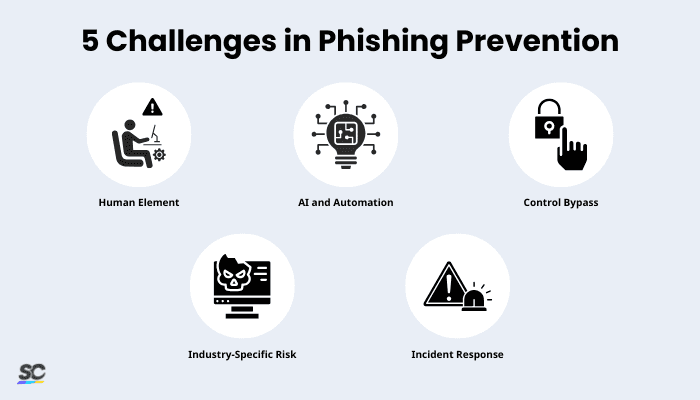
5 Challenges in Phishing Prevention
Human element
People make decisions quickly when under pressure, which attackers exploit by crafting urgent or emotionally charged messages. Even well-trained employees can fall for convincing scams when distracted or fatigued. Reducing this risk requires ongoing training, realistic simulations, and a culture that encourages verification without blame.
AI and automation
AI and automation let attackers scale phishing campaigns and create highly personalized messages using scraped data. Deepfake audio and synthetic text make impersonation more convincing and harder to detect. Defending against this requires advanced detection tools and continuous updating of training and detection rules.
Bypassing technical controls
Phishing techniques often evolve to circumvent email filters, security gateways, and URL reputational checks. Attackers use tactics like compromised legitimate accounts, encrypted channels, or multifaceted delivery to slip past controls. Effective defense combines layered technical controls with human review and threat intelligence.
Industry-specific risk
Different sectors face tailored threats because attackers target the valuable data and processes unique to each industry. For example, the healthcare industry holds sensitive patient records, while the finance industry and retail industry handle large fund transfers, making them high-value targets. Organizations must adopt controls and training that reflect their sector's unique threat landscape and compliance requirements.
Incident response
Phishing incidents require fast detection, containment, and coordinated communication to limit damage. Many organizations struggle with unclear roles, slow decision-making, or inadequate logging that hampers investigations. Building playbooks, running tabletop exercises, and automating evidence collection improve readiness and recovery.
How to Combat Phishing Attacks
Fighting phishing attacks and protecting employee and company data requires a multi-faceted approach. This ensures that teams cover the attacks from all bases. Here’s a list of efforts companies can implement to protect their team and data against dangerous phishing attacks:
Provide awareness training
Awareness training educates employees on how to recognize phishing attempts and respond safely. It focuses on identifying red flags such as suspicious links, unusual requests, and unexpected attachments. Consistent, updated training, especially with the help of mobile-friendly modules, helps build a vigilant workforce that acts as the first line of defense against phishing threats.
Conduct simulated exercises
Simulated phishing exercises test employees’ ability to detect and report fake phishing messages in a controlled environment. These simulations help identify weaknesses in awareness and measure the effectiveness of training programs. Over time, they reinforce good habits and reduce the likelihood of real-world compromises.
Do regular audits
Regular risk assessment and management audits evaluate how well an organization’s security measures and policies protect against phishing attacks. They help uncover outdated procedures, configuration gaps, or unmonitored communication channels. Conducting these reviews ensures that phishing defenses evolve alongside emerging attack techniques.
Establish clear reporting procedures for suspicious emails
Clear reporting procedures allow employees to quickly escalate suspicious messages without fear of blame or confusion. Having a defined process enables faster detection, containment, and threat analysis by the security team. It also promotes a culture of accountability and proactive cybersecurity awareness.
Implement Multi-Factor Authentication (MFA)
Utilizing MFA adds an extra layer of security by requiring additional verification beyond a password. Even if attackers steal credentials through phishing, MFA helps prevent unauthorized account access. This simple yet powerful control significantly reduces the success rate of phishing-related breaches.
Enhance Phishing Attack Defenses with SafetyCulture
Why Use SafetyCulture?
SafetyCulture is a mobile-first operations platform adopted across industries such as manufacturing, mining, construction, retail, and hospitality. It’s designed to equip leaders and working teams with the knowledge and tools to do their best work—to the safest and highest standard.
Promote a culture of accountability and transparency within your organization where every member takes ownership of their actions. Align governance practices, enhance risk management protocols, and ensure compliance with legal requirements and internal policies by streamlining and standardizing workflows through a unified platform.
✓ Save time and reduce costs ✓ Stay on top of risks and incidents ✓ Boost productivity and efficiency ✓ Enhance communication and collaboration ✓ Discover improvement opportunities ✓ Make data-driven business decisions
Related articles
Security
Information Technology

Cybersecurity Risk Assessment: The Ultimate Guide
Learn how cybersecurity risk assessments identify threats, address risks, and protect operations through structured risk management.
Information Technology
Security

A Guide to Global Data Privacy Day
Learn more about Data Privacy Day and the activities to celebrate it to ensure a more privacy-centric and efficient workplace.
Security
Information Technology

A Guide to Ensuring Cybersecurity for Manufacturing Organizations
A deep dive into what cybersecurity for manufacturing is, its importance, and the different ways for teams to enhance their cybersecurity framework.