Parking Lot Safety: How to Avoid Costly Accidents
Find out why parking lot safety is crucial and how hazards can be mitigated, particularly in crowded retail spaces such as shopping malls or grocery stores.
Find out why parking lot safety is crucial and how hazards can be mitigated, particularly in crowded retail spaces such as shopping malls or grocery stores.
Published 28 Apr 2026
Article by
8 min read
Parking lot safety is the practice of ensuring that traffic regulations are followed, signage is clear, and both customers and employees are protected from unsafe driving. It also covers security measures, prevention of vehicle and pedestrian accidents, crime reduction, and maintaining an efficient layout with proper lighting and traffic flow. Due to the high volume of people and vehicles in shopping centers and grocery stores, parking lots are accident hotspots.
Parking lots play an important role in urban environments, providing people with easy access to shops and services while supporting businesses. Research shows that parking lots occupy around 35% of land in residential areas, but in urban cities, parking demand can consume between half to over two-thirds of the land space.
However, if parking spaces are unorganized, poorly managed, or unsafe, businesses will suffer. Customers expect to find parking quickly, and they don’t want to worry about whether their vehicle is secure or if exiting the lot will be difficult. That’s why strong site facility management is essential for every retail or parking lot manager.
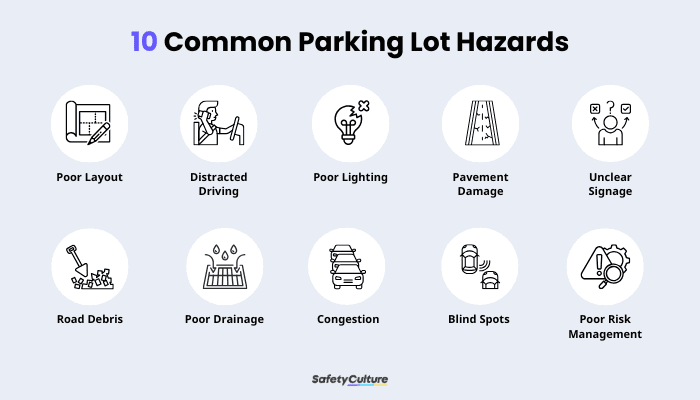
10 Common Parking Lot Hazards
With so many moving vehicles, parked cars, pedestrians, changing weather, signs, and careless drivers, a lot can go wrong in a parking lot. That’s why regular maintenance, compliance with government regulations, and effective management—supported by a parking lot safety checklist —are key to preventing parking lot hazards.
Here are the key parking lot safety hazards to be aware of and tips to resolve them:
Design parking lots with enough space for both vehicles and pedestrian walkways. The design should allow for smooth traffic flow during busy hours, with clearly marked entrances and exits to avoid confusion.
More than 50,000 crashes occur in parking lots every year because drivers are looking at their phones instead of the road. Install barriers, speed bumps, and one-way traffic lanes to keep everyone alert and protected.
Maintain proper lighting by replacing broken or flickering bulbs and add light to dark corners for better visibility. Well-lit areas help prevent accidents and deter criminal activity.
Repair cracks, potholes, and broken curbs to keep pathways safe. Ensure pedestrian walkways are clear and spacious, and repaint faded markings or signs to reduce the risk of collisions.
Keep traffic signs clear and visible for both drivers and pedestrians. Add missing signs or remove unclear ones to guide traffic flow, prevent congestion, and improve safety.
Remove hazards such as fallen branches, dangling wires, or abandoned vehicles to keep pathways clear. In retail areas, provide cart corrals to prevent loose shopping carts from blocking traffic.
Ensure proper drainage system maintenance to keep roads clear of flooding, broken pipes and leaks, and standing water. Provide easy access to running water in case of emergency.
Provide sufficient parking spaces and implement an efficient turnover system, such as tiered hourly rates, to reduce peak-time crowding and prevent customer complaints.
Reduce blind spot accidents by installing parking lot safety mirrors or convex mirrors, along with speed bumps to slow drivers down. Install CCTV cameras to monitor activity and strengthen security in case of incidents.
Deter theft and criminal behavior by employing security personnel and installing CCTV. Strengthen risk management and emergency preparedness with first aid kits and regular staff training.
Manage assets, schedule repairs, and maintain parking environments effortlessly across all locations.
Parking lot rules and regulations must be followed to avoid fines or non-compliance reports for the landowner or shopping center. Parking lot safety requirements vary by country, each with its own standards. Below is a quick list of regulations that retail parking lots should adhere to:
Occupational Safety and Health Administration (OSHA) 1910 Subpart N focuses on “Materials Handling and Storage,” covering requirements for the safe handling and storage of materials, including vehicle storage for fleets.
Any vehicles in a fleet yard are treated like “materials” that must be parked and stored safely. They must be kept free from hazards, which means safe storage, fueling, maintenance areas, driver training, daily vehicle inspections, and traffic management procedures must all be in place.
The Work Health and Safety (WHS) Regulations set requirements for managing workplace hazards and risks. A person conducting a business or undertaking (PCBU) is responsible for ensuring the safety of workers. Parking lots and fleet yards are considered part of the workplace and therefore fall under these standards.
PCBUs must identify hazards such as traffic flow, poor lighting, potholes, congestion, and safe ingress/egress, then implement corrective actions. They must also control traffic flows and ensure vehicles and pedestrians are moving safely within the site.
The Health and Safety Executive (HSE) in the UK provides guidance and regulations that apply to parking lots and vehicle storage. Parking areas must be clearly signposted, well-drained, and well-lit for the safety of both vehicles and pedestrians.
Parking layouts should be designed to minimise reversing wherever possible, as recommended in INDG199: Workplace Transport Safety, to reduce the risk of accidents. Additional safeguards include using barriers and bollards, securing vehicles parked on slopes with brakes, and eliminating blind spots through careful design.
The UK also operates the Safer Parking Scheme (Park Mark®), which recognises car parks that meet high standards of safety and security. Certified facilities receive a Park Mark® certificate and can display it on-site to show risk assessment and legal compliance.
In Canada, Occupational Health and Safety (OHS) rules vary by province or territory, but all include an Act and supporting regulations that define what employers and workers must do to prevent injuries and illnesses.
For vehicle storage and parking lot safety, the requirements are similar across jurisdictions, from using proper signage to meeting local building and fire codes. Some provinces also have additional clauses. For example, in Ontario, Regulation 851 (Industrial Establishments) requires safe aisles and adequate lighting.
Creating a safe parking space or vehicle storage area takes time and careful planning.
Here are some pain points when implementing parking lot safety:
Regular maintenance is necessary to prevent hazards, but managers often struggle to find time without disrupting business operations. A parking lot safety digital checklist can make inspections faster and more efficient.
Distracted drivers and pedestrians are unpredictable. No amount of signs or speed bumps can fully stop unsafe habits such as glancing at a phone or not wearing a seatbelt. Frequent reminders and clear rules help encourage safer behavior.
Weather is beyond control and can disrupt safety planning. Rain, snow, and heat cause wear and tear, such as potholes, cracks, and faded paint. Flooding also creates hazards if not addressed quickly. Scheduling preventive maintenance helps minimize risks.
Safety upgrades such as lighting, CCTV, mirrors, resurfacing, or automatic boom barriers require significant investment from property owners or management companies. Ongoing costs for inspections, staffing, and repairs may also be deprioritized.
Older lots may not support modern traffic flow or safety features. Limited space makes it difficult to add wider walkways, cart corrals, or extra signage without major redesigns or acquiring more land.
Property owners may not be fully aware of local codes, ADA requirements, or safety regulations. Missing compliance can lead to safety risks, liability issues, and fines.
With technological advancements, parking lot management has become simpler and more streamlined. Automatic boom gates eliminate the need for staffed ticket booths. Light sensors indicate whether a space is occupied, creating a smoother driver experience. CCTV systems with license plate recognition (LPR) track vehicles as they enter and exit, improving both security and efficiency.
When it comes to signage, many parking lots now use smart parking technology. Electronic displays connected to IoT sensors and AI provide real-time assistance by showing drivers how many spaces are available before they even enter. Lighting has also become more energy-efficient, with smart LED systems that adjust brightness as needed. In some cities like San Diego, smart sensing lights even help guide drivers by indicating free parking spaces.
Property managers and businesses often face roadblocks when implementing parking lot safety protocols, from paperwork and scheduling to compliance requirements. A Quality Management System (QMS) with digital checklists can help streamline the process and make safety implementation more manageable. These tools can also support audits, employee evaluations, and training to ensure standards are consistently met.
SafetyCulture is a mobile-first operations platform adopted across industries such as manufacturing, mining, construction, retail, and hospitality. It’s designed to equip leaders and working teams with the knowledge and tools to do their best work—to the safest and highest standard.
Efficiently manage and streamline health and safety processes across the organization, including incident management, safety audits and inspections, risk assessment, waste management, and more, using a comprehensive EHS software solution.
✓ Save time and reduce costs ✓ Stay on top of risks and incidents ✓ Boost productivity and efficiency ✓ Enhance communication and collaboration ✓ Discover improvement opportunities ✓ Make data-driven business decisions