Risk Management Checklist vs Risk Register
A risk management checklist is a procedural tool you run at a specific point in time to work through identification, assessment, and response in a structured sequence. A risk register is a living document that tracks all known risks over time using metrics like their status, ownership, and history.
Most organizations need both. The checklist drives the review; the register captures the outcomes. Findings from each checklist run should be fed back into your risk register to keep it current.
What to Include in a Risk Management Checklist
A good risk management checklist follows a logical sequence: identify what could go wrong, score the likelihood and impact, decide how to respond, and set up a review cycle. Here's what each step should capture.
Step 1: Risk identification
This is where you document every potential threat before deciding how serious it is. Each entry in your checklist should capture:
Risk description — What could go wrong and in what context
Risk category — Operational, financial, legal, reputational, safety, or compliance
Risk source — Internal process, third party, environmental, regulatory change, or human error
Affected area or asset — Which team, site, system, or resource is exposed
It’s important to collect different perspectives across teams during this stage. Risk identification is more accurate when it draws on past incidents, near misses, cross-department input, and frontline observations. The broader the input, the fewer gaps in your risk identification checklist.
Step 2: Risk assessment and prioritization
Once risks are identified, the checklist should help you score and rank them so you can focus resources where they matter most. Use a simple likelihood-impact matrix:
Rating | Likelihood | Impact |
1 | Rare | Negligible |
2 | Unlikely | Minor |
3 | Possible | Moderate |
4 | Likely | Major |
5 | Almost certain | Severe |
Multiply the likelihood score by the impact score to get a risk rating. Anything scoring 15 or above is a high priority. When resources are limited, start there — high-likelihood, high-impact risks cause the most damage if left unaddressed. A 5x5 risk matrix is a useful companion tool for visualizing this scoring at a glance.
For a deeper look at the methods behind risk scoring, the risk analysis process covers qualitative and quantitative approaches in detail.
Step 3: Risk response and controls
For each risk, your checklist should record the response strategy and who's responsible for it. The four standard options are:
Avoid — Change the plan or process to eliminate the risk entirely
Transfer — Shift the risk to a third party, typically through insurance or contractual terms
Reduce — Implement controls to lower the likelihood or impact
Accept — Acknowledge the risk and monitor it, usually when the cost of mitigation outweighs the exposure
Beyond the strategy, the checklist entry should include the assigned risk owner, specific mitigation actions, due dates, and an escalation path if the risk worsens. This is what separates a risk management checklist from a vague list of concerns.
Step 4: Monitoring and review
Risk management doesn't end when the checklist is completed. Build a review cadence into each entry:
High-priority risks to be reviewed quarterly
Medium-priority risks to be reviewed every six months
Low-priority risks to be reviewed annually at minimum
Each review should update the residual risk score and note whether the status is open, in progress, or closed. ISO 31000:2018, the international standard for risk management, treats continuous monitoring as a core principle of the process, not an optional step.
How to Use This Checklist Effectively
The checklist is a tool and it only works if the right people are using it at the right times. Here's what that looks like in practice:
Assign a risk owner for each item: Someone specific needs to be accountable for the response and the review.
Run a full checklist review at key trigger points: This is usually done before a new project kicks off, after a significant operational change, following an incident or near miss, or at each scheduled review interval.
Document your outputs: Completed checklists are evidence of due diligence. They're useful in audits, regulatory inspections, and insurance claims.
Treat the template as a starting point: No generic checklist covers every industry or context. The use-case variants below show how to adapt the structure for specific scenarios.
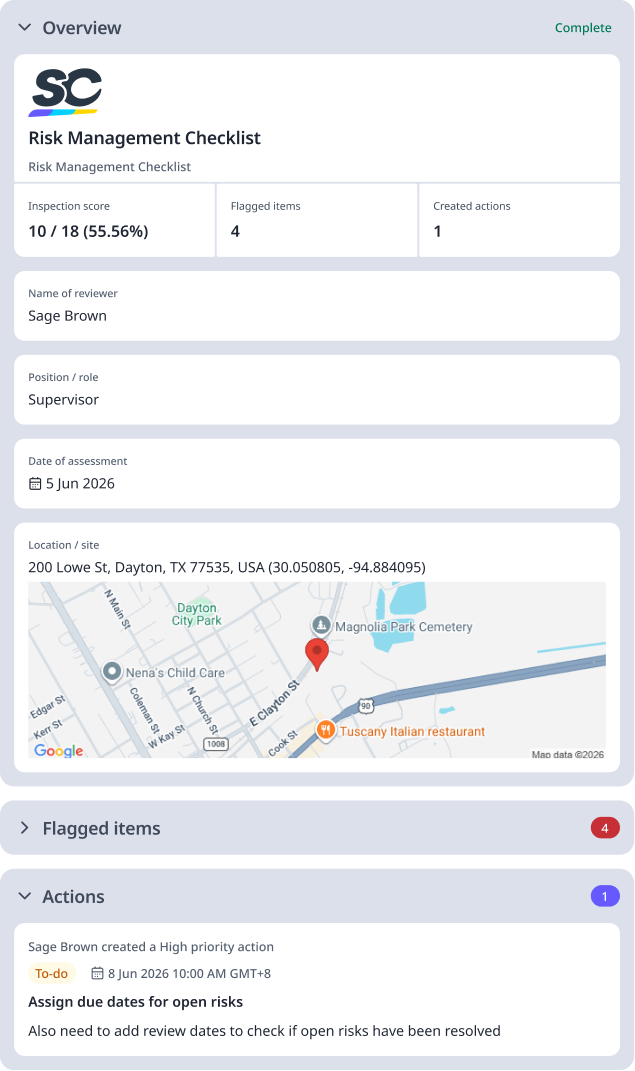
For reference, here is an example of a completed risk management checklist PDF report:
Preview Risk Management Checklist Report
Risk Management Checklist Templates by Use Case
The standard risk management checklist covers the core steps, but most teams need to adapt it for their specific context. Below are three common variants and what each one should focus on.
Vendor and third-party risk management checklist
When a third party has access to your systems, data, or operations, the standard checklist needs additional fields. A vendor risk management checklist should capture:
Vendor compliance status — Certifications held, audit history, regulatory standing
Contractual obligations — SLAs, data processing agreements, liability clauses
Data handling practices — Where data is stored, who can access it, breach notification procedures
Business continuity provisions — What happens if the vendor fails or is acquired
Third-party risk is a compliance requirement under frameworks including ISO 27001, GDPR, and SOC 2. Running a dedicated vendor risk management checklist before onboarding a new supplier reduces exposure across your supply chain.
Risk management checklist for small businesses
Small businesses face the same risk categories as large organisations: operational, financial, legal, safety, and reputational. The difference is that there are fewer people, less redundancy, and tighter budgets — which means the checklist needs to be lean.
Focus on the risks with the highest potential impact for your business size. Assign a single owner to each item rather than a team. A quarterly review cycle works well for most small business risks. ISO 31000's principles apply regardless of organisation size — the framework scales down without losing its structure.
Event risk management checklist
Events introduce a concentrated set of risks that standard operational checklists don't fully capture. An event risk management checklist should cover:
Crowd safety and capacity limits
Weather and environmental conditions
Supplier and vendor reliability
Permits, licences, and local authority compliance
Emergency response and evacuation procedures
Post-event review and incident reporting
Sydney Festival, which manages 60 venues and over 150 events annually, uses SafetyCulture templates for inductions, pre-event checks, and incident reporting across all sites — keeping risk management consistent at scale.