
Mastering Multi-Site Maintenance
Explore proven methods and modern technologies for managing maintenance across multiple sites.

Published 21 Nov 2025
Article by
7 min read
What is Multi-Site Maintenance?
Multi-site maintenance refers to the strategic management of equipment, infrastructure, and operational processes across the company’s different locations. It involves organizing repairs, inspections, and routine upkeep for operational continuity, optimal cost control, and regulatory compliance. Leveraging Enterprise Asset Management (EAM) software or Computerized Maintenance Management Systems (CMMS) centralizes these functions, driving significant performance enhancements.
Key Components
Managing upkeep or repairs can be challenging, especially when facilities are spread across cities, regions, or even countries. Efficient coordination from a central location ensures every site receives the same level of maintenance care. Each component plays a crucial role in achieving this goal. Said components are the following:
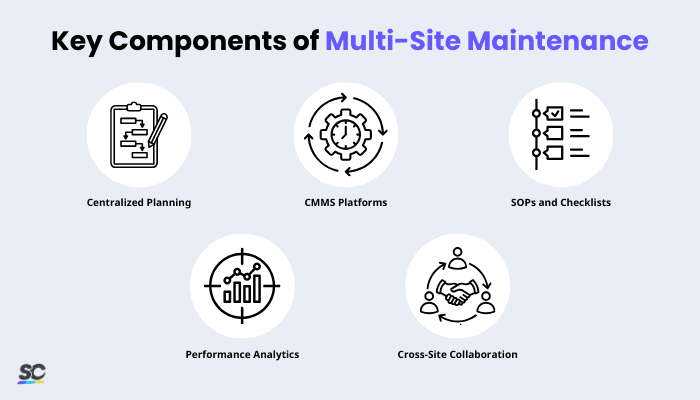
Key Components of Multi-Site Maintenance
Centralized Planning with Local Execution
To manage multiple sites and their maintenance, planning is essential. Planning, scheduling, and budgeting must originate from a single, central command, while field execution (e.g., repairs, calibration, inspections) remains localized, carried out by local teams. This balances uniform oversight with flexibility, ensuring consistent performance metrics, reducing downtime, and preventing resource duplication.
Use of CMMS or Digital Platforms
Digital solutions, like CMMS and EAM software, serve as the digital backbone of multi-site operations. All maintenance data, from work orders to asset histories, is kept in this centralized system, enabling real-time monitoring and task scheduling. More importantly, this supports predictive maintenance through the integration of analytics and IoT.
Standard Operating Procedures (SOPs) and Checklists for Consistency
Developing a set of documented, standardized SOPs establishes the mandatory protocol for task execution, ensuring consistent performance across all relevant personnel. Checklists also help with ensuring these instructions are followed. Without these, each site may adopt its own methods independent of each other, leading to inconsistent quality and compliance risks.
Performance Monitoring and Data Analytics
Continuous Key Performance Indicator (KPI) tracking is vital because performance trends and bottlenecks are not usually visible in routine activities, especially in large, distributed networks. Tools that translate these into data analytics are also essential for knowing how to better manage and maintain multiple sites. With these, managers can make data-driven decisions, prioritize resources efficiently, and forecast maintenance needs before failures occur.
Cross-Site Communication and Collaboration Framework
Effective communication is crucial in any operation, but especially so when managing multiple sites. Efficient and constant communication ensures alignment between corporate leadership in the headquarters and local maintenance teams, improving collaborative efforts. It also prevents information silos between locations and duplicated efforts.
Manage Factory Assets with Confidence
Maximize equipment uptime with real-time asset visibility and automated preventive maintenance workflows.
Real-Life Applications
Leading global conglomerates recognize that developing a maintenance plan for multiple sites is foundational to operational excellence. It’s not just about fixing issues as they arise—it’s also about protecting brand consistency, minimizing downtime, and ensuring compliance. Here are some noteworthy examples:
Retail - Businesses that operate across numerous branches require consistent standards in lighting, refrigeration, and display equipment. Preventive maintenance (e.g., regular checks and servicing of facilities and equipment) reduces breakdowns and keeps energy consumption efficient.
Manufacturing - Production efficiency and equipment uptime are non-negotiable in this industry. Predictive maintenance leverages sensor data and advanced analytics to accurately forecast potential equipment failures, enabling proactive intervention before critical breakdowns occur.
Hospitality - Hotel multi-site facilities maintenance is about upholding consistent guest experiences across all branches. While preventive maintenance strengthens customer satisfaction and brand reputation, the ability of the staff to execute swift corrective actions on sudden failures remains equally vital.
Healthcare - Clinics and diagnostic centers depend on reliable equipment and clean, safe environments. Compliance-based maintenance ensures that all medical devices and sanitation equipment meet regulatory and accreditation standards.
Education - Universities and school networks operate multiple campuses that must maintain safe, efficient, and comfortable learning environments. Condition-based maintenance across the school’s properties requires regular monitoring of building systems to determine when service is truly needed.
PHX Ireland (McCabes Pharmacy and United Drug), with its over 100 sites, significantly improved multi-site assessment and maintenance by adopting a high-quality platform. The digital solution centralized safety, compliance, and communication processes, yielding concrete benefits for the administrative team. With over 3000 staff hours saved in a year, the company can focus more intently on patient and customer care.
Simplify maintenance scheduling for your business with SafetyCulture
Streamline your operations with usage-based maintenance using our intuitive management software.
Challenges in Managing and Maintaining Multiple Locations
Multi-site facility maintenance presents significant challenges. Scaling operations across geographically dispersed locations inherently multiplies complexity, directly threatening efficiency, compliance, and brand integrity. Some challenges commonly associated with multi-site maintenance include the following:
Operational constraints - Inconsistent practices and standards mean one site may follow a rigorous procedure while the other uses outdated methods. This leads to unpredictable maintenance quality, higher repair costs, and operational failures.
Regulatory and compliance issues - Each local jurisdiction may have different occupational health and safety, fire safety, and environmental standards. Non-compliance risks severe penalties, including shutdowns.
Resource allocation strains - Balancing budgets and staffing levels equitably across all locations can be difficult. Poor allocation at one site may lead to failures, while over-resourced ones cause fiscal waste.
Data and visibility gaps - Siloed information prevents managers from gaining real-time insights into asset health or benchmarking the performance of different sites. Failure to consolidate siloed data directly results in flawed decision-making, ineffective capital forecasting, and a slow response to emerging issues.
Framework for Effective Multi-Site Maintenance
Running maintenance across multiple locations requires a systemic, data-driven process supported by the right digital tools. Here is a step-by-step look at how multi-site maintenance works and the right technology that supports each phase:
Centralize all asset information: Create a single source of truth for all assets, including equipment, buildings, and systems, across every site. This management platform stores and updates asset data (e.g., location, condition, maintenance history, warranties, etc.) in one place, preventing duplication of records and confusion between sites.
Automate maintenance scheduling: Once assets are cataloged, establish preventive and predictive maintenance plans. A CMMS or Integrated Workplace Management System (IWMS) can automatically generate maintenance tasks based on time, usage, or condition triggers, helping prevent human errors by ensuring critical tasks are never overlooked (or forgotten).
Standardized procedures and compliance requirements: Every maintenance activity should follow the same quality and safety standards, regardless of the location. Technicians can access up-to-date checklists and standard operating procedures by reviewing digital forms on their mobile devices.
Manage work orders and assign tasks efficiently: When issues arise, they must be logged, assigned, and resolved quickly—especially when teams are spread out geographically. Utilizing a digital work order and task management system streamlines communication between managers and field teams, providing real-time visibility into open and completed work orders.
Foster continuous training and communication: People remain at the heart of maintenance operations. Platforms with built-in messaging, video tutorials, and a knowledge base specifically for facility managemen t support consistent team engagement, which is crucial to long-term success.
Continuously monitor and analyze performance: Data-driven decisions are the backbone of efficient multi-sight maintenance. Real-time reporting and analytics dashboards display KPIs such as downtime, Mean Time to Repair (MTTR), and work order completion rates, which help identify problem areas or under performing sites.
Enable on-the-go access and flexibility: Maintenance personnel often work in the field, where internet access may be limited. Leveraging mobile apps allows technicians to access tasks, update work orders, and record data. Some solutions available today can even be accessed offline, keeping teams productive without dependency on constant connectivity.
Connect systems for seamless operations: This task benefits from interoperability between platforms, including HR, inventory, and procurement systems. Seamless integration automates data sharing, reducing administrative workload and errors.
Improve Multi-Site Maintenance Consistency with SafetyCulture
Why Use SafetyCulture?
SafetyCulture is a mobile-first operations platform adopted across industries such as manufacturing, mining, construction, retail, and hospitality. It’s designed to equip leaders and working teams with the knowledge and tools to do their best work—to the safest and highest standard.
Streamline processes, eliminate bottlenecks, enhance resource utilization, and build an agile and scalable infrastructure with SafetyCulture. Strive for operational excellence to boost competitive advantage, foster sustainable growth, and deliver long-term value.
✓ Save time and reduce costs
✓ Stay on top of risks and incidents
✓ Boost productivity and efficiency
✓ Enhance communication and collaboration
✓ Discover improvement opportunities
✓ Make data-driven business decisions
FAQs About Multi-Site Maintenance
Related articles
Facility Management
Maintenance

The Ultimate Guide to Warehouse Layout Optimization
Learn effective strategies in warehouse layout optimization to maximize space, streamline flow, and support efficient production operations.
Facility Management
Maintenance

Workplace Management: The Ultimate Guide
Learn how workplace management drives safe, efficient operations through frontline visibility, consistency, and continuous improvement.
Facility Management
Maintenance

A Guide to Retail Facility Management
Improve store performance with effective retail facility management, and learn its key components, challenges, and top solutions for success.