
Master Maintenance Documentation
Build a robust documentation system that guarantees asset efficiency and reliability.

Published 23 Dec 2025
Article by
6 min read
What is Maintenance Documentation?
Maintenance documentation refers to the structured compilation of technical manuals, maintenance Standard Operating Procedures (SOPs), work order schedules and histories, inspection checklists, and calibration records. Keeping comprehensive records on maintenance tasks enables your team to easily track work history, comply with regulations, and make informed, data-driven decisions about asset management.
Importance and Benefits
Maintenance is vital across industries. It prevents massive economic losses due to equipment failures and subsequent downtime. While the routine upkeep for machinery exceeded $50 billion in the US in 2016, the cost of handling preventable issues, including unplanned downtime, reached $100 billion in losses. A vital part of this task is keeping comprehensive documentation. Here’s why that matters:
Guaranteed regulatory compliance: Creating clear audit trails satisfies Occupational Safety and Health Administration (OSHA) and ISO standards for maintenance documentation. This reduces compliance violations by eliminating documentation gaps.
Reduced downtime: Teams can immediately diagnose faults and schedule routine care with complete asset files. Proactively reviewing these can significantly cut unplanned downtimes.
Higher cost savings : Standardized documentation improves planning and resource use. This reduces maintenance costs because fewer emergency repairs require additional tools and staff.
Improved safety : Offering accessible SOPs, safety protocols, and inspection logs empowers workers to control hazards. These documents reduce workplace incidents and compliance risks associated with maintenance failures.
Data-driven decisions: Centralized maintenance records, sensor data, and performance trends help relevant personnel forecast failures and prioritize work. Proactive decision-making will always trump reactive fixes.
Explore SafetyCulture Monitoring Solution
Utilize advanced sensor technology to monitor assets, automate vital alerts, implement actions, and report urgent issues.
Documenting Various Maintenance Tasks
While many organizations prioritize equipment repair, they often overlook the importance of documenting that work. Neglecting this is a costly oversight that leads to recurring failures, compliance issues, and inefficient labor allocation. This guide serves as a reminder that effective maintenance systems and documentation are inseparable.
Here are some of the most common maintenance types and what to document about them:
Predictive
Considered the highest level of maintenance maturity, predictive strategies anticipate failures before equipment conditions degrade. While this involves minimal physical labor up-front, the following must be documented:
Source of data
Predictive model or method applied
Risk level and confidence score based on historical patterns
Recommended action and timing
Outcome tracking after intervention
Condition-based
Since triggers are based on real-time equipment health rather than set intervals, this type identifies issues early and avoids unnecessary repairs. Depending on the severity, these tasks can take several hours. Ensure the following are recorded:
Condition indicators (e.g., motor vibration, oil temperature, pressure fluctuations)
Trigger thresholds and limits
Inspection method and tools used
Trend comparison with past data
Decision rationale (repair now vs. monitor)
Preventive
This scheduled strategy reduces failure probability but does not account for actual equipment condition. Each task may range from 30 minutes to several hours. Document the following:
Exact steps followed
Date, time, and frequency for compliance
Measurements, readings, or tolerances
Deviations or early signs of wear
Technician sign-off for traceability
Planned
Work is organized in advance to improve efficiency and safety, though it does not inherently prevent failures. As these jobs can span several days, ensure the following are recorded:
Clearly defined scope of work
Approved job plans and procedures
Required tools, permits, and parts
Resource allocation and scheduling
Completion notes vs. original plan
Corrective
This is a reactive strategy, occurring only after a failure. While sometimes unavoidable, it is often costly and disruptive. Because repairs can take days depending on parts availability, record the following:
Clear description and symptoms of the fault
Root cause analysis
Parts used and replacements
Labor hours and downtime recorded
Post-repair verification results
Create your own Asset Maintenance checklist
Build from scratch or choose from our collection of free, ready-to-download, and customizable templates.
Real-Life Applications
Maintenance documentation is vital across all industries, from high-risk environments to everyday operations. Here are some examples that prove its significance:
Manufacturing : A leading automaker utilizes standardized documentation to ensure uniform equipment care standards across its global service network.
Facilities management : Some of the world’s largest commercial real estate services firms document their Heating, Ventilation, and Air Conditioning (HVAC), electrical, and fire system upkeep for smooth handovers between teams and so clients have a clear proof of service completion.
Transport and logistics: Various logistics companies rely on detailed aircraft documentation and change log maintenance to track inspections, repairs, and component lifecycles to meet aviation regulations and prevent service disruptions.
Construction and mining: Mining companies maintain detailed equipment history files for haul trucks and excavators, supporting safety-critical decisions and reducing catastrophic failures.
Audit and compliance : Pharmaceutical and biotechnology corporations keep records of all asset servicing according to validated procedures to demonstrate Good Manufacturing Practice (GMP) compliance.
Knowledge transfer : A multinational tech conglomerate logs maintenance procedures and lessons learned to protect institutional knowledge.
Best Practices for Effective Maintenance Documentation
Technology is no longer optional in today’s digital-first environment. Routine, compliance-driven tasks like keeping maintenance documents reduce manual effort, prevent errors, and ensure accuracy and accessibility in fast-moving operational environments. Here are some best practices for effective maintenance documentation with help from modern technology:
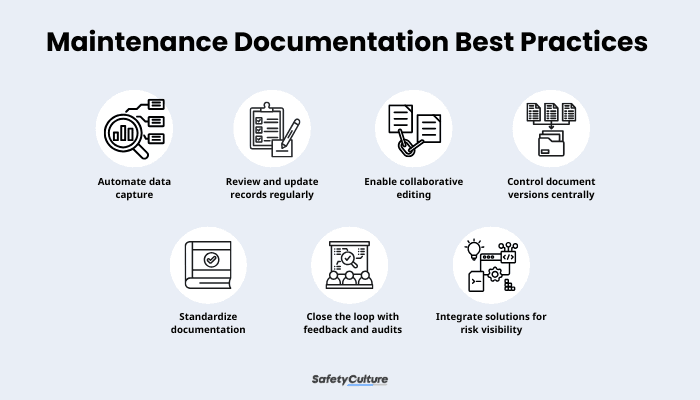
Maintenance Documentation Best Practices
Automate data capture: Mobile solutions with real-time updates capture data at the point of work. Some even have photo and media attachments that provide visual evidence on top of written annotations.
Review and update maintenance records regularly: Procedures should reflect current assets, risks, and operating conditions . Aside from triggering periodic reviews and revisions, utilize maintenance templates and checklists while conducting the tasks to make updates quick and consistent.
Enable collaborative editing: Collaboration and communication tools allow shared editing, comments, and approvals. This is very helpful to frontline technicians and engineers, especially when they need procedural assistance.
Control document versions centrally : Version control is vital, ensuring technicians follow the latest approved procedures. Centralizing this in one authoritative location and tracking who changed what, when, and why supports compliance.
Standardize documentation using data insights : Consistent structure and terminology is non-negotiable to gain meaningful analysis of assets across sites. Data-driven insights can identify inconsistencies while recording tasks.
Close the loop with feedback and audits : Documentation should evolve based on audit findings, specifically failures that were observed. Getting feedback in real-time through communication tools and evaluating them instantly with analytics helps capture recurring issues for immediate correction.
Integrate solutions for asset performance and risk visibility : Integration connects documentation to real asset behavior. Teams can review asset history and condition data or get real-time alerts that facilitate risk-based decision-making.
Modernize Maintenance Documentation with SafetyCulture
Why Use SafetyCulture?
SafetyCulture is a mobile-first operations platform adopted across industries such as manufacturing, mining, construction, retail, and hospitality. It’s designed to equip leaders and working teams with the knowledge and tools to do their best work—to the safest and highest standard.
Streamline processes, eliminate bottlenecks, enhance resource utilization, and build an agile and scalable infrastructure with SafetyCulture. Strive for operational excellence to boost competitive advantage, foster sustainable growth, and deliver long-term value.
✓ Save time and reduce costs
✓ Stay on top of risks and incidents
✓ Boost productivity and efficiency
✓ Enhance communication and collaboration
✓ Discover improvement opportunities
✓ Make data-driven business decisions
FAQs About Maintenance Documentation
Related articles
Facility Management
Maintenance

The Ultimate Guide to Warehouse Layout Optimization
Learn effective strategies in warehouse layout optimization to maximize space, streamline flow, and support efficient production operations.
Facility Management
Maintenance

Workplace Management: The Ultimate Guide
Learn how workplace management drives safe, efficient operations through frontline visibility, consistency, and continuous improvement.
Facility Management
Maintenance

A Guide to Retail Facility Management
Improve store performance with effective retail facility management, and learn its key components, challenges, and top solutions for success.