
ISO 15118: The Future of Smart EV Charging
Master ISO 15118 and discover how it secures and automates the future of intelligent EV charging.

Published 13 Jan 2026
Article by
5 min read
What is ISO 15118?
ISO 15118 is a global standard that enables high-level, secure data exchange between Electric Vehicles (EVs) and their supply equipment. Setting up this “universal language” ensures that cars and chargers work together seamlessly, allowing for automatic payments, smart energy use, and even sending power back to the grid.
Importance and Benefits
ISO 15118 Plug and Charge emerged in the early 2010s as the universal language for EV charging. Created by the International Organization for Standardization (ISO) and International Electrotechnical Commission (IEC), it turned something extremely technical into a seamless experience. By automating identification and billing, it makes charging and associated workflows effortless for EV fleet managers and owners.
With this standard, EV users can simply plug in their vehicles and walk away, with charging and payment handled automatically. Operators gain secure authentication and smoother electric operations with minimal manual interventions. Utilities and grid managers see and shape demand in real-time, balancing loads more efficiently. Thus, ISO 15118 has become the driving force for convenience, efficiency, and grid resilience.
Core Pillars
True “Plug & Charge” requires a smart network. ISO 15118 provides the language for cars to talk to chargers, while IEC 63110 allows those chargers to talk to the energy grid. This link is the backbone of a modern charging infrastructure.
Here are the vital components:
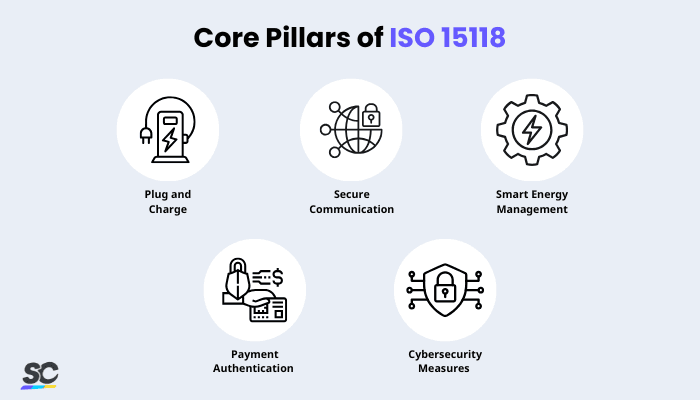
Core Pillars of ISO 15118
Plug and charge
Under ISO 15118, EV charging should be as simple as plugging in the vehicle and letting the charger do its job. This allows an electric vehicle to automatically identify itself to a charging station using digital certificates. It eliminates cards, apps, or manual log-ins that used to slow the process at the charging point.
Since there are no apps or cards involved, operators deal with fewer failed charges and support calls. It is also beneficial for energy grids, as it turns cars into mobile batteries that can safely send power back to homes and buildings.
Secure communication
It’s essential to have a Power Line Communication (PLC) that acts both as a charger and a built-in high-speed data line. Newer systems can even do this over Wi-Fi, allowing the car and charger to share complex information.
Since the connection is secure and smart, the charger can check its own health. With sensors that feel vibrations or loose connections alert users especially, it becomes easier to ascertain efficient EV battery management since it allows for prompt resolution.
Explore SafetyCulture Monitoring Solution
Utilize advanced sensor technology to monitor assets, automate vital alerts, implement actions, and report urgent issues.
Grid interaction and smart energy management
The growth of EVs strain local grids and may increase energy costs. Smart charging, optimized scheduling, and load balancing enable vehicles and chargers to respond dynamically to grid conditions.
This means operators can align charging sessions with off-peak hours, renewable availability, and utility signals. It also lets EVs share power back, turning parked cars into valuable energy sources for users.
Payment authentication
By automating payments and displaying prices upfront, there are no more “hidden costs.” This ensures drivers know exactly what they’ll pay before they plug in, which builds trust and eliminates the confusion that usually leads to billing disputes.
With the ISO 15118, both fleet owners and charging operators are fully protected. They can secure commercial contracts and customer credentials, eliminating the risks associated with unauthorized access and theft.
Cybersecurity measures
Because EV chargers handle sensitive data, they are often targets for cyberattacks. ISO 15118 compliance solves this by requiring end-to-end encryption and secure software updates, ensuring every connection remains locked down and compliant.
Aside from preventing hackers from stealing data or messing with the power grid, this ensures that only trusted vehicles can send energy back to buildings and homes. For companies, this means fewer risks and a scalable network ready for future technologies.
Future-Proofing the EV Network
Keeping up with standards can get complicated, especially since ISO 15118 is constantly evolving as the EV landscape changes. Companies across industries need smart digital tools to turn those complex rules into simple, everyday actions. Here are some solutions that ensure relevant personnel follow best practices for EV charging, ensuring reliable and secure workflows:
Track and manage assets per ISO 15118 guidelines: Track chargers, connectors, communication modules, and firmware versions to improve EV maintenance planning , ensure every charging point meets Plug and Charge standards, and strengthen cybersecurity protocols.
Deploy mobile tools for field teams: Enable field technicians and site managers to easily access data directly at charging locations through dedicated software solutions that offer free downloads of compliance templates, maintenance checklists, and observation logs, ensuring consistent practices across dispersed sites.
Report issues and trigger corrective actions in real-time: Flag charging failures, communication errors, or security concerns as they happen, and assign corrective actions immediately to minimize downtimes and repeated failures.
Integrate sensors for real-time monitoring: Sensors that read temperature, power flow, and vibration provide continuous visibility into charger and connector health.
Centralize all compliance documentation: Keep certificates, security policies, contracts, and technical documentation in one place to reduce version conflicts, support faster audits, and ensure teams always follow the latest approved procedures.
Automate workflows and task assignments: Ensure inspections, updates, renewals, and reviews happen on time without manual follow-ups. T
Standardize training and knowledge sharing: Support structured training and easy knowledge sharing around ISO 15118 concepts and procedures with mobile-ready learning materials.
Analyze charging performance for network efficiency: Turn operational data into clear insights about charger performance, compliance trends, and recurring issues with smart dashboards for better investment decisions, continuous improvements, and stronger compliance.
Blink Charging, a leading global operator and provider of EV charging equipment, upholds ISO 15118 standards by streamlining the commissioning and maintenance of "ISO-ready" hardware. Automated inspections and real-time risk assessments ensure that their Plug & Charge workflows remain secure, encrypted, and compliant.
Drive Charging Reliability and Compliance with ISO 15118 with SafetyCulture
Why Use SafetyCulture?
SafetyCulture is a mobile-first operations platform adopted across industries such as manufacturing, mining, construction, retail, and hospitality. It’s designed to equip leaders and working teams with the knowledge and tools to do their best work—to the safest and highest standard.
Streamline processes, eliminate bottlenecks, enhance resource utilization, and build an agile and scalable infrastructure with SafetyCulture. Strive for operational excellence to boost competitive advantage, foster sustainable growth, and deliver long-term value.
✓ Save time and reduce costs
✓ Stay on top of risks and incidents
✓ Boost productivity and efficiency
✓ Enhance communication and collaboration
✓ Discover improvement opportunities
✓ Make data-driven business decisions
FAQs About ISO 15118
Related articles
Maritime
Transportation

Inside The World Of Shipyard Management
Learn about the shipyard management process, from planning and construction to commissioning and operation.
Transportation
Automotive

A Comprehensive Guide to Delivery Driver Training
Learn how delivery driver training improves safety, consistency, and frontline readiness across fleets while reducing operational risk.
Automotive
Transportation

Driver Training: How to Improve Safety
Discover driver training programs, understand safety requirements, and learn which certifications are needed for specific industrial roles.