The Ultimate Guide to Safety and Security Trends in the Hospitality Industry
Learn how to protect your property and guests effectively with the current safety and security trends today.

Learn how to protect your property and guests effectively with the current safety and security trends today.
Published 5 May 2026
Article by
5 min read
Safety and security trends in the hospitality sector reflect the growing need to protect guests, staff, and property while enhancing the overall customer experience. These trends often evolve in response to emerging threats, technological advancements, and changing guest expectations. As a result, hospitality businesses are increasingly adopting proactive strategies that balance safety with convenience, such as integrating innovative technology and staff training programs.
The global hospitality market grew to an impressive $4.9 trillion in 2024, highlighting the industry's continuous growth and importance in the global economy. With this expansion comes greater competition and a growing focus on providing exceptional customer service to stand out among competitors.
However, as much as delivering exceptional service is important, ensuring the safety and security of guests is equally crucial. Let's take a closer look at their essential roles:
Guests are more likely to book—and rebook—at properties that prioritize their safety and well-being. When guests feel protected, they relax and enjoy their experience, directly influencing satisfaction and loyalty. A proactive approach to ensure guest security enhances peace of mind and shields the establishment’s reputation from damage caused by preventable incidents.
Businesses in the hospitality industry must navigate various safety laws and industry regulations to remain in good standing. Adhering to these standards reduces the risk of penalties and reinforces a commitment to protecting guests and staff. By embedding compliance into daily hospitality management practices, managers also minimize the likelihood of costly legal issues. An example of compliance is following the conditions set by the liquor license when serving and selling alcohol.
Creating a safe environment for employees is just as crucial as protecting guests. When hospitality staff feel secure, their morale and performance improve, positively impacting overall operations. Equipping them with proper training ensures they can respond quickly and effectively in emergencies, safeguarding everyone on the property.
Advances in technology and changing guest expectations are improving health and safety in the hospitality industry. Businesses in this industry, such as leisure places and hotels, embrace new practices and implement innovative solutions regularly to ensure their guests' and employees' safety and security.
Here are some of the emerging trends in hospitality safety and security:
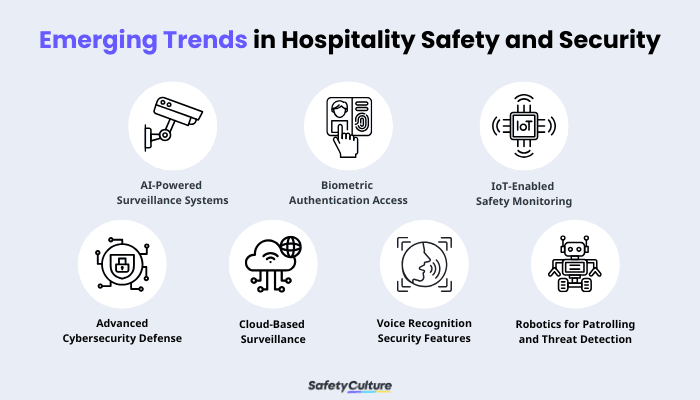
Emerging Trends in Hospitality Safety and Security
Artificial Intelligence (AI) transforms hotel surveillance practices and systems by providing real-time monitoring and predictive threat detection. These AI systems analyze footage and sensor data to flag anomalies like loitering or unauthorized access, allowing hospitality staff to act quickly. With AI-enhanced security, hospitality establishments can proactively prevent incidents, improving guest safety and reducing response times significantly.
Facial recognition and fingerprint scanning reshape hospitality establishment access control by offering secure, contactless authentication. These biometric authentication tools enhance security and elevate guest satisfaction by enabling seamless check-ins and room entries. This technology reduces the chances of lost or stolen keys while ensuring that only authorized individuals access sensitive areas.
Internet of Things (IoT) technology allows hotels and leisure places to connect devices like smoke detectors, motion sensors, and environmental monitors for continuous security oversight. In particular, IoT sensors can immediately alert staff about unauthorized entries or mechanical malfunctions, enabling swift intervention. In addition to improving safety, these smart systems also boost operational efficiency by preemptively identifying maintenance needs.
As hospitality business owners digitize their processes, the industry faces increasing cyber threats, with attacks linked to vulnerable devices like point-of-sale systems and IoT networks. To protect their data and their customers, businesses in the hospitality sector have started implementing zero-trust models and using AI-powered behavior-based threat detection to address this. These measures protect guest data and uphold the hotel's digital reputation and customer trust.
For hospitality businesses, high-definition surveillance cameras supported by cloud storage are essential, as they offer crystal-clear imagery and secure access to footage from any location. This setup enhances the accuracy of investigations and protects data from being tampered with on-site. Security teams in particular benefit the most from remote monitoring capabilities, enabling faster and more coordinated responses across properties.
Voice technology is emerging as a secure and hands-free authentication method, using unique vocal patterns for identity verification. With this, guests can control room settings, access emergency services, or log in to systems simply by speaking, which is especially useful during medical emergencies. This intuitive solution strengthens hospitality safety without adding hardware or complexity for users.
Security robots equipped with sensors and cameras now patrol hotel and event grounds to detect suspicious behavior and report it in real-time. These robots serve as mobile surveillance units, complementing human staff and improving response efficiency. An example of this are Autonomous Data Robots (ADRs), which are used in places like airports, hotels, and leisure places to detect concealed weapons and deter potential threats, demonstrating their growing role in hospitality security.
SafetyCulture is a mobile-first operations platform adopted across industries such as manufacturing, mining, construction, retail, and hospitality. It’s designed to equip leaders and working teams with the knowledge and tools to do their best work—to the safest and highest standard. Efficiently manage and streamline health and safety processes across the organization, including incident management, safety audits and inspections, risk assessment, waste management, and more, using a comprehensive hospitality management software solution.
Save time and reduce costs
Stay on top of risks and incidents
Boost productivity and efficiency
Enhance communication and collaboration
Discover improvement opportunities
Make data-driven business decisions