Hotel maintenance KPIs: Essential metrics to track
Learn which hotel maintenance KPIs to track, how to benchmark them, and how to report them to leadership.

Learn which hotel maintenance KPIs to track, how to benchmark them, and how to report them to leadership.
Published 3 Jul 2026
Article by
4 min read
A hotel maintenance Key Performance Indicator (KPI) is a measurable standard used to track how well an engineering or facilities team keeps a hotel property's physical assets running. Having maintenance KPIs matter for hotels because they connect directly to what guests notice first, such as working air conditioners, hot showers, and elevators that don't stall between floors. Setting hotel maintenance KPIs also protect asset lifespan, control repair spend, and give engineering leaders something concrete to bring into a budget meeting instead of a gut feeling.
As part of general hospitality management, hotels track various performance indicators such as the following:
Revenue per available room (RevPAR)
Average Daily Rate (ADR)
Occupancy rate tracks
Guest satisfaction scores
Maintenance KPIs are more specific, focusing on aspects of hotel management such as the condition of the building and the performance of the team that keeps it running. They’re a part of the hotel’s general KPIs, but are measured and tracked differently. Maintenance KPIs need more detailed tracking with items such as a hotel maintenance checklist, since there are more moving parts to take note of. For example, a property can hit its RevPAR target in a month, but when three Heating, Ventilation, and Air Conditioning (HVAC) units fail and the preventive maintenance schedule slips, that can become an operation risk going beyond maintenance tasks.
Once a property is tracking the core KPIs, the next concern is usually determining if these numbers are good or bad. Industry benchmarks give a rough answer, though they vary by property type, age, and brand standard.
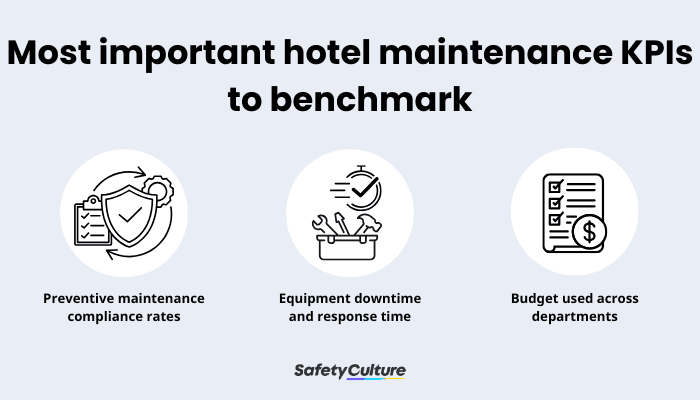
For preventive maintenance: Properties moving off a reactive baseline typically target 80–90% Preventive Maintenance (PM) compliance rates for both building and equipment compliance as a first milestone, while top-performing engineering teams sustain 95% or higher. The gap between those two is usually the difference between a team that schedules and tracks PM digitally, and one still relying on a paper logbook or spreadsheet to manage and achieve goals.
For equipment downtime and response time: A common target for guest-impacting work orders is a response time under a few hours, with equipment uptime held above 95% for critical systems like HVAC and elevators. Hotels that miss these targets consistently tend to see the gap show up first in guest reviews mentioning room temperature or noise before it shows up in a financial report.
For budgeting across hotel maintenance departments: Hotel maintenance budget ranges are often created with the goal to ensure operations flow smoothly with as little spending as possible, but without risking harm to workers and guests. On a per-room basis, properties with mature PM programs tend to land toward the lower end of whatever range their brand or ownership group tracks, since fewer emergency repairs mean fewer rush parts orders and overtime call-outs.
From front desk to housekeeping, get complete business visibility, guarantee guest safety, and help your teams deliver their best work.
The best way to track and report hotel maintenance KPIs are with digital tools, specifically ones that can make it as easy as possible to capture issues and schedule inspections. When a technician closes a work order or checklist on a mobile device, the time spent, parts used, and equipment affected are captured at the source, so the PM completion rate and cost per room update automatically rather than waiting for someone to tally a logbook.
It’s also important that your digital tool allows you to centralize data with a customizable dashboard. A useful dashboard should pull from three data sources, namely completed work orders, asset records, and inspection results. Work orders show what got fixed and how long it took. Asset records show age, warranty status, and repair history for individual equipment. Inspection data shows condition trends before something actually breaks.
Each feeds a different layer of the picture. A dashboard with only one or two of the mentioned sources won’t paint a complete picture of what needs repairs, maintenance, or changes.
Hospitality group Accor replaced spreadsheet-based standards tracking across its properties with a digital platform specifically so managers could analyze performance against set standards in one place, rather than reconciling separate logs department by department. That same logic applies directly to a maintenance dashboard: consolidating data sources is what turns raw activity into something leadership can actually read at a glance.
“For our hotel, SafetyCulture platform gives us the tools to check ourselves… It is a tracking system where we can analyze and elaborate on our performance in any given area of the hotel, based on Accor’s set standards.”
SafetyCulture is a workplace operations platform adopted across industries such as manufacturing, mining, construction, retail, and hospitality. It’s designed to equip leaders and working teams with the knowledge and tools to do their best work—to the safest and highest standard.
Streamline processes, eliminate bottlenecks, enhance resource utilization, and build an agile and scalable infrastructure with SafetyCulture. Strive for operational excellence to boost competitive advantage, foster sustainable growth, and deliver long-term value.
✓ Save time and reduce costs
✓ Stay on top of risks and incidents
✓ Boost productivity and efficiency
✓ Enhance communication and collaboration
✓ Discover improvement opportunities
✓ Make data-driven business decisions
In this article