A Comprehensive Guide on RCRA Training Requirements
Keep your team informed on the newest RCRA training requirements to ensure they’re fully equipped for effective waste management.
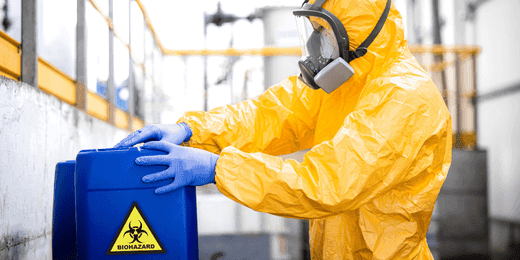
Keep your team informed on the newest RCRA training requirements to ensure they’re fully equipped for effective waste management.
Published 28 Apr 2026
Article by
5 min read
RCRA training educates relevant teams on the proper disposal of solid and hazardous waste, as outlined in the Resource Conservation and Recovery Act (RCRA). It helps keep teams safe and compliant with regulations as they handle different kinds of hazardous waste on the job.
The Resource Conservation and Recovery Act is a federal law that determines how hazardous waste should be disposed of, transported, treated, and stored. Specific RCRA training requirements for small and large quantity generators are established under Title 40 of the Code of Federal Regulations to help implement RCRA.
Facilities that produce over 1,000 kg of hazardous waste per month are categorized as large quantity generators. Handling this high volume of waste increases the risk of harmful spills, fires, or pollution. To mitigate these hazards, LGQs must follow specific training regulations as listed below:
Training must be given within 6 months of the workers’ hiring date.
Employees cannot work without supervision until initial training is completed.
After their initial training, they must complete an annual refresher training.
The program must be directed by an experienced professional certified in hazardous waste regulations under 40 CFR §262.17(a)(7).
On the other hand, any organization that generates less than 1,000 kg of hazardous waste per month is classified as a small quantity generator. Unlike the more precise requirements of large quantity generators, SQGs only need to make sure their workers are familiar with waste handling and emergency procedures. There are no fixed hours or annual requirements, but retraining is highly recommended if there are work process changes.
Extra training requirements are provided for some states that have authorized RCRA programs. These additional mandates are based on the individual risks assessed in each state. Below are some examples of locations with state-specific requirements on RCRA hazardous waste training.
Massachusetts: Requires a written training plan for all generators.
Rhode Island: Adds specific curriculum details, extra documentation, and trainer qualifications.
Vermont: Clarifies rules for satellite accumulation area (SAA) training.
California: Demands 24 contact hours every two years for certification, extending SQG standards to very small generators.
Connecticut: 8-hour annual program blending state/federal rules for generators.
New Hampshire: Requires a Hazardous Waste Coordinator to be present at all times
Cultivate a safe working environment and streamline compliance with our EHS solutions.
Although RCRA regulations don't dictate an exact list of topics, every training program must satisfy a general requirement. Under 40 CFR 262.17(a)(7)(i)(C), all personnel involved in hazardous waste management must be trained to handle emergencies effectively. This includes:
Procedures for spills, fires, or other releases, and immediate response steps and cleanup basics
Locations of evacuation routes, alarms, and shut-off switches for utilities like gas or power
Emergency communication protocols, such as internal alerts or coordinating with local fire departments
RCRA training promotes the safe handling and management of hazardous waste. This makes it helpful for teams that work with waste management systems. It’s also most frequently encountered by specific frontline roles in various industries like:
Maintenance technicians: They’re often required to use toxic solvents and oils as they conduct routine fixes and regular upkeep tasks on machinery. RCRA training teaches the proper storage of these hazardous wastes to avoid fires, as well as respond to accidental spills and leaks.
Production supervisors: Their main responsibility is to oversee daily manufacturing lines. This requires skills included in RCRA training, like signing manifests, conducting compliance checks, and verifying the proper labeling of hazardous substances.
Store managers: Responsible for handling returns and damaged goods, they may encounter hazardous chemicals like hardware, autoparts, and paint. Training briefs them on the safe storage, disposal, and labeling of these chemicals.
Inventory clerks: They learn how to spot hazardous waste while inspecting incoming goods for spills or defects. Additional training on proper waste labeling techniques also allows them to segregate expired or damaged items, preventing leaks or improper mixing.
Site safety supervisors: Hazardous chemicals can mix with soil during fuel leaks, concrete curing, and paint stripping. RCRA training helps supervisors implement proper water and waste management to protect workers and the environment.
Hazardous waste handlers: RCRA doubles as their site safety training on the safe handling of hazardous waste during cleanup. This keeps them protected and aware of the dangers of the chemicals they’re exposed to at work, like asbestos and site runoff.
Lab technicians: Learning how to use the right waste ID and implement proper labelling techniques can help them avoid dangerous chemical reactions during their routine experiments.
Environment, Health, and Safety (EHS) Coordinators: EHS Coordinators must ensure that work sites are consistently compliant with safety regulations. RCRA training equips them to write SOPs and create checklists that align with legal requirements.
SafetyCulture is a mobile-first operations platform adopted across industries such as manufacturing, mining, construction, retail, and hospitality. It’s designed to equip leaders and working teams with the knowledge and tools to do their best work—to the safest and highest standard.
Streamline processes, eliminate bottlenecks, enhance resource utilization, and build an agile and scalable infrastructure with SafetyCulture. Strive for operational excellence to boost competitive advantage, foster sustainable growth, and deliver long-term value.
Save time and reduce costs
Stay on top of risks and incidents
Boost productivity and efficiency
Enhance communication and collaboration
Discover improvement opportunities
Make data-driven business decisions