The Ultimate Guide to IFS Food
Learn about IFS Food, an internationally recognized standard for ensuring food safety and quality throughout the supply chain.

Learn about IFS Food, an internationally recognized standard for ensuring food safety and quality throughout the supply chain.
Published 28 Apr 2026
Article by
5 min read
The IFS Food Standard, developed by the International Featured Standards (IFS), is a globally recognized certification that ensures product quality, safety, and compliance for food processing companies. The Global Food Safety Initiative (GFSI) benchmarks and applies it to various food processing and handling stages, excluding primary production.
This standard was developed with input from major players in the food supply chain to ensure consistent production of safe, legal, and high-quality food. Through comprehensive audits, IFS enables companies to align with global food safety benchmarks, improve internal processes, and meet customer expectations.
IFS Food Version 8 is the most recent update to the International Featured Standards (IFS) food safety certification. Released on April 18, 2023, and mandatory for certified companies starting January 1, 2024, this version reflects the industry's shift toward stronger risk management, increased transparency, and alignment with global standards like Codex Alimentarius, ISO 22003-2, and GFSI benchmarking requirements.
This update has notably improved the standard's structure and requirements, so audits are more effective, less complex, and more credible across the food supply chain.
Key highlights of IFS Food Version 8 include:
Redefined B-Score: The B-score is now classified as a deviation, meaning it identifies non-critical non-conformities that still require corrective actions.
Introduction of IFS Star Status: Unannounced audits can now earn the IFS Star status, boosting trust and transparency in the certification process.
A Clearer Focus on Food Safety Culture: Companies must now define objectives across all four dimensions of food safety culture, supporting a more comprehensive approach to food safety.
EU PDO/PGI Recognition: Organizations can list EU Protected Designation of Origin (PDO) or Protected Geographical Indication (PGI) on their certificates, with disclaimers, recognizing regional product quality.
Streamlined Documentation: Reporting time and doctrine rules have been reduced, easing the administrative load and aligning with GFSI expectations.
Restructured Audit Checklist: The checklist now follows the audit process more closely, improving the flow and clarity of evaluations.
Terminology Changes: They have reverted the term "assessment" back to "audit" and clarified the wording of requirements to avoid ambiguity.
IFS Food certification unlocks measurable advantages for food businesses by improving supply chain efficiency, reducing costs, and strengthening food safety and legal compliance. Some benefits include:
It minimizes the need for second-party audits by providing a common standard for evaluating supplier quality.
It enhances supply chain consistency and efficiency for retailers, manufacturers, and suppliers.
It reduces process-related costs while increasing safety across the food supply chain.
It serves as legal protection under the due diligence concept in food safety incidents.
It supports a robust management system to meet food safety and legal requirements.
It offers tools to improve and track food safety performance over time.
It helps reduce product waste, rework, and the likelihood of product recalls.
The IFS Food Certification covers six primary areas that form the foundation of a strong food safety and quality management system. Each area ensures businesses have the proper structure, resources, and controls to maintain compliance and protect consumer health. These areas include:
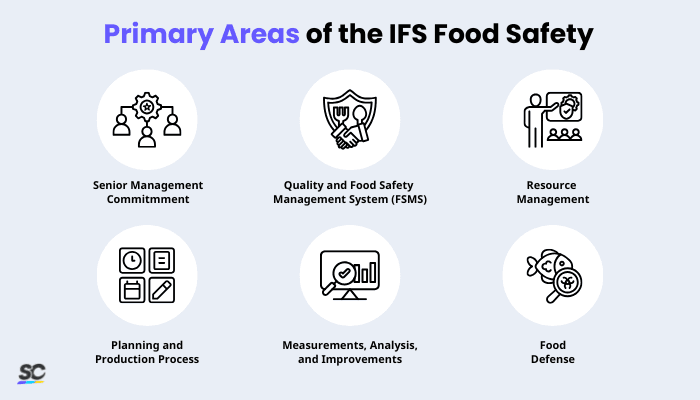
Primary Areas of the IFS Food Safety
Senior Management Commitment: Ensures leadership is fully committed to food safety and quality by defining objectives, allocating resources, and fostering a culture of continuous improvement.
Quality and Food Safety Management System (FSMS): Covers developing, implementing, and maintaining documented FSMS procedures that ensure food safety and compliance with legal and customer requirements.
Resource Management: Focuses on providing the necessary infrastructure, training, and personnel to implement the food safety system effectively.
Planning and Production Process: Involves establishing controlled product design, manufacturing, and handling procedures to guarantee consistent quality and safety.
Measurements, Analysis, and Improvements: Companies must monitor performance, analyze results, and continually implement corrective actions to enhance their food safety systems.
Food Defense: Addresses protective measures to prevent intentional contamination or tampering, safeguarding both the product and consumers.
One of the most critical parts of getting the IFS Food Safety Certification is conducting internal audits as part of pre-certification preparations. Digital auditing solutions can make this easier by organizing documentation, tracking corrective actions, and ensuring compliance at every stage.
Below is a step-by-step guide on how to prepare for the IFS Food Safety Certification:
Familiarize Yourself with the Standard: Start by understanding the core principles and updates in IFS Food Version 8, including new focus areas such as food fraud, safety culture, and defense strategies.
Align Your Food Safety Management System (FSMS): Adjust your processes to meet the updated food safety standard. This means updating hygiene practices, developing employee training modules, and implementing risk-based procedures.
Evaluate Gaps in Compliance: Compare your current food safety system with the latest IFS requirements to uncover gaps or weaknesses that need correction.
Carry Out Internal Reviews: Perform regular internal audits to ensure your food safety system is in line with IFS standards and identify areas for improvement.
Take Action on Audit Findings: Resolve any issues discovered during audits or gap evaluations. Follow through with corrective measures and verify their effectiveness with rechecks.
Keep Records and Procedures Updated: Ensure all food safety documentation, including protocols for food safety hazard control, is up-to-date and reflects current practices.
Prepare for the IFS Food Certification: Do a comprehensive check of your systems, staff readiness, and documentation to ensure you're fully prepared for the certification audit.
SafetyCulture is a mobile-first operations platform adopted across industries such as manufacturing, mining, construction, retail, and hospitality. It’s designed to equip leaders and working teams with the knowledge and tools to do their best work—to the safest and highest standard.
Promote a culture of accountability and transparency within your organization where every member takes ownership of their actions. Align governance practices, enhance risk management protocols, and ensure compliance with legal requirements and internal policies by streamlining and standardizing workflows through a unified platform.
Save time and reduce costs
Stay on top of risks and incidents
Boost productivity and efficiency
Enhance communication and collaboration
Discover improvement opportunities
Make data-driven business decisions