ESG Risk Assessment: The Ultimate Guide
Learn about the importance of conducting ESG risk assessments and how it helps organizations manage potential environmental threats across operations.

Learn about the importance of conducting ESG risk assessments and how it helps organizations manage potential environmental threats across operations.
Published 27 Apr 2026
Article by
6 min read
An ESG risk assessment is the evaluation of Environmental, Social, and Governance (ESG) factors as part of a comprehensive analysis to identify potential risks and opportunities facing a business or investment. This assessment is crucial because it helps investors and companies identify non-financial risks that may affect an organization’s financial performance, reputation, and long-term sustainability.
ESG risk assessment helps organizations strengthen their ESG governance practices and identify areas of improvement. It also helps them stay ahead of potential risks to address them proactively.
Some more key reasons why ESG risk assessment is important include:
Protects corporate reputation: An ESG risk assessment helps identify potential issues early on, including environmental violations or labor concerns. Proactively addressing these risks helps avoid reputational damage and preserve stakeholder trust.
Reduces financial and operational risks: Evaluating ESG risks minimizes fines, legal penalties, supply chain disruptions, and asset devaluation. Early mitigation strategies protect financial stability and ensure operational continuity.
Strengthens ESG governance and accountability: A structured assessment process supports strong ESG initiatives by embedding sustainability considerations into leadership decisions, policies, and operational oversight.
Ensures regulatory compliance: Global regulations, including climate disclosure and sustainability reporting rules, require companies to track ESG risks. Regular assessments help organizations maintain compliance and limit legal exposure.
Improves investor confidence: Investors increasingly evaluate ESG performance when allocating capital. Demonstrating a robust ESG risk assessment process signals transparency, responsible management, and long-term business viability.
Enhances organizational resilience: Identifying ESG risks such as climate impacts and supply chain vulnerabilities helps companies adapt to market changes. Managing these risks effectively promotes innovation and sustainable growth.
Drive sustainable growth and create long-term value with our ESG solutions.
ESG risks arise from environmental damage, failures in social responsibility, and weak governance practices. These risks can significantly affect business operations, finances, and reputation when they are not properly identified and managed.
Here are some examples of ESG risks that companies may face:
Environmental risks involve harm to ecosystems, excessive emissions, or poor resource management. A well-known example is a major global oil company responsible for a massive offshore oil spill in 2010, which caused extensive wildlife damage and resulted in roughly $65 billion in cleanup costs and penalties.
In another case, a large U.S. utility company faced nearly $30 billion in liabilities after neglected power lines sparked destructive wildfires. This emphasizes the importance of conducting comprehensive risk assessments and establishing mitigation procedures to minimize the environmental damage.
Social risks arise from issues that affect employees, consumers, and communities. This includes unsafe working conditions, child or forced labor, and violations of human rights within supply chains. Data privacy failures can also fall under this category, especially when companies mishandle customer information and face lawsuits, regulatory action, or product recalls.
Governance risks occur when an organization's leadership and internal controls lack transparency, accountability, or effective oversight. A notable example involved a leading German car manufacturer that installed software to manipulate emissions tests. The scandal exposed major governance failures and led to fines and penalties totaling more than €30 billion (~$34.86 billion).
Most organizations rely on established frameworks to guide ESG risk assessments and ensure consistent evaluation of environmental, social, and governance risks. Some of the most commonly used frameworks in risk assessments include:
Global Reporting Initiative (GRI): GRI focuses on sustainability reporting that reflects an organization’s environmental and social impacts. It emphasizes transparency and helps companies disclose the impact of their activities on society and the environment.
Sustainability Accounting Standards Board (SASB): SASB centers on financially material ESG factors. It helps organizations pinpoint sustainability issues that could impact financial results and investor decisions.
Task Force on Climate-related Financial Disclosures (TCFD): TCFD guides organizations in assessing and disclosing climate-related risks and opportunities. It helps them evaluate how climate change could impact their governance, strategy, risk management, and financial planning.
Corporate Sustainability Reporting Directive (CSRD): CSRD is a European regulation that requires large companies to provide detailed ESG disclosures. It enhances transparency by ensuring organizations report consistent environmental sustainability data to regulators and investors.
Environmental and Social Framework (ESF): The ESF guides development projects by providing a structured framework for evaluating environmental and social risks in project financing. It uses risk categorization and safeguards for responsible project implementation.
An ESG risk assessment follows a structured process to identify, evaluate, and manage environmental, social, and governance risks. The following steps outline the general process for conducting an ESG risk assessment:
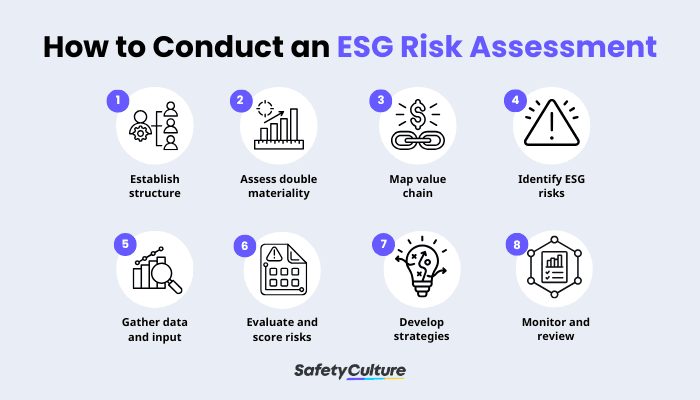
Establish a governance structure: Form an ESG steering committee comprising senior leaders from risk, sustainability, finance, and other relevant teams. It creates clear accountability and ensures the assessment has cross-functional support.
Conduct a double materiality assessment: Evaluate how the business impacts society and the environment, and determine its effects on financial performance.
Map the value chain: Review the full value chain, including suppliers across different tiers, to identify areas with elevated ESG exposure. It helps uncover risks related to geography, sourcing, and resource availability.
Identify ESG risks: Categorize risks into environmental, social, and governance groups. It may include climate-related threats, labor issues, corruption risks, or other concerns revealed through stakeholder input and data gathering.
Gather data and stakeholder input: Collect relevant internal data, supplier information, and key stakeholders' feedback to strengthen the assessment. An ESG checklist helps standardize the process for data collection and ensures that teams do not overlook critical risk areas.
Evaluate and score risks: Assess each risk based on likelihood, impact, speed of occurrence, and its connection to other risks. A simple scoring system, such as low, medium, or high, can help prioritize action.
Develop mitigation strategies: Create response plans for the highest-priority risks. These may include stronger controls, insurance coverage, supplier interventions, policy updates, or operational adjustments.
Monitor and review continuously: Track ESG risks through analytics dashboards, KPIs, and regular reviews. Ongoing monitoring helps organizations respond to changes and keep the assessment relevant over time.
SafetyCulture is a mobile-first operations platform adopted across industries such as manufacturing, mining, construction, retail, and hospitality. It’s designed to equip leaders and working teams with the knowledge and tools to do their best work—to the safest and highest standard.
SafetyCulture complements your organization's efforts to implement and maintain ESG strategies. Through seamless data collection, real-time tracking, and reporting of your progress against sustainability goals, your organization can effectively drive sustainable growth and success.
✓ Save time and reduce costs
✓ Stay on top of risks and incidents
✓ Boost productivity and efficiency
✓ Enhance communication and collaboration
✓ Discover improvement opportunities
✓ Make data-driven business decisions