A Guide to IEC 63110: How to Ensure Compliance
Learn what the IEC 63110 is, why it’s important, and the key requirements to follow to ensure readiness with the standard.
Learn what the IEC 63110 is, why it’s important, and the key requirements to follow to ensure readiness with the standard.
Published 5 May 2026
Article by
5 min read
IEC 63110 is an international standard developed by the International Electrotechnical Commission (IEC) to define how Electric Vehicle (EV) charging and discharging infrastructure are managed through standardized communication. It focuses on backend and infrastructure management functions such as charging session control, authorization, metering, reporting, pricing, and asset management. It complements other EV standards (such as ISO 15118 for vehicle-to-charger communication and the Open Charge Point Protocol (OCPP) for charger-to-backend communication) by addressing higher-level system and network management.
IEC 63110 is important for EV fleet management because it provides a standardized way to manage large numbers of chargers, charging sessions, and energy usage across multiple sites. Fleets depend on consistent communication for scheduling, authorization, metering, and reporting, and compliance with IEC 63110 helps ensure these functions work reliably across different vendors and systems. Following this standard also reduces integration complexity and supports scalable fleet operations.
For fleet operators, IEC 63110 also enables smarter charging strategies that control costs and improve vehicle availability. By supporting coordinated charging, monitoring, and data exchange, it helps fleets align charging with operational schedules, grid constraints, and energy pricing. This is especially critical as fleets adopt depot charging, smart charging, and vehicle-to-grid capabilities at scale.
EV use has been on a steady rise in the past decade, as more individuals and companies begin to switch to electric or hybrid vehicles. Because of this, organizations worldwide have been developing standards such as the IEC 63110 to give a better framework for EV use, fleet management, and more. Here are some of the key reasons the IEC has established this standard.
EV charging ecosystems often rely on multiple proprietary or semi-standardized protocols, making fleet systems difficult to integrate and manage. IEC 63110 helps reduce fragmentation by defining a common framework for managing charging infrastructure across vendors and platforms. This improves interoperability, lowers integration costs, and simplifies fleet-wide charging operations.
As more EVs connect to the grid, fleets must account for load limits, demand charges, and grid stability requirements. IEC 63110 supports structured communication between these, charging systems and management platforms, enabling better coordination with energy management and grid services. This allows fleets to respond dynamically to grid conditions while maintaining operational reliability.
Fleet operators increasingly need to control when and how EVs charge to optimize costs and availability. IEC 63110 enables standardized management of charging sessions, scheduling, and energy data needed for smart charging strategies. This supports advanced use cases such as load balancing, peak shaving, and vehicle-to-grid integration.
Automate tracking and harness digital workflows to ensure compliance with evolving regulations effortlessly.
IEC 63110 sits at the infrastructure and backend management layer of the EV charging stack, above physical chargers and below energy and business systems. It focuses on how charging assets, sessions, and operational data are coordinated across large, multi-site deployments.
ISO 15118 and OCPP are other international standards that work very similarly to the IEC 6311 standard. However, they are different from one another, but used together.
ISO 15118 governs communication between the EV and the charging station, enabling functions like Plug & Charge and vehicle-to-grid interactions. On the other hand, OCPP focuses on charger-to-central-system communication, handling real-time control and status updates for individual charge points. IEC 63110 operates at a higher level, defining how charging infrastructure is managed end-to-end, including sessions, authorization, pricing, reporting, and integration with enterprise systems.
In the typical EV management flow, ISO 15118 is often referred to as the standard for handling authentication and charging parameters between the EV and the charger. The OCPP is then used to transmit charger status, meter values, and commands between the charger and the central system.
Compared to them, the IEC 63110 standards coordinates higher-level responsibilities such as session lifecycle management, aggregation of metering data, pricing logic, and interaction with fleet, billing, or energy management platforms.
While IEC 63110 is different from OCPP, organizations looking to comply with IEC 63110 must evaluate how it aligns with existing OCPP-based systems and backend architectures. Migration often involves mapping current data models, workflows, and APIs to IEC 63110-defined functions rather than replacing protocols outright. A phased approach allows operators to preserve existing charger investments while enabling standardized, future-ready infrastructure management.
As EV charging networks scale and become more integrated with fleet operations, energy systems, and grid services, companies need to prepare for standards like IEC 63110 to remain interoperable and future-ready. However, readiness goes beyond protocol support and requires foundational capabilities in security, data management, and infrastructure oversight. Here are some of the key requirements for companies to keep in mind for complying with IEC 63110:
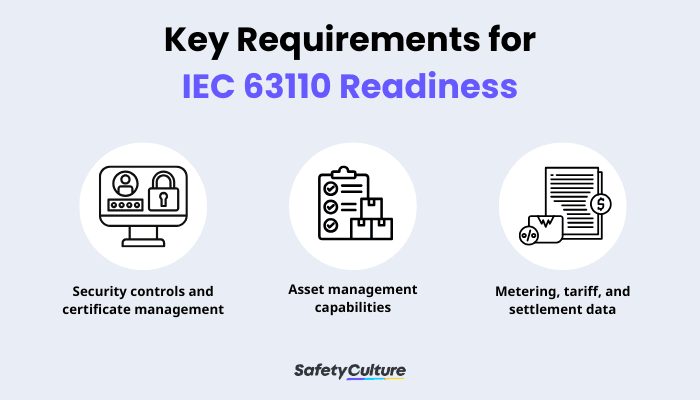
IEC 63110 readiness requires strong security controls to protect charging infrastructure and operational data. This includes identity management, authentication, and secure communication between systems using certificates and encryption. Proper certificate lifecycle management is critical to maintaining trust across fleets, operators, and energy stakeholders.
Operators must be able to inventory, monitor, and maintain charging assets across multiple locations. IEC 63110 assumes support for asset lifecycle management, including firmware updates, fault reporting, and configuration control. These capabilities are essential for maintaining uptime and operational efficiency in large-scale fleet environments. It’s best to utilize a workflow solution that has these features to ensure compliance, while improving operations.
Accurate and standardized metering data is foundational to IEC 63110 compliance. Systems must support detailed energy measurements, tariff definitions, and settlement records for billing, reporting, and regulatory purposes. The use of monitoring solutions, digital and hardware, can also be helpful. Together, these ensure transparent cost allocation and reliable financial reconciliation for fleet and multi-operator charging scenarios.
SafetyCulture is a mobile-first operations platform adopted across industries such as manufacturing, mining, construction, retail, and hospitality. It’s designed to equip leaders and working teams with the knowledge and tools to do their best work—to the safest and highest standard.
Promote a culture of accountability and transparency within your organization where every member takes ownership of their actions. Align governance practices, enhance risk management protocols, and ensure compliance with legal requirements and internal policies by streamlining and standardizing workflows through a unified platform.
Save time and reduce costs
Stay on top of risks and incidents
Boost productivity and efficiency
Enhance communication and collaboration
Discover improvement opportunities
Make data-driven business decisions