The Importance of Understanding Inherent Risk
Learn about the fundamentals of inherent risks, its role in risk assessments, and how to evaluate exposure before implementing controls for risk management.

Learn about the fundamentals of inherent risks, its role in risk assessments, and how to evaluate exposure before implementing controls for risk management.
Published 7 May 2026
Article by
6 min read
Inherent risk refers to the level of risk that exists before any internal controls or mitigation measures are taken to control it. It represents the raw exposure an organization faces, essentially what the risk looks like in its natural state, without anything in place to reduce it. Understanding inherent risks is the starting point of effective risk management and is used to establish a baseline for determining the appropriate controls necessary.
Every workplace task carries some level of built-in risk, whether it's operating machinery on a factory floor, working at height on a construction site, or handling hazardous materials in a lab. Before any control measure is introduced, that risk exists in its purest form.
Understanding who is exposed, under what conditions, and with what potential consequences is a critical part of effective risk management, alongside other benefits such as:
Prioritizing threats - Ranking threats based on likelihood and impact allows teams to focus resources on the most critical exposures, instead of spreading their efforts on several risks.
Informing decisions - Having a clear baseline of potential consequences helps leaders decide on the right strategy, investment, and operational choices.
Preventing incidents - Recognizing these threats and vulnerabilities enable proactive planning, setting up safeguards to reduce the chances of accidents, disruptions, or losses.
Building compliance - Identifying and assessing inherent risks tied to legal and industry requirements support compliance. It ensures organizations can implement the appropriate controls to meet standards and avoid penalties.
Boosting resilience - Being prepared for potential disruption strengthens the company's ability to absorb shocks, adapt to changes, and maintain operations despite uncertainties.
Simplify risk management and compliance with our centralized platform, designed to integrate and automate processes for optimal governance.
Inherent risks are often invisible because they are embedded in everyday processes. In fact, even experienced managers fail to identify them early, causing serious operational failures. Here are the most common inherent risk examples in different industries.
Construction - Consistently ranked as the most dangerous industry in the world, there are numerous raw dangers in works sites, from working at heights to moving heavy equipment.
Manufacturing - Heavy machinery, complex processes, and continuous operations keep factory floors highly hazardous. Equipment malfunction is a major raw risk that may cause serious injuries and production downtimes that disrupt supply chains.
Healthcare - Patient care complexity and exposure to biological hazards are common inherent risks in this sector. These have a high potential of causing harm that leads to legal consequences.
Property Management - Maintaining buildings, tenants, and facilities can be problematic because neglected repairs can lead to structural issues, which may result in accidents and legal claims.
Retail - While seemingly low risk, modern financial transactions are at risk of cybersecurity issues. If overlooked, this can lead to massive data breaches that can compromise an entire institution’s reputation.
Even the most seasoned managers can’t distinguish between the different types of risks. It is not enough to know the fundamental inherent risk definition because clarity is the backbone of any safety strategy. Identifying these risks and understanding the distinction are critical to protecting the operations.
Aspect | Inherent Risk | Control Risk | Residual Risk |
Definition | Natural level of risk present before safeguards are applied. | The risk that existing controls will fail or not work as intended. | The remaining risk after controls and mitigation measures have been implemented. |
Timing in the Risk Process | Identified at the beginning of risk assessment | Evaluated during the review of internal controls | Determined after all controls are in place |
Focus Area | Nature of the activity, environment, or process | Effectiveness and reliability of controls | Overall exposure that the organization should accept or further manage |
Level of Influence | Cannot be eliminated, only understood and assessed. | Can be reduced by improving control design and execution | Can be minimized further, but rarely eliminated completely |
Practical Example | Operating heavy machinery | Ignoring safety guards or training | Sudden internal structural failure due to a defect or extreme temperature change |
Inherent risk assessment is essential for both early-stage planning and late-stage auditing. By applying these structured steps during strategy sessions or routine reviews, teams can ensure consistency, accuracy, and clarity.
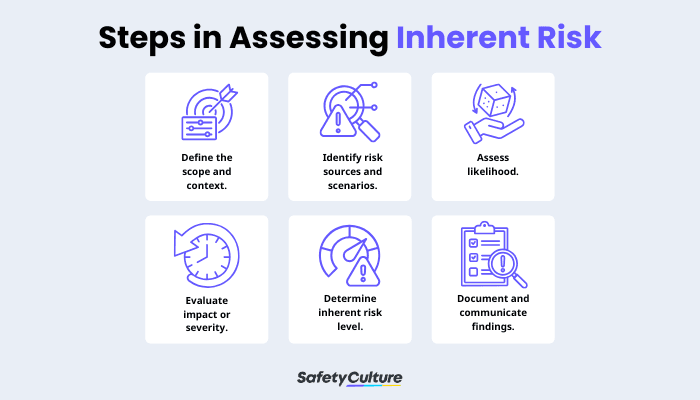
Establish the clear boundaries of the system, process, or environment in question. Defining these limits prevents dangerous gaps in oversight and eliminates redundant overlaps, ensuring every potential threat and risk exposure is accounted for.
Clearly define what is included and excluded from the assessment
Align with the organization’s broader goals
Involve key stakeholders, especially frontline workers, early
Pinpoint potential events, hazards or conditions that could negatively impact the objectives. This step reduces the chance of overlooking critical risks. Use different methods to capture everything:
Brainstorming reveals what people feel and foresee
Historical data provides a factual baseline, preventing teams from guessing
Industry benchmarks help teams see what their competitors are experiencing
Estimate how often a specific danger could occur without any safeguards in place. This helps prioritize which risks need immediate attention based on probability. Use standardized rating scale, turning subjective guesses into objective and data-driven strategies.
Determine the potential consequence of the risk to highlight their seriousness. Aside from assessing the likelihood, this component of risk analysis guides prioritization and resource allocation. Using tools like checklists can help provide a comprehensive assessment and document each observation for future reference.
Build from scratch or choose from our collection of free, ready-to-download, and customizable templates.
Integrate the likelihood and impact to assign an overall risk rating for the company’s safety efforts. Risk matrices and other scoring models transform raw data into a standardized ranking (e.g., low, medium, high), ensuring critical threats receive the immediate resources required.
Record identified risks, ratings, assumptions, and rationale, and then share them with stakeholders. This ensures transparency, accountability and alignment across teams.
Use standardized formats for easy understanding and comparison
Tailor the communication to the audience for better alignment
Update and validate information regularly for ongoing planning and risk management
Both Newmont Mining and Sunshine Crane Repair operate in high-risk industries where inherent risks are unavoidable. Software solutions help reduce distractions and exposure through comprehensive checklists, digital inspections, and real-time reporting. By improving workflow accuracy and efficiency, teams gain better visibility and control over naturally hazardous conditions.
SafetyCulture is a mobile-first operations platform adopted across industries such as manufacturing, mining, construction, retail, and hospitality. It’s designed to equip leaders and working teams with the knowledge and tools to do their best work—to the safest and highest standard.
Utilize mobile-first tools that allow frontline teams to capture raw threats in real-time then enable managers to evaluate them accurately with advanced analytics. Boost collective awareness by instantly sharing these findings across a shared digital workspace. Transition from reactive fixes to proactive protection by digitizing every stage of the risk lifecycle through a unified platform.
✓ Save and reduce costs
✓ Stay on top of risks and incidents
✓ Boost productivity and efficiency
✓ Enhance communication and collaboration
✓ Discover improvement opportunities
✓ Make data-driven business decisions