A Guide to How Operations Automation Streamlines Workflows
Learn about the benefits of automating workflows and how it transforms operational efficiency for better productivity.

Learn about the benefits of automating workflows and how it transforms operational efficiency for better productivity.
Published 24 Feb 2026
Article by
6 min read
Operations automation is the process of using technology to fulfill routine and repetitive business tasks, from filing reports to transferring data between systems. The automation is supported by digital solutions like workflow orchestration, artificial intelligence (AI), and robotic process automation (RPA). The primary goal of operations automation is to eliminate manual work and associated errors to create a scalable foundation for peak efficiency and consistent compliance.
Automation process is an emerging trend across different industries, as it presents a more efficient way of working while reducing costs on labor. IBM cites that 87% of business executives expect artificial intelligence (AI) and automation systems to continue optimizing workflows and reinvent the structure of productivity within work environments.
Here are other core benefits of integrating operations automation into workflows:
Improved accuracy and reduced errors - Systematizing workflows ensures consistency and creates better data integrity for more reliable business outcomes.
Lower operational costs - Cutting manual labor, reducing errors, and optimizing resources help companies save up on expenses and allocate financial budgets for other improvements.
Increased productivity and efficiency - This type of technology boosts productivity by streamlining routine work through automation to allow employees to shift toward higher-value, specialized work.
Faster decision-making with real-time data - With real-time insights and monitoring, businesses can react faster to disruptions and proactively manage issues to ensure operational resilience.
Higher customer satisfaction and competitive advantage - One of the biggest challenges of businesses is ensuring customer satisfaction and having efficient customer support channels. By removing friction from customer service through automated systems, companies create a seamless experience that fosters client trust and loyalty.
Business operations automations streamline critical tasks that often drain time and resources. Leading companies across sectors, from manufacturing to healthcare, have invested in technology to digitize most business functions, allowing teams to focus on strategy and value-added work. These are processes that should be prioritized and some real-life examples:
This covers high-volume, repetitive activities that are the backbone of daily operations. Automation eliminates human factors such as fatigue and errors for better output and productivity.
A good example of this is when construction managers used to manually track equipment function hourly. Now, there are automated asset maintenance alerts to ensure heavy machinery is inspected on schedule to prevent costly breakdowns.
Work should move efficiently from one employee to another, ensuring people get the right information at the right time. Effectively managing workflows with digital tools gets rid of manual handoffs and the potential bottlenecks that stall progress.
In manufacturing, digital systems can automatically trigger quality control inspection once a component is assembled. No follow-ups are required for QA and QC teams to initiate their assigned tasks.
While often overlooked, data entry is the critical first link in the operational chain. Digitizing this guarantees data integrity from the beginning, transforming a manual chore into a fail-safe system.
For example, healthcare facilities today provide and request information through secure, cloud-based systems linked to medical records (EMR) in real-time. Both patient and provider can engage in consultations confidently, knowing medical records are accurate and automatically updated.
Manual data compilation, especially for large volumes of information, is a slow process and prone to errors that compromise quality and trust. Automation transforms raw information into structured insights that helps leadership make decisions based on facts.
To illustrate, large financial institutions automate daily compliance reports (e.g., SOC 2, ISO 27001, GDPR) to make them easily available to auditors and immediately detect deviations that may escalate into bigger issues.
Departmental silos create friction, leading to the communication gaps that stall manual handoffs. Optimizing coordination creates a unified operational engine, speeding up the pace of business without compromising quality.
A good solution to this is seamlessly linking sales data with inventory and logistics transforms the fulfillment process into a high-speed, automated system. Meeting customer expectations today requires a supply chain that responds in milliseconds, not hours.
Modernizing workflows is a strategic necessity, but effective implementation is often challenging. Organizations should be able to recognize common roadblocks to establish digital efficiency throughout operations. Here are some challenges to take note of:
Integration with legacy systems - New digital tools rarely work with outdated or incompatible systems. Connection can lead to delays, costly customization, and operational disruptions.
Lack of skilled technical talent - Experts in programming, data analytics, machine learning, and system design are needed for successful automation. Finding and retaining consultants can be challenging.
Data quality and governance issues - Automated systems require clean, accurate data. Flawed and unreliable information undermines analytics and subsequent decision-making.
Employee resistance - Employees fear job loss, disruption, or loss of control when anything new comes up. Resistance slows adoption, decreases morale, and prompts active pushback.
Poor stakeholder management - The success of any initiative demands total alignment. Engaging frontline employees early helps with complete buy-in and prevents resistance.
Successfully deploying automated solutions requires proper workflow orchestration. Here are some best practices that can help companies adopt automation while reducing friction, risk, and resistance.
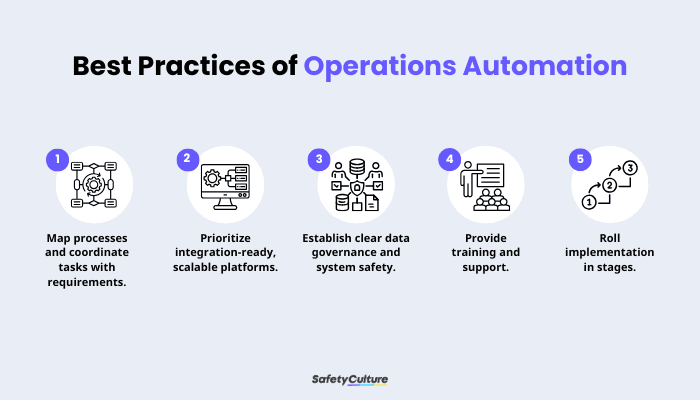
Starting with a clear process map to expose hidden inefficiencies and ownership gaps before they become expensive mistakes. Use a checklist to perform a thorough operational audit and create a consistent framework that can scale across departments.
Strategically choosing the right platform resolves two challenges: incompatibility with legacy systems and the growing skill shortages. Accessible and intuitive interfaces don’t require a fleet of specialists to remain agile and adaptable as older infrastructure ages out.
Automated systems work best with reliable data. Digital solutions like automated data checks, centralized repositories, and secure log-ins enforce clear standards, tracked logs, and appropriate corrective actions.
Automation impacts how people work. Without clear communication and training, employees resist or underutilize new systems. It is important to offer learning systems, in-app guidance, and collaborative workflow tools that help employees adapt while building their confidence.
Large-scale initiatives launched all at once increases risk. Incremental implementation allows teams to learn, adapt, and prove value quickly. Digital tools like analytics dashboards and performance tracking tools help monitor impact that aid in refining workflows.
SafetyCulture is a mobile-first operations platform adopted across industries such as manufacturing, mining, construction, retail, and hospitality. It’s designed to equip leaders and working teams with the knowledge and tools to do their best work—to the safest and highest standard.
Replace manual, paper-based checks with digital inspections to capture instant operational insights. Drive smarter scheduling and corrective actions with real-time analytics. Simplify training and performance tracking with a centralized dashboard. Eliminate repetitive tasks, allowing teams to focus on high-impact growth and long-term stability through a unified platform.
✓ Save and reduce costs
✓ Stay on top of risks and incidents
✓ Boost productivity and efficiency
✓ Enhance communication and collaboration
✓ Discover improvement opportunities
✓ Make data-driven business decisions
In this article