
Industry Insights
The people running your business are the ones nobody's investing in
Share article
Middle managers are the ones holding accountability, communication, and people management together.
Cutting middle management doesn't save money, it just creates problems that are harder to ignore.
Companies that invest in their middle managers don't just see better retention, they see better risk management practices, and improved business results.
Back in Google's early days, they believed that if you hired brilliant engineers, managers would just get in the way.
So they did exactly that. They focused on hiring highly skilled, autonomous engineers with no middle management layer to speak of.
Predictably, things fell apart fast. Teams had no visibility into what others were working on. Two or three teams would independently build the same product without knowing it. Months of engineering time, resources, and money wasted.
That's partly why Google had a slow start in the cloud market early on. Businesses and enterprises don’t just need good technology; they need a team that could be held accountable with capable managers.
Middle managers aren't just there to supervise talent, they’re there to keep everyone on the same page, and avoid risk.
Most companies have three layers of management: upper, middle, and lower. Each layer depends on one another. It’s very hard to run a business if you’re missing one of these.
Your C-suite—CEOs, CFOs, COOs. They decide where the company is going and why. More specifically, they set long-term goals, manage investor relations, and make the big calls on deals and partnerships. They're not usually in the weeds of day-to-day operations, but they keep a close eye on overall business performance.
Your first-line managers. They're the closest to the actual work and report directly to higher management. Example positions in this rank include team leads, supervisors, and floor managers. They make sure tasks get done, deadlines are met, and employees know what they're doing on any given day.
They sit between the two. Compared to the other two positions, they’re not setting the strategy, and they're not doing the frontline work. Some common positions include branch managers, HR managers, and site managers. They take what upper management decides, and turn it into something lower management can actually execute.
Companies have tried to kill middle management many times throughout history. It happened with software, then automation, and now AI.
And it hasn't worked yet.
Because when you cut middle management, here's what actually disappears:
Accountability: Senior management sets the direction, frontline workers get things done, but middle management connects the two. Without them, there's no one accountable for the gap between strategy and execution.
People Management: For most employees, their middle manager is the company. The person who gives feedback, notices burnout, and steps in when someone needs help. According to Gallup, the single biggest factor in whether an employee is engaged at work is their manager.
Communication: Middle managers sit in the middle of all the noise. Information flows in four directions:
Downward: they turn leadership's decisions into clear direction for their team.
Upward: they tell leadership what's actually happening on the ground.
Sideways: they keep different teams from working against each other.
Filtering: they decide what gets passed on, to who, and when.
And there's plenty more beyond that. The funny thing is, most people still think managers just walk around watching people work, but that is far from the truth.
Being part of the middle means that you should be able to absorb pressure from both sides. Upper management pushing down, frontline realities pushing up, and it’s up to you to solve it before it becomes a problem.
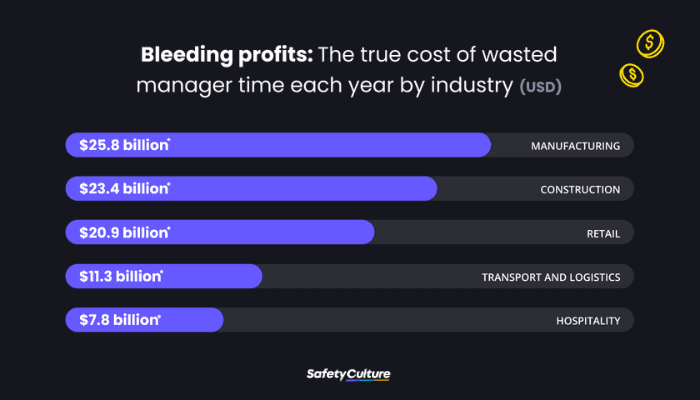
The True Cost of Waster Manager Time Each Year By Industry
Middle managers are the most underrated risk buffer in any company. And when the role isn't set up properly, the costs go down the drain fast. In fact, according to SafetyCulture’s recent Feedback from the Field (FFF) report, every week, managers lose more than 5 hours to low-priority work. Across the globe, that adds up to nearly $90 billion a year in wasted time.
Don’t leave them doing work upper or lower management can do better. Utilize the fact that they can help with the following:
Catching risks and near misses before they escalate
Interpreting and applying policies and regulations to their specific team
Knowing what’s best for the team when it comes to physical and mental health
Flagging when workloads, deadlines, or conditions are becoming unsustainable
And if you are in upper management, don't dismiss your middle managers or shut down their ideas. Based on the FFF report, 93% of managers have ideas for improvement, but just over half (55%) are implemented. If they have suggestions that could improve how your organization manages and mitigates risk, hear them out. They're closer to the work than you are. And by ignoring them, you increase the chances of letting risks get worse in the long run..
Yes, it is. Research shows that a well-functioning middle management can make a huge impact.
According to a 2023 McKinsey study, companies with strong middle managers greatly improved their risk management practices and grew their overall business value three to 21 times more than those with weak middle managers.
The other interesting find was that consistency mattered as much as individual performance, both for employee growth and risk management. It's not just about having one or two great managers, it's about building a workplace culture where everyone operates from the same playbook.
The previous FFF report also mentions that management is turning into an unwanted role with 2 out of every 3 managers saying they would rather just do their own work if it weren’t for a pay increase. A disengaged middle manager is a risk that doesn't show up on any safety report until it's too late.
The middle manager role is one of the most demanding in any organization. Here's what most of them are quietly dealing with every day, and what it costs the business when these go unaddressed:
Pulled in three directions at once: Middle managers are the only people in a company who have to keep everyone happy at the same time. When they're stretched too thin, the risks they're supposed to catch start slipping through the cracks.
Drowning in the wrong work: Workplace efficiency suffers when the people responsible for execution are buried in admin and bureaucracy instead. Every hour spent on the wrong work is an hour not spent identifying hazards, flagging issues, or keeping the team safe.
Expected to lead through decisions they didn't make: When a company restructures or rolls out a new program, middle managers are in charge of bringing their teams along. When people don't understand why things are changing, corners get cut.
Being ignored by upper management: Middle managers are usually the first to spot what's broken. When those observations don't reach the people making decisions, small risks quietly become big ones.
Burnout: A burnt out middle manager isn't just a people problem, it's a risk gap. When the person responsible for catching near misses and protecting their team is running on empty, things get missed.
This is why proper middle manager training is needed so that they know what they will encounter. The FFF report also shows that only one in five managers feel their organization sets them up to succeed, which suggests most companies aren't even investing in their middle management. The companies that figure this out won't just have better managers, they'll have better businesses.
Important notice
The information contained in this article is general in nature and you should consider whether the information is appropriate to your specific needs. Legal and other matters referred to in this article are based on our interpretation of laws existing at the time and should not be relied on in place of professional advice. We are not responsible for the content of any site owned by a third party that may be linked to this article. SafetyCulture disclaims all liability (except for any liability which by law cannot be excluded) for any error, inaccuracy, or omission from the information contained in this article, any site linked to this article, and any loss or damage suffered by any person directly or indirectly through relying on this information.


