Industry Insights
ISO 14001 has a gap problem. The 2026 revision might be able to close it.
Share article
Passing an ISO 14001 audit doesn't mean your environmental performance has actually improved, and that distinction is costing organizations more than they realize.
ISO 14001:2026 tightens expectations around leadership accountability, supply chain scope, and biodiversity, but still doesn't mandate specific performance outcomes.
How your organization uses ISO 14001 standard matters more than whether or not you pass the audit.
By now, you've probably heard the news: ISO 14001 is getting its first update since 2015. Since then after nearly 30 years of use, it’s become the world’s most widely adopted Environmental Management Standard (EMS) with over 670,000 certified organizations across more than 170 countries as per 2024.
And yet, many of them have two different goals when acquiring this certification: one, as intended, is to improve their environmental footprint, while the other just aims to pass the audit.
And half the time, they can't even manage that.
That’s the problem this upcoming 2026 revision aims to address.
The distinction matters because the 2026 revision is, at its core, an attempt to close that gap. So, to get to the problem, let’s clarify the two kinds of failings: hard failures and soft failures.
Hard failures are when the audit itself goes wrong. This is when the big guns come out: nonconformities in the internal audits, missing documents, and top management who can't demonstrate any personal involvement in the environmental management system.
Soft failures, on the other hand, are quieter, more common, and more likely to slip through the cracks. The audit is normal, the certificate gets renewed, but the organization's emissions haven't dropped. Waste volumes are flat. Energy use is up.
Everything is technically conformant, but nothing has actually improved.
Between the two, the hard failures are easier to fix. By improving your documentation, briefing your leadership, and running your internal audits properly, you’re good as new.
It’s the soft failures that are harder to fix because it blindsides your organization. Because the standard, by design, doesn't mandate specific outcomes. An organization can clear every clause and still produce the same environmental footprint it had before certification.
Enter: A gap. A big one.
There are a few reasons why these audits fail. Here are some of the most common ones:
Certification as the finish line: This occurs when the certification is treated as the goal, and not a means to one. Once the certificate is on the wall, internal audits become performative, objectives get recycled, and nobody asks whether the system is actually working.
Documentation written for the wrong audience: This occurs when documentations are written for auditors and not for the team, for the processes, and for the organization. If the organization itself is not aware of or updated with the written policies and plans, it becomes useless.
Leadership on paper only: This occurs when the top management’s involvement only amounts to signing a policy statement and attending one review meeting a year. This lack of leadership can affect how initiatives are carried out.
Ambiguous language, inconsistent application: This occurs when unclear and ambiguous instructions are given. That creates room for inconsistent interpretation across sites and teams.
It’s important to note that the 2026 update only aims to refine the past version, not reinvent it. The core framework retains the same 10-clause structure, but this time, it’s sharper and more concise in explaining what it expects from you.
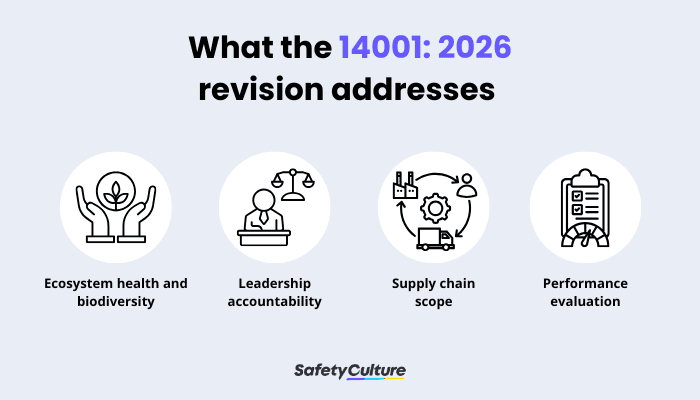
Here’s what’s changing:
Ecosystem health and biodiversity: Organizations must now consider how their activities affect local ecosystems, species, and natural habitats. It's no longer enough to manage your own outputs in isolation, organizations must now also be involved in the ecological context of their operations.
Leadership accountability: Top management are now required to demonstrate personal involvement, and not just sign off on a policy. The standard now requires support for all relevant roles, not just management levels.
Supply chain scope: The term "outsourced processes" has been replaced by "externally provided processes, products and services.” This broadens the EMS boundary to cover the full value chain.
Performance evaluation: There’s now a stronger focus on evaluating what the EMS is actually achieving, and not just whether or not it's being followed. Requirements for management review inputs and outputs are also now more structured.
Can you believe these gaps have existed for more than 10 years? A decade of organizations treating leadership commitment as nothing but a box-ticking exercise.
All the more reason why this update is needed.
The 2026 doesn't add new requirements for the sake of it.Every change applied is a direct result of a failure pattern that's been playing out in certified organizations for years.
Finally, the standard is catching up to the reality auditors have been watching from the room.
The ISO 14001 was never going to save the environment on its own, because. it wasn’t designed for that. Rather, it was designed to give organizations a way to manage their environmental responsibilities, a lens to which they can look through for identifying what matters, setting objectives, controlling impacts, and improving continuously.
The gap between certification and real environmental performance isn't a flaw in the standard.
It's a reflection of how the standard gets used.
If your organization treats this certification as just that, then that is all you’ll get: a certificate.
But, if you start now, if you use this certification for how it’s intended, you won't just be certified. You'll be one of the rare ones who can actually prove it.
Important notice
The information contained in this article is general in nature and you should consider whether the information is appropriate to your specific needs. Legal and other matters referred to in this article are based on our interpretation of laws existing at the time and should not be relied on in place of professional advice. We are not responsible for the content of any site owned by a third party that may be linked to this article. SafetyCulture disclaims all liability (except for any liability which by law cannot be excluded) for any error, inaccuracy, or omission from the information contained in this article, any site linked to this article, and any loss or damage suffered by any person directly or indirectly through relying on this information.