Industry Insights
ISO 14001:2026 key changes and guidelines for a smoother transition
Share article
ISO 14001:2026 builds on the existing framework with sharper requirements around life cycle thinking, leadership accountability, and supply chain oversight.
Environmental responsibility is no longer just an EHS team function; the 2026 revision distributes accountability across the entire organization, including top leadership.
With a transition deadline of May 2029, organizations have three years to close gaps, but those already treating their EMS as a living system will find the shift straightforward.
ISO 14001 is the world's most widely used Environmental Management Standard (EMS). After a decade of use, it's receiving its first significant update since 2015.
Let’s clarify something: the upcoming 2026 revision doesn't throw out what works. It builds on it.
Think of it as ISO 14001:2015 with sharper teeth and a broader lens that’s designed for a world where regulators, investors, and supply chains are all asking harder questions about environmental performance.
Let’s break it down.
ISO 14001 is the international standard for EMS planning and usage. It gives organizations a structured framework to identify, manage, and reduce their environmental impact.
It applies to any organization. Any size. Any industry. A small manufacturer in regional Australia can use it the same way a global logistics company does. The standard adapts to your context, not the other way around.
That’s why it’s in dire need of an update. Over 300,000 organizations in more than 170 countries are ISO 14001certified, proving that this isn’t just some niche standard—it’s a global baseline for environmental responsibility.
Now, you might be confused between ISO 14001 and ISO 9001, especially with ISO 9001’s 2026 changes.
ISO 9001 focuses on Quality Management Systems (QMS), making sure products and services consistently meet customer requirements. The new 2026 version of ISO 9001 does emphasize more on sustainability and environmental considerations, but at its core, it remains fundamentally a quality-focused standard.
ISO 14001, on the other hand, focuses more on the EMS of an organization, making sure your operations don't cause unnecessary harm to the environment and that you're meeting your legal and voluntary obligations.
The confusion is completely understandable though, as both standards use the same high-level structure (Annex SL), which makes it easier to run them together inside a single integrated management system.
Environmental compliance used to feel like a box-ticking exercise. The upcoming update changes that.
Regulations are getting stricter across every major market. ISO 14001 helps organizations stay ahead of compliance obligations, reducing the risk of fines, enforcement action, and the kind of reputational damage that's hard to recover from.
Of course it won’t replace your legal responsibilities, but it will give you a system to track and meet them consistently.
Not only will this update help you be spared from countless suits, it’ll also help you lower your costs. Better management of energy, water, and waste means lower costs.
Organizations that take their EMS seriously also often find it pays for itself through reduced resource consumption, fewer incidents, and less rework.
The short version? It's an evolution, not a revolution.
The 2026 revision keeps the same core structure, and the Annex SL framework is still there. What's changed is the precision: clearer language, tighter requirements, and a stronger focus on actual environmental performance, rather than just having the right processes in place.
Here's what's changing in the areas that matter most:
Under the 2026 revision, your EMS scope needs to reflect a life cycle perspective, urging organizations to think beyond the four walls of your own facility.
Organizations will need to consider the impacts they can control or influence like raw material sourcing, supplier practices, product end-of-life, and distribution.
Think: if you can influence it, you need to account for it.
And for the first time, environmental conditions are also getting explicit attention. The days these problems were just background noises are long gone. Climate change, pollution, and biodiversity are now needed to be factored into your EMS context.
Another major change is the extension of accountability requirements beyond management roles. Top management will be required to support all relevant roles and not just the people with"manager"in their title.
In essence, environmental responsibility is now distributed across the organization and no longer something that only sits with the Environment, Health, and Safety (EHS) team and gets reported upward. Leaders need to be personally accountable and involved, and that involvement needs to be visible, documented, and seen.
With the new update comes a new structured change management requirement. A new Clause 6.3 is introduced for structured change management, and shifts risks and opportunities to later in the planning process.
This is to close the gap that’s been hassling auditors and organizations alike. When processes, teams, or facilities change, the EMS needs to keep up.
ISO 14001:2026 formalizes that.
Emergency situations also get a new home in the revised standard. They're now to be explicitly identified when considering risks and opportunities, and not just when reviewing environmental aspects.
Clause 7 will get the fewest changes in the upcoming update, mostly terminology updates with no new requirements that’ll require major rework.
One addition worth noting, however, is Clause 7.1.3 clarifies that infrastructure requirements now apply to onsite, remote and hybrid work.
Organizations will be required to extend oversight to suppliers and partners, not just internal processes. This change will push operational controls further than it used to be.
Terminologies will change too, with what was previously called"outsourced processes"now referred to as"externally provided processes, products or services.” With that, comes a broader expectation:
If someone outside your organization is doing work that affects your EMS outcomes, you're responsible for making sure it meets the same standard.
Internal audits have always required a defined scope and criteria, but ISO 14001:2026 adds a third requirement: each audit must now have defined objectives.
A small change, yes, but not without a meaningful effect.
Objectives force clarity on what an audit is actually trying to find out, not just what it's looking at. It shifts audits from a coverage exercise toward a performance exercise.
The new update will simplify the structure of Clause 10.
Basically, Clause 10.1, which previously sat as a standalone general requirement for improvement, is removed. Its content is then absorbed into Clauses 10.2 (nonconformity and corrective action) and 10.3 (continual improvement).
This simplification creates a cleaner connection between finding a problem and actually doing something about it. Before, the improvement obligation and the corrective action process lived in separate sub-clauses. Now, they're joined.
An audit finding should lead directly into a documented improvement action, with no gap between the two. It's the same intent as before, just with less room to treat them as separate exercises.
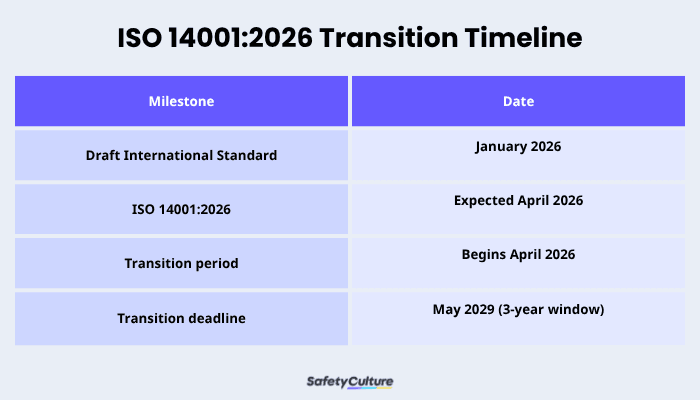
To give you an idea of the timeline, here’s a quick breakdown for you:
Draft International Standard: January 2026
ISO 14001:2026: Expected April 2026
Transition period: Begins April 2026
Transition deadline: May 2029 (giving you a 3-year window to adapt)
If your EMS is well-maintained and your team is engaged with it, this upcoming update is no reason to panic. You're already most of the way there.
But to help you out, here’s how you can be even more prepared for it:
Conduct a gap analysis: Review the published ISO 14001:2026 text clause by clause against your current EMS.
Update your documentation: Policies, procedures, scope statements, risk registers and operational controls all need to reflect new terminology and clause references.
Build your change management process: Consider any new plants, processes, suppliers, products, legislation, and climate risks when reviewing your EMS and, if applicable, existing ISO 14001 certification.
Reassess aspects, risks and opportunities: Apply a life cycle and climate lens, and, with the right emergency planning documents, make sure all potential situations are captured.
Extend controls into the supply chain: Define expectations for externally provided processes, products and services that affect your EMS.
Train your people: Make sure everyone understands their responsibilities, the new terminology and what good looks like under the 2026 standard, ideally with mobile-friendly training courses accessible at all times.
The 2026 revision isn't a reinvention, it's a raising of the bar.
All in all, the new ISO 14001:2026 aims to just keep up with where the environment is at, and it pushes organizations to keep up with it. It reflects a world where environmental performance is measured, not assumed.
Organizations that have been treating their EMS as a living system rather than a compliance document should find the transition straightforward.
Either way, three years is enough time to get it right.
Important notice
The information contained in this article is general in nature and you should consider whether the information is appropriate to your specific needs. Legal and other matters referred to in this article are based on our interpretation of laws existing at the time and should not be relied on in place of professional advice. We are not responsible for the content of any site owned by a third party that may be linked to this article. SafetyCulture disclaims all liability (except for any liability which by law cannot be excluded) for any error, inaccuracy, or omission from the information contained in this article, any site linked to this article, and any loss or damage suffered by any person directly or indirectly through relying on this information.