
Industry Insights
OSHA updated its heat rules in 2026. Here's what that actually means for your workplace
Share article
OSHA's 2026 National Emphasis Program (NEP) for Outdoor and Indoor Heat-Related Hazards update added 55 industries, including indoor workplaces that were previously overlooked.
With the proposed federal heat rule frozen, this NEP is the only active national enforcement tool protecting workers from heat hazards right now.
This 2026 update will run all the way through 2031.
There's no escaping the scorching heat. Construction sites, delivery routes, foundries, steel mills. Even the place where your bread gets made.
In 2020, a bakery hired someone to load and unload dough on the oven line. Everything was going fine for their first two days.
But on their third day, the oven was running at 550–575°F (Celsius). Humidity had climbed to 79%, making the air so saturated that you can’t even sweat. Plus, he was already wearing layers of protective clothing. And the fans had been removed from the floor because of COVID protocols.
After being asked to cool down and hydrate, he was later found outside, passed out in the parking lot. By the time emergency services arrived, his temperature reached as high as 109°F (42.78°C)! Doctors consider a fever dangerous at 103°F (39.44°C).
He was pronounced dead at the emergency room.
This is exactly the kind of case that pushed the US Occupational Safety and Health Administration (OSHA) to make heat a national enforcement priority. In April 2026, OSHA updated its National Emphasis Program (NEP) for heat-related hazards, extending it through 2031.
Heat doesn't stay outside. It follows workers indoors too. And OSHA is making it known just how dangerous that is.
OSHA, as big as it is, doesn’t have unlimited resources and people. They have a relatively small number of inspectors that cannot physically inspect everywhere. So they need to use their resources wisely and target the industries and problems without wasting any bandwidth.
This is where NEP comes in. Instead of spreading resources thin across everything, OSHA looks at injury data, fatality rates, illness reports, and industry trends, and identifies the biggest hazards to different workforces right now. Different issues and concerns can have their own NEP.
Recently, heat-related incidents were identified as one of the top safety concerns of workplaces around the US.
Having a NEP focused on heat-related hazards was introduced as early as April 2022, when OSHA first launched the program to specifically target indoor and outdoor heat-related hazards.
Before 2022, OSHA was conducting only about 200 heat-related inspections per year, including just 15 fatality inspections.
That wasn't enough.
Because OSHA found that between 2015 and 2019, environmental heat cases were killing an average of 35 workers per year and sending 2,700 more home with injuries serious enough to miss work.
Some common heat-related workplace hazards would be:
Outdoors:
Extreme heat and direct sun exposure
High humidity (makes the body unable to sweat)
Physical work in high temperatures (construction, farming, road work)
No nearby shade or cooling areas
Working on heat-absorbing surfaces like asphalt and rooftops
Dehydration from working outdoors
UV radiation exposure
Indoors:
Radiant heat from ovens, furnaces, and industrial equipment
Poor ventilation and cooling systems
High humidity in enclosed spaces (laundries, commercial kitchens)
Wearing heavy or layered Personal Protective Equipment (PPE) clothing
Physical exertion in confined hot spaces
If the NEP for heat illness prevention and safety launched in 2022, why was there a need to update it? How much could change in just a few years?
Two words: global warming.
Climate change was already a big factor into why a dedicated NEP for heat safety was introduced. But now, in 2026, it’sonly gotten worse as days are getting hotter and hotter. In fact, 2024 was the hottest year ever recorded, beating out any year in the last 175 years of climate data.
The numbers have been climbing since 2022. Heat inspections now make up 6% of all federal OSHA inspections, up from just 0.5% before 2022. In 2024, according to National Safety Council data, there were 48 work-related deaths from environmental heat exposure, along with 7,100 Days Away, Restricted, or Transferred (DART) cases involving heat exposure across 2023 and 2024 combined.
Global temperatures are hitting record highs. New industries are showing up on the heat risk radar. And with OSHA's proposed federal heat rule currently on hold, there's no formal heat safety law in place. This makes the April 2026 NEP for Outdoor and Indoor Heat-Related Hazards the only active enforcement tool workers have.
A lot can change in four years. Here are the biggest updates in the 2026 National Emphases Program revision:
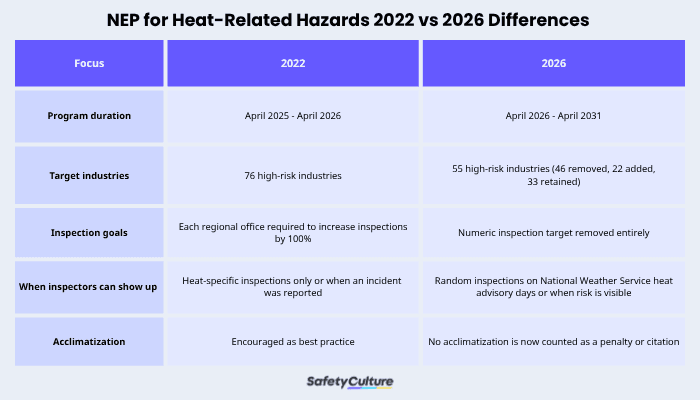
NEP for Heat-Related Hazards 2022 vs 2026 Differences
The NEP update runs through 2031.
OSHA refreshed the list of high priority industries to 55 (22 added, 46 removed, 33 retained).
Regional offices no longer have a required inspection quota to hit.
Random inspections can now happen on National Weather Service heat advisory days or whenever a heat hazard is visible during any inspection.
Not having an acclimatization plan can now result in an OSHA citation.
If your industry is on the list, or if heat hazards are present in your workplace, OSHA could already be coming to inspect.
Under the 2026 update to the NEP for Heat-Related Hazards, more industries covered with stricter inspection triggers. Also, there are now clearer consequences for employers who skip heat safety basics. And as a manager, what you do next matters more than you think.
Here are some ways to put these changes into practice:
Check if your industry is on OSHA's updated 2026 target list and make the necessary changes.
Build an acclimatization plan for new workers.
Be prepared for unannounced OSHA inspections on heat advisory days.
Do a walkthrough of your workplace, inside and out, with a dedicated checklist for inspections.
Train your team to recognise early signs of heat illness.
Document your heat prevention plans, training records, and acclimatization schedules.
Cut unnecessary equipment runtime as it reduces heat exposure and your carbon footprint.
Treat heat as a year-round issue, not just a one time thing.
You can't control the weather. What you can control is what happens inside your workplace. OSHA isn't waiting around anymore. And frankly, neither should you.
Important notice
The information contained in this article is general in nature and you should consider whether the information is appropriate to your specific needs. Legal and other matters referred to in this article are based on our interpretation of laws existing at the time and should not be relied on in place of professional advice. We are not responsible for the content of any site owned by a third party that may be linked to this article. SafetyCulture disclaims all liability (except for any liability which by law cannot be excluded) for any error, inaccuracy, or omission from the information contained in this article, any site linked to this article, and any loss or damage suffered by any person directly or indirectly through relying on this information.


