
Industry Insights
What can leaders expect from the ISO 9001:2026 changes?
Share article
Leadership is taking more accountability by driving quality, culture, and improvement, not just signing off on it.
Climate and sustainability play a larger role in the standard, so quality planning has to account for environmental risks and sustainable operations.
Risk and opportunity now require a more proactive mindset. Leaders need to encourage experimentation and improvement, not just focus on avoiding mistakes.
Keeping your ISO 9001 certification shouldn’t derail day-to-day operations. But for many leaders, it does.
You have to book an auditor, pay for recertification and extra consulting, rework documents, and redo audits—all while customers and stakeholders start questioning your organization’s capability if certification lapses.
It’s the kind of work you want to do only once and move on from right after it’s done. However, it’s time to get those documents and audits back out, because the upcoming changes for ISO 9001:2026 are going to take effect soon.
The good news is the revisions are less about rewriting everything and more about how leaders should show up in an organization’s quality system. If you prepare early, it doesn’t need to be painful.
Here’s what’s changing and what it means for you:
Here’s a quick breakdown of the changes from ISO 9001:2015 to ISO 9001:2026 that leaders specifically need to take note of:
In the 2015 version, climate change and sustainability were always implied, but never outright mentioned. Now, with the 2026 revision, they play a big part in quality management.
For leaders, this means quality planning now needs to look beyond internal considerations. Ensuring sustainable operations is no longer optional, especially now when customers are demanding more eco-friendly products and services. Planning for natural disasters also matters more now than ever. Extreme weather changes, flooding, and resource constraints need to be considered ahead of time, because they’re now risks that can significantly impact your business if you’re not prepared.
In the ISO 9001:2015 standard, opportunity and risk were under the same clause, which meant businesses focused more on risk mitigation than opportunity. To balance this, ISO 9001:2026 will separate risk and opportunity so teams can take a more active approach with opportunity-based thinking.
Opportunity-based thinking doesn’t just happen on its own. Leadership has to set the direction. If teams are only rewarded for avoiding mistakes, opportunities for improvement will rarely surface. Leaders need to encourage calculated experimentation and improvement.
Culture and ethics were implied through leadership and support clauses in the 2015 version, but the 2026 revisions will double down and expand on them. This means that no matter how good your product is, if the team behind it enables a toxic environment, those results won’t last.
Culture and ethics always start at the top. If your teams are hesitant or afraid to speak up, it’s a sign of fear, not alignment. And improvement can’t happen without trust.
ISO 9001:2015 required continual improvement actions, but leadership involvement was often reactive.
ISO 9001:2026 will take a different approach. Leaders are expected to be actively involved in driving incremental improvements, not just approving corrective actions. This may mean conducting regular floor walks, performing due diligence on suppliers beyond low cost, and allocating budgets to prepare for emergencies.
There’s still roughly five to six months to prepare before the revision goes live in September 2026, though it isn’t final yet. A three-year transition period similar to ISO 9001:2015 is also expected. This gives leaders more than enough time to prepare for multiple audits without rushing.
However, it’s best to start now. Starting early gives you control instead of urgency.
Practical steps to take now include:
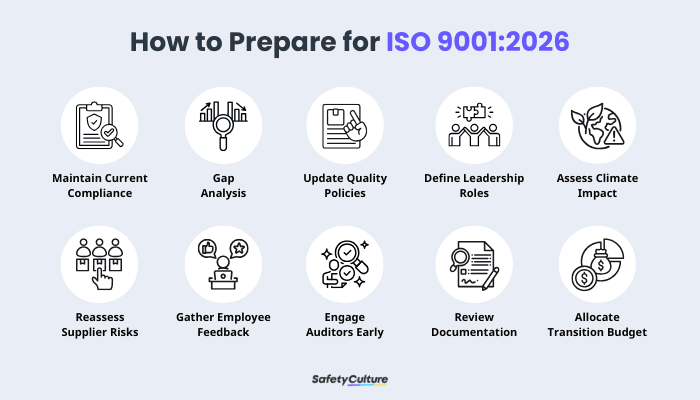
How to Prepare for ISO 9001:2026
Maintaining compliance with existing ISO 9001:2015 Clauses
Conducting a gap analysis against the draft ISO 9001:2026 requirements
Reviewing, updating, and simplifying quality policies
Defining leadership roles and accountability for the transition
Assessing how your product or service is affected by climate change
Reassessing supplier risks beyond cost and availability
Gathering employee feedback through surveys
Engaging with your certification or auditing body early
Reviewing documented information for clarity and relevance
Allocating budget for transition, new tools, and employee training
Preparing early allows leaders to better focus on meaningful improvement rather than scrambling to meet deadlines at the last minute. Doing so also helps organizations prevent incomplete documentation, re-audits, missed auditor bookings, added costs, and unnecessary stress.
Important notice
The information contained in this article is general in nature and you should consider whether the information is appropriate to your specific needs. Legal and other matters referred to in this article are based on our interpretation of laws existing at the time and should not be relied on in place of professional advice. We are not responsible for the content of any site owned by a third party that may be linked to this article. SafetyCulture disclaims all liability (except for any liability which by law cannot be excluded) for any error, inaccuracy, or omission from the information contained in this article, any site linked to this article, and any loss or damage suffered by any person directly or indirectly through relying on this information.


