
Best Practices
AI didn't break the risk assessment process. It just revealed how much was falling through the cracks.
Share article
AI can't replace the human element of the risk assessment process.
Risk data goes stale faster than most teams realize, and AI is what keeps it current.
A logged near-miss means nothing if nobody acts on it; AI makes sure someone does.
Risk assessments get missed sometimes. They go to the wrong person, sit in the wrong file, or just get buried under everything else. Humans forget. And of course, they only realize they forgot after something goes wrong.
Take this incident in a Texas City refinery:
For years, warning signs had been piling up: ageing equipment, like an alert system that would sometimes lie and give false readings. These risks were logged and reviewed, but by different teams and at different times. In the end, no one acted on them.
On March 23, 2005, a distillation tower was restarted after maintenance. Operators kept filling it well past safe levels, and the alert system gave the wrong readings, which was, sadly, normal.
Liquid and vapor shot out through an old vent stack instead of a safer flare system, and a vehicle nearby ignited it. The explosion killed 15 workers and injured more than 170 others.
But that was over 20 years ago.
Now, workers have AI, and that changes how risks get caught. It makes sure risk assessments get seen and acted on before something goes wrong.
Absolutely, yes. It smoothens out the risk assessment process in specific, grounded ways.
AI can do things like:
Process large volumes of data faster than manual review
Identify patterns across data sources that are easy to miss
Monitor risks in real time, not just at scheduled reviews
Flag prioritized risks to the right people before they're forgotten
Keep a transparent, timestamped audit trail of what was assessed and when
None of these replace human judgment. AI can never do that, and it’s not meant to. But they do give that judgment significantly more to work with, which can be the difference between a normal day and a disaster.
Traditional risk assessments are thorough on paper, but even when a risk gets flagged, that doesn't always lead anywhere.
One survey of over 600 IT professionals by CyberGRX found that less than 8% of these assessments actually resulted in action, like disqualifying a risky contractor or forcing someone to fix a security issue. Even when an assessment actually found something wrong, only 24% of organizations worked to fix the issue. The rest either just asked nicely and hoped, or did nothing at all.
But with the help of AI, closing that gap doesn't depend on someone remembering to follow up. The system keeps flagging the risk until it's actually resolved.
Traditional risk assessments also only capture an accurate picture of risk at the time it’s done. The problem is, that picture rarely gets updated as fast as conditions change and it becomes outdated just like that.
Most organizations know they should review their risk assessments more frequently. However, most don't, because manual reviews are time-intensive and expensive. This lack of action then contributes to how the gap between "how current our risk data actually is" and "how current we think it is" quietly widens.
With AI in the mix, what you think you know about your risk and what's actually true stop drifting apart. The system is watching continuously, so there's little to no widening gap to close.
AI doesn't just help catch existing risks faster. It helps prevent the secondary and compounding risks that humans are more likely to miss.
When a near-miss gets logged, AI doesn't just file it away like staff naturally would. It checks whether the same thing has happened before, and whether the same conditions are building up somewhere else in the operation right now, because unlike a single reviewer, it's watching everything at once.
That's what AI in risk management actually changes, risk assessment stops being something you schedule and starts being something that never stops running.
Research from Wolters Kluwer confirms this shift is already happening, with operational risk management gradually moving from periodic assessment toward continuous oversight supported by AI. That shift matters more than most teams realize until something slips through.
Integrating AI into an existing risk program doesn't require rebuilding from the ground up. The structure stays the same; AI just makes each phase more thorough.
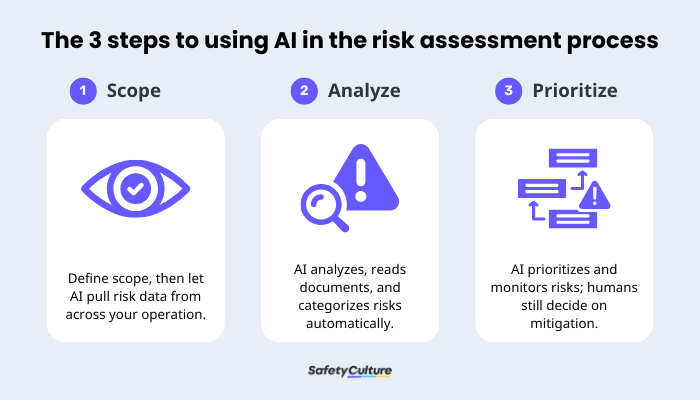
The 3 steps to using AI in the risk assessment process
AI can’t read your mind, so you need to tell it what it can and can’t do. Define the scope of its work and impact on risk assessment, such as where they operate and what decisions they influence.
Once the scope is clear, AI can then pull risk data from across your whole operation: sensor alerts, maintenance records, audit findings, near-miss logs, and regulatory updates. The result is a much wider view of potential risks than any manual review would ever produce.
With more data in the pool, AI gets to work assessing how likely each risk is and how bad it could get. The more incidents it learns from over time, the sharper those assessments become, so make sure that you’re feeding it trustable and correct information.
AI can also read. Natural language processing scans inspection reports, contractor documentation, and email threads, and flags risk signals that a manual reviewer would almost certainly miss just by volume alone.
From there, every risk gets categorized by type, severity, and area of impact. Automatically and consistently. Not depending on which reviewer happened to be assigned that day.
Once everything is categorized, AI ranks the risks by impact and likelihood. Not just what looks risky today, but what the data suggests could become a problem tomorrow.
The mitigation part still needs a human. Manual review and decision-making are necessary in determining what controls to put in place, who owns them, and what the deadline looks like. That doesn't change. But once those controls go live, AI keeps watching. It can also flag when something triggers a reassessment when conditions shift. Teams that understand the full risk assessment process are better placed to layer AI on top of it without missing a step.
That continuous loop is what separates AI-assisted risk management from a risk register document that sits on a shelf. It's why teams that adopt it stop treating risk assessment as something they schedule, and start treating it as something that never switches off.
Blink Charging is a good example of what that looks like in practice. With the help of real-time digital tools, their team was able to report 123 hazards and near-misses in a short period, risks that would’ve been overlooked or passed on.
When we started rolling out SafetyCulture, people were wary that it might create extra work. But, they quickly realised it helps our workforce to work smarter, not harder. Now we can address issues faster than before, keep our teams running smoothly and safely.
Important notice
The information contained in this article is general in nature and you should consider whether the information is appropriate to your specific needs. Legal and other matters referred to in this article are based on our interpretation of laws existing at the time and should not be relied on in place of professional advice. We are not responsible for the content of any site owned by a third party that may be linked to this article. SafetyCulture disclaims all liability (except for any liability which by law cannot be excluded) for any error, inaccuracy, or omission from the information contained in this article, any site linked to this article, and any loss or damage suffered by any person directly or indirectly through relying on this information.


