
Best Practices
Section 26A is new. Here's why NSW added it to the Work Health and Safety Act
Share article
With Section 26A of NSW's Codes of Practice, nobody needs to get hurt for a business to prove they’ve breached safety standards.
Psychosocial hazards, fatigue, silica, healthcare, and falls from heights are prioritized right now, but every approved code is enforceable.
Proof of compliance needs to exist even before an inspector walks in.
One random day in New South Wales (NSW), a 19-year-old plumbing apprentice was just clearing out a trench with a shovel. This is the kind of routine work apprentices do every day.
But then, the worst happened. A 2-metre unsupported wall collapsed on him. He didn't make it, and the business was fined $225,000.
You'd have to ask yourself, why was the wall unsupported in the first place? Were they only going to act once someone got hurt?
This is the exact gap that led to the creation and implementation of section 26A of the NSW Work Health and Safety Act. Under it, inspections are stricter now, and regulators don't need proof someone was harmed to act. Businesses need proof they were compliant, before anything goes wrong.
The Work Health and Safety Act is the main law that keeps workplaces safe in NSW, Australia's most populated state.
The main goal behind it is simple: businesses have to keep their workers safe, using whatever steps are reasonably possible. This is where the Codes of Practice come in. It is a detailed guidance document SafeWork NSW publishes for a specific hazard or industry.
In theory, all businesses had to do was to stay compliant with the code. But that's where the problem started. Businesses were cutting costs or skipping safety protocols entirely, because at the end of the day, ignoring the code didn't matter without physical evidence that someone had actually been harmed.
This is why something needed to be changed.
Section 26A of the Work Health and Safety Act 2011 (NSW) was introduced.
Before this, every approved Code of Practice in NSW like psychosocial hazards, manual handling, working at heights, and healthcare was just something a business could ignore, as long as they could argue some other way that they were managing the risk safely.
From July 1 2026 onward, every Person Conducting a Business or Undertaking (PCBU) now is required by law to do one of two things for any code that applies to their workplace:
Follow the code, or
Do something different, but prove it's just as safe or safer.
Now, if a business does neither, that alone can be treated as a legal breach. A regulator doesn't need to show any proof that anyone got hurt. They just need to show the business isn't meeting the code and can't justify an alternative.
Every Code of Practice in NSW was affected, more than 40 of them. You can see the full list here. But let’s talk about the ones the Health and Safety Act are specifically focusing on these next couple of years:
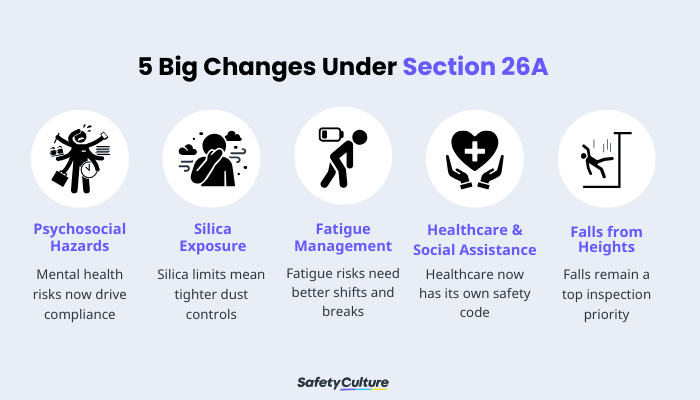
5 Big Changes Under Section 26A
Managing Psychosocial Hazards at Work like excessive workload or discrimination was probably the most affected code because of how important mental health has become over the past years.
In all of Australia, mental health conditions made up 12% of serious workers' compensation claims in 2023–24, a 14.7% increase in the number of these claims compared to the year before.
SafeWork NSW is treating this more seriously now. In March 2026, they added 20 more psychosocial inspectors as part of a broader $127.7 million investment in workplace health and safety, with the power to run unannounced visits and issue on-the-spot fines.
Training alone also won't cut it anymore. Inspectors want to see that a business changed something structural about the work itself, workload adjustments, break periods, or how a team is managed, not just a one-off seminar.
One of the most serious workplace health problems in Australia right now is silicosis from engineered stone cutting. Cases among young stonemasons have been growing, leading Australia to ban the manufacture, supply, and installation of engineered stone in 2024.
The ban only targeted one source of respirable crystalline silica. Silica can also be found in sandstone, granite, concrete, and the rock that tunnels are cut through.
From December 1, 2026, there's a hard rule to follow now: the legal exposure standard is 0.05 milligrams of silica dust per cubic metre of air, measured over an 8-hour work day. Cross that line, and your business will get penalized.
Using Personal Protective Equipment (PPE) alone won't cut it here either. Dust masks should be the last line of defense, not the first. Inspectors expect to see dust suppression, wet cutting methods, and proper ventilation built into the job itself, not just a box of respirators handed out at the start of a shift.
Managing the risk of fatigue at work only became an official NSW code in February 2026. Before that, fatigue only had a guide, and nobody had to actually follow it. But with the rise of psychosocial risks, it makes sense that burnout is up too. Like every other code, it became enforceable under section 26A.
Did you know fatigue is a bigger workplace risk than drugs or alcohol? It's four times more likely to cause impairment on the job. Also, one in two Australians are facing workplace burnout, according to a community poll of 1,000 people in June 2025. Both cloud judgement, slow work down, and drive up sick leaves.
Back in 2024, fatigue was recognized as a psychosocial hazard under the Code of Practice. In 2026, it got big enough to warrant its own dedicated code, not because it's not a psychosocial hazard anymore, but because it's significant enough to deserve its own spot.
The code expects businesses to look at shift design, rest breaks, and workload first, changing the schedule and the job itself, rather than expecting workers to just push through exhaustion to prove themselves for that next raise or promotion.
The newest addition to the list is the inclusion of the healthcare and social assistance industry. These are your nurses, aged care workers, and disability support workers. And rightfully so, since it's already the most commonly injured industry in Australia.
It's gotten so bad that almost four in 10 workers in health and community services report being exposed to violent or traumatic incidents on the job. This is why the addition was needed.
Before this, healthcare and social assistance businesses only had the general duty to go on, wherein a business must ensure the health and safety of workers, so far as reasonably practicable. Now, the industry has its own dedicated Code of Practice.
NSW adopting this code makes it the first jurisdiction in the country to do so, ahead of the national model code still being finalized elsewhere. For an industry already stretched thin, the standard businesses are measured against just got a lot more specific.
While falls from heights doesn't have a new code, what's changed for 2026-27 is that SafeWork NSW named it one of its four top enforcement priorities.
Falls from height are one of the biggest killers on the job. In 2024, they caused 13% of all worker fatalities in Australia. In NSW specifically, SafeWork recorded more than 600 fall-related incidents, including five fatalities, in the past 12 months alone.
This risk always had rules attached to it, and ladders, scaffolds, roof work, and harness systems have been covered for years. But now, the focus on enforcing it has sharpened. If your construction site has a risk of falling 2 metres or more, that's already considered dangerous and would need proper safety protocols.
The gap inspectors keep finding isn't a lack of rules, it's a lack of follow-through. Some workers think they've done it enough times that they don't need to follow safety protocols. That's exactly the kind of gap the enforceable code standard is designed to close; experience and habit don't count as proof of a safe system.
Cultivate a safe working environment and streamline compliance with our EHS solutions.
Not only did the codes get more in-depth and specific, but the punishment for failing to follow also got stricter.
Unlike the US, Australia uses a different type of measurement for non-compliance instead of a fixed dollar figure: penalty units. One penalty unit is equivalent to $123.31 in NSW right now. But each state sets its own dollar value per unit, so the same number of penalty units can mean a different fine depending on where you are.
The WHS Act splits offences into three tiers, plus a fourth for fatalities:
This is the lowest tier of penalty that involves less serious risk exposure like not consulting workers on a safety decision or failing to keep proper safety records. Workers specifically can face penalties of up to 607 penalty units, which costs approximately $74,800 in 2025-26.
No recklessness needed here, just a failure that exposed someone to a risk of death or serious injury like an unguarded machine on the factory floor or ignoring a fire exit that has been broken for months. The penalties are lower than Category 1, but still substantial.
The most serious tier behind industrial manslaughter. This is when someone negligently puts someone at risk of death or serious injury. As of 1 July 2024, this carries a maximum of 10 years imprisonment for an individual and up to $10.4 million for a corporation.
NSW passed this offence in June 2024, on top of the three categories above. If gross negligence gets a worker killed, the maximum penalty is a $20 million fine for the company, and up to 25 years in prison for the individual responsible.
With Codes of Practice now the law, and penalties higher across the board, businesses can't treat compliance as a checkbox anymore. Here's where to start.
Map hazards against every code that applies to the workplace
Apply the hierarchy of controls
Keep training current, role-specific, and not optional
Check if your safety measures are actually working, and update them if they aren't
Consult with your workers directly
If you're not following the code exactly, have proof that your approach is safer
Assign someone to watch for new or updated codes in the industry
Compliance is more serious now than before. Gone are the days of explaining yourself after something went wrong. Now, proof is all that matters.
Important notice
The information contained in this article is general in nature and you should consider whether the information is appropriate to your specific needs. Legal and other matters referred to in this article are based on our interpretation of laws existing at the time and should not be relied on in place of professional advice. We are not responsible for the content of any site owned by a third party that may be linked to this article. SafetyCulture disclaims all liability (except for any liability which by law cannot be excluded) for any error, inaccuracy, or omission from the information contained in this article, any site linked to this article, and any loss or damage suffered by any person directly or indirectly through relying on this information.


