Best Practices
Rest is not the enemy of productivity, fatigue is
Share article
Fatigue is a workplace safety issue, not just a wellness one.
The culture around overwork is the real hazard.
Microbreaks are needed to keep work performance from falling off a cliff.
In 2007, Arianna Huffington was just checking emails in the US when she suddenly collapsed and woke up in a pool of blood, and a broken cheekbone. Imagine collapsing that hard, you break your cheekbone.
She went to the doctors expecting the worst. The diagnosis? No underlying illness. Just exhaustion.
Before the collapse, Arianna had apparently been working 18-hour days building a website she co-founded The site was only two years old at the time, so she was running from interviews to speaking events to the day-to-day office grind.
Arianna said:
"For many years, I subscribed to a very flawed definition of success, buying into our collective delusion that burnout is the necessary price we must pay for success."
She thought her achievements were because of the grinding, not in spite of it.
Later on, she launched Thrive in 2016 with the goal to eliminate work burnout and find the connection between wellbeing and performance, through seminars and coaching focused on rest and recovery.
No amount of coffee or energy drinks can cure workplace fatigue. Burnout is a behavior and workplace culture problem, not something that can be cured within a day.
When talking about workplace safety, physical hazards usually come to mind, and in some industries, they matter most. But there's another harder-to-see hazard that doesn't show up on inspection checklists:
Workplace fatigue.
It's real, and even often built into how organizations operate. Most businesses technically comply—they implement rest break policies, shift limits, and maybe a wellness program. But the lived culture often points the other way.
Overworking gets quietly rewarded, as people who stay late are seen as dedicated. Additional research shows workers logging 60-hour weeks are also favored for promotion nearly 89% of the time over equally performing colleagues who work 40.
And this is a growing trend, with more than 8 out of 10 employees at risk of burnout. At the same time, less than half of employers design work with wellbeing in mind.
Policies exist. The culture just says something different.
AI was supposed to reduce workload, not add onto it. But reality is often more complicated.
A study published in Harvard Business Review tracked how generative AI changed work habits at a 200-person US tech company over eight months. Employees worked faster and extended their hours voluntarily. The company didn't mandate any of this. Workers did it on their own initiative because AI made doing more work possible.
That's the part worth paying attention to: when a tool makes working feel effortless, the culture around making a few extra cash raises to the top.
Whether AI becomes a workload problem or a workload solution comes down to the same thing that determines most workplace safety outcomes: the culture it operates inside. In an organization that already rewards work and more work, AI accelerates the problem. In one that actively protects recovery time, it can genuinely share the workload.
A lot of research has been done on how to best rest and recover—not only after work, but during it.
Workers get tired regardless of role or industry. When work is cognitively demanding and sustained, the brain has a limit. Research by the Draugiem Group found that the top 10% most productive workers weren't the ones who pushed hardest or the longest. They worked in focused 52-minute sprints, took a 17-minute microbreak completely away from their screens, then returned for the next sprint. Their breaks were what made the next 52 minutes possible. Rinse and repeat.
Another perspective comes from Burnout: The Secret to Unlocking the Stress Cycle by health behavior scientist Emily Nagoski and music professor Amelia Nagoski. The book argues that stress is a physiological process with a beginning, middle, and end,but most people never complete it.
When a stressor (such as a tight deadline or a workplace incident) hits, the body activates a stress response. However, those stressors are rarely resolved. That accumulated, unresolved stress is what leads to burnout, exhaustion, and physical health deterioration.
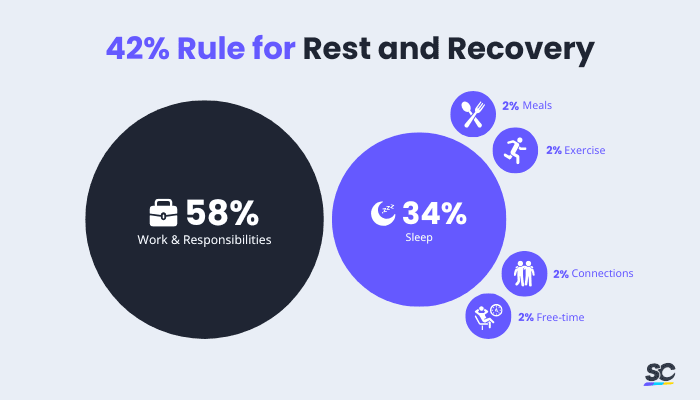
42% Rule for Rest and Recovery
One of the ways the Nagoskis suggest managing this long-term is the 42% rule—a guide for how much rest the body and brain need to prevent burnout from building. With the 42% being split into sleep, healthy meals, exercise, social connections, and free-time for yourself.
Research from the US National Safety Council (NSC) shows 13% of workplace injuries can be attributed to fatigue. Occupational Safety and Health Administration (OSHA) adds that almost 15 million US workers have full-time jobs requiring evening, night, rotating or other irregular shifts—exactly the conditions fatigue thrives in. Other research also suggests employee burnout costs US employers between $4,000 for frontline workers and over $20,000 for executives every year.
Here’s a fun fact: if you miss enough sleep, the brain performs like it's had a few alcoholic drinks. After 17 to 19 hours without rest, reaction time and accuracy drop to the equivalent of a 0.05% blood alcohol level. In high-risk industries, that's the difference between a close call and a fatality.
The signs of fatigue can be split into two sections: the physical signs and the behavioral signs.
Taking more sick days than usual
Snapping at colleagues over small things
Withdrawing from the team or skipping casual conversations
Exhibiting visibly lower energy compared to their usual self
Performing more mistakes than usual on familiar tasks
Skipping breaks or eating lunch at their desk
Taking longer to complete tasks they normally finish quickly
Forgetting basic safety steps or cutting corners on tasks
Stalling on tasks that don't usually require much thought
Showing up, but clearly not present
That said, none of these signs are a definitive diagnosis. Maybe an employee might’ve just caught the flu. Someone low on energy might have had a rough night. The point isn't to jump to conclusions; it's to have conversations about how they’re doing. When these signs start appearing consistently, a one-on-one is the right first step.
Checking in on the team is a start, but the bigger goal is building a culture where people feel safe enough to say when they're struggling. If workers are afraid to push back on workload, they’ll force themselves to overwork rather than speak up.
That gets worse when overtime pay enters the picture. When working overtime is quietly rewarded through bonuses and promotions, people will keep pushing past their limits without noticing what it's costing them.
AI can help ease the load, but not in every environment. In workplaces where output is prioritized over people, it becomes another tool to squeeze more work out of already stretched teams.
That's where managers matter. Managers are responsible for catching the signs early, having the necessary conversations, and keeping the culture honest.
But doing it well takes more than good intentions. Mental health is more complex than it appears on the surface, and managers aren't psychologists. Proper training matters here, not just gut feel. Not just for the team's sake, but for the business as well.
Important notice
The information contained in this article is general in nature and you should consider whether the information is appropriate to your specific needs. Legal and other matters referred to in this article are based on our interpretation of laws existing at the time and should not be relied on in place of professional advice. We are not responsible for the content of any site owned by a third party that may be linked to this article. SafetyCulture disclaims all liability (except for any liability which by law cannot be excluded) for any error, inaccuracy, or omission from the information contained in this article, any site linked to this article, and any loss or damage suffered by any person directly or indirectly through relying on this information.