
Best Practices
Leadership's most overlooked responsibility: psychosocial safety
Share article
Many forget that leadership has a responsibility to ensure psychosocial safety in the workplace
It can be hard for leaders and managers to manage psychosocial safety if they’re not properly equipped for it, hence the need for training and exposure
While managing psychosocial is leadership’s job, it doesn’t have to be done alone
When you think of a leader, you might imagine someone like this: someone confident, decisive, and inspiring. Someone who gets things moving, setting the direction for their team, organization, or goal.
And when it comes to what a leader actually does, you might think of someone who attends a lot of meetings, champions their team in front of senior stakeholders, and helps the people under them grow. Someone who passes information up and down the chain, and makes sure their team has what they need to do their best work.
But what you might not consider when thinking about leadership is how they’re also responsible for employee wellbeing. Specifically, setting the psychosocial tone of their workplace.
Psychosocial safety is about how well a workplace protects the mental health and emotional wellbeing of employees. It involves creating a workplace where people feel supported, safe, respected, and able to perform their work duties, without fear of harm, stress, and other unnecessary psychological strain.
It also shifts responsibility from the individual ("you need to be more resilient") to the system ("we need to design work that doesn't break people").
Common psychosocial safety hazards at work include the following:
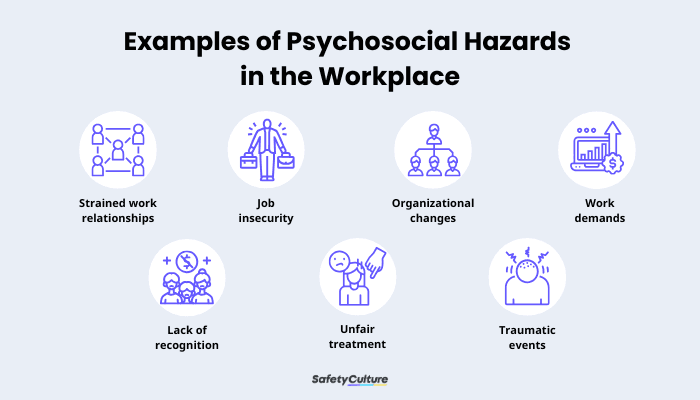
Strained work relationships
Job insecurity
Organizational changes
Work demands
Lack of recognition
Unfair treatment
Traumatic events
Poor psychosocial safety is directly linked to:
Burnout and chronic stress
Anxiety and depression
High absenteeism and turnover
Reduced productivity and engagement
Workplace injuries (stress impairs judgment and focus)
Having proper psychosocial support and policies in place ensures psychological safety, which is an individual's belief that they won't be punished or humiliated for speaking up.
If an organization has poor psychosocial safety (e.g., burnout-inducing workloads, no harassment protections), psychological safety within teams will be very hard to sustain. You can have a manager who's brilliant at creating team openness, but if the organization's systems are harmful, people will still suffer.
A healthy workplace needs both: systemic protections at the organizational level, and a strong company culture built on openness and trust at the team level.
How leaders—especially middle managers —behave and create psychosocial safety systems greatly influence how a team or organization operate. Sitting between higher management and frontline workers, they have the clearest view on what psychosocial policies are needed, what risks need to be addressed, and what changes need to be made. This makes them the most important factor in setting the psychosocial tone of a workplace.
This means when leaders commit to making safety a priority, their teams follow. When they don't, it shows.
Sometimes, though, psychological safety gets left out of it. And that’s where the problem lies.
As part of maintaining a culture of safety, their responsibilities include maintaining and improving the Psychosocial Safety Climate (PSC) in their teams. PSC is defined as the shared perceptions of organizational policies, practices, and procedures for the protection of worker psychological health and safety—and it’s shaped largely by management behavior..
PSC also reflects the balance of concern by management about psychological health versus productivity. And if leaders consistently prioritize productivity over people's mental health, they become directly responsible for the harm that follows.
The business case is clear too. A study by Workplace Options supports this, showing how 93% of business leaders worldwide agree psychological safety directly impacts business performance and profits. Nine out of ten respondents also estimate at least 6% return on investments when psychosocial safety policies are properly carried out. Psychologically safe employees also lead to higher retention rates, which leads to higher morale, drive, and engagement.
There's also a legal dimension to this. There’s ISO 45003, an international standard that guides organizations how to manage psychosocial risk. And governments worldwide—including Mexico, Chile, the UK, Canada, Japan, South Korea, Australia, and Colombia—have passed legislation requiring employers to identify, eliminate and prevent psychosocial hazards at work.
Cultivate a safe working environment and streamline compliance with our EHS solutions.
Ensuring psychosocial safety in the workplace is genuinely hard. Not because leaders don't care, but because there are real, structural obstacles in the way. Here are the most significant ones:
Skill gaps: While many managers believe psychological safety is important at work, not all feel properly equipped or trained to handle challenging conversations with their teams. So even if leaders want to do the right thing, they may sometimes end up sending signals that shut down openness rather than encourage it.
Old leadership habits: Research shows that directive, strict, and commanding leadership behaviors work against psychological safety, while consultative and supportive behaviors promote it. The challenge here is that many leaders were promoted precisely because they were decisive, directive, and results-driven—exactly traits that can work against the consultative style psychosocial safety requires.
Balancing safety with business demands: Some leaders may struggle to find a balance between ensuring psychological safety for their employees and meeting targets. What the pressure is on, one is prioritized over the other, leading to issues.
Leaders’ own psychological state: When a leader is stressed or frustrated, it can shut down certain kinds of conversations, meaning they might be unable to consider the psychosocial safety of their workers. A reactive or withdrawn leader has a ripple effect on team climate — whether they intend it or not.
Psychosocial safety isn't about making work comfortable all the time. It's about making sure the way work is designed, managed, and experienced doesn't damage people's mental health. And research is clear: the biggest driver of psychosocial harm isn't workload or job insecurity—it's management behavior.
Leaders have more power to change things than one might think.
But first, they must start with themselves.
Before leaders can go about ensuring psychosocial safety, they need to be safe themselves first. Burned-out leaders tend toward reactive, destructive behavior—not because they're bad leaders, but because they're depleted. And a leader’s emotional state directly affetcs their workers. When they’re calm, the team follows. When they’re frustrated and reactive, workers go quiet. That silence isn't agreement—it's self-protection.
Once stable, here’s how they can look outwards towards your team:
Start treating psychosocial risks the same way you treat physical ones. That means regularly asking your team what's making work hard, not just what's going wrong with output. It means following up on what you hear. And it means using your tools to create a record, not just a conversation. With digital forms and checklist, it can become easier to perform regular psychosocial check-ins with your workers.
Uncertainty is one of the most reliable drivers of workplace stress. When people don't know what's changing, why decisions are being made, or what's expected of them, they fill the gap with anxiety.
And it’s leaders like middle managers who are responsible for closing that gap with honest, timely information. The best way to communicate clearly and regularly would be with digital solutions with real-time notifications.
One of the most consistent findings in psychosocial safety research is that middle managers often want to do the right thing—they just don't have the skills. That's a training problem, not a character problem.
Managers and other leaders should make sure they’re not only trained on technical skills, but also on how to have hard conversations, recognize early signs of distress, and respond in ways that build trust rather than erode it. Having regular training sessions on mental health, psychosocial hazards, work-life balance, emotional management, and better leadership can be a great help for this, especially with bite-sized training modules for repetitive learning. Conducting training on days such as World Day for Safety and Health at Work is also helpful, as it aids in driving home the point that psychosocial safety matters.
Equip your team with the knowledge and skills to operate safely through extensive training programs.
Psychosocial safety can be hard to ensure, especially for leaders who are most likely just as tired and stressed as their teams are. But it won't fix itself, and it can't be delegated entirely to HR or the workers. It lives in the daily behavior of leaders and middle managers—in how you respond when someone pushes back, in whether you follow up on concerns, in the tone you set when things are hard.
The good news is, nobody has to do everything on their own. Nobody has to do this from scratch. The right tools, habits and processes make it far easier to build a workplace where people can do their best work without paying for it with their mental health.
That's not a nice-to-have. That's the job.
Important notice
The information contained in this article is general in nature and you should consider whether the information is appropriate to your specific needs. Legal and other matters referred to in this article are based on our interpretation of laws existing at the time and should not be relied on in place of professional advice. We are not responsible for the content of any site owned by a third party that may be linked to this article. SafetyCulture disclaims all liability (except for any liability which by law cannot be excluded) for any error, inaccuracy, or omission from the information contained in this article, any site linked to this article, and any loss or damage suffered by any person directly or indirectly through relying on this information.


