
Best Practices
Managing workloads without burning people out: A practical guide for leaders
Share article
Burnout is an organizational problem and not a personal one, and it shows up in your numbers long before anyone says the word.
The conditions that drive burnout are set at the leadership level and no middle manager can fully compensate for a structural resourcing problem.
Preventing burnout starts with making workload visible, distributing work by capacity, and building recovery into the process.
Every year on April 28 is the World Day for Safety and Health at Work. This 2026, the International Labour Organization (ILO)’s focus is on something that rarely makes it onto a safety agenda: psychosocial safety in the workplace.
In other words: the pressure employees carry. Pressure that, if left unchecked, quietly erodes your organization’s people and performance.
Burnout sits right in the center of that. A problem worth noting not only because it's a people issue, but because it’s an organizational one as well.
Burnout shows up anywhere in the organization: turnover, disengagement, absenteeism, to name a few. And the kicker? These show up in your numbers long before the word “burnout” is even uttered.
Let’s talk about what's actually driving burnout in your organization, and what needs to change structurally to prevent it.
The World Health Organization (WHO) defines burnout as a syndrome resulting from chronic workplace stress that hasn't been successfully managed. It shows up in a variety of ways like exhaustion, growing cynicism toward work, and a drop in effectiveness that compounds over time—which, if you’re running your own business, is something that should take top priority.
Burnout at work is rarely a personal failing. It can happen even to the most capable, committed people when put in unsustainable positions.
And the thing about burnout is that by the time it shows up, that means it's been building for a while.
The numbers are pretty hard to dismiss. In 2025, more than half of US workers reported burning out, while over 75% of workers report some degree of burnout globally in 2026.
Burnout is a cry for help. It’s a signal that something in how work is organized isn’t working. And the decisions that shape those very conditions are made at the top.
Burnout is developed through continuous exposure to unhealthy work environments that grind people down to a pulp. Some of the reasons being:
Excessive and unmanageable workload: When volume and complexity exceed what employees can realistically handle. Whenever demand exceeds the capacity, something breaks.
No autonomy over how work gets done: People who feel they have no control over their work disengage significantly faster when faced with micromanagement, rigid processes and constant approval requirements.
Unclear or shifting expectations: Teams burn energy and effort when priorities change constantly without prior explanation or clear instructions.
Poor team dynamics or interpersonal conflict: An unhealthy culture where people feel unsafe to speak up in fear of retaliation doesn’t just affect morale, they also compound onto the fatigue that affects the employees in the long run.
Values misalignment: When people are regularly asked to do things that conflict with what they believe is right, it creates a kind of moral exhaustion. This tends to hit your most principled, high-standard people hardest.
One thing these all have in common is that it’s all organizational conditions. All can be completely avoided just by readjusting the structure that has been built into the system.
Cultivate a safe working environment and streamline compliance with our EHS solutions.
It’s easy to look at an employee’s manager and blame them for the burnout, but what some fail to realize is that managers can only do so much with the constraint of the decisions made above them.
Resource and people management. Setting the scope and expectations. Culture. These all sit at the leadership level.
Which is why managers are having a hard time protecting their employees from overload; it's usually because they don’t have the authority to do so.
Though that doesn’t exempt managers from being a contributing factor to burnout. From poor delegation to over-relying on top performers, even the most understanding managers can’t compensate for a structural resourcing problem.
If anything, they just absorb it too and burn out themselves.
Which is where this lands: the conditions that managers operate in are set by the people above them.
They're leadership decisions made at the top that ripple down. If the workload being placed on teams is unsustainable, the honest question to ask isn't “why isn't my manager handling this better?”, but rather, it’s “who is giving these instructions in the first place, and why?”.
By now, it’s rather obvious what the next steps should be. Wellness programs won’t fix workload management; organizations need new and improved structural changes.
You could start with:
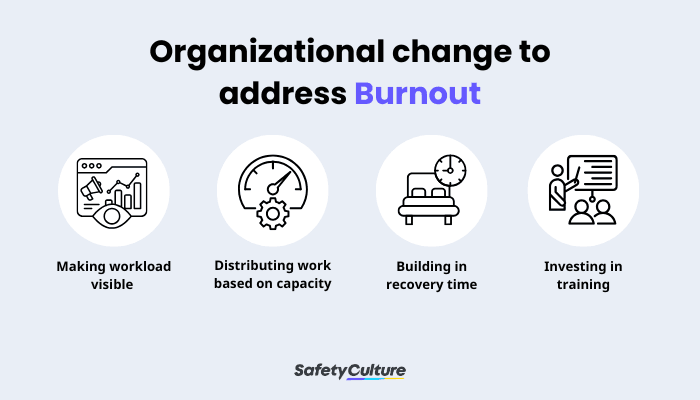
Making workload visible across the organization: Build the habit and the infrastructure for managers to surface workload data through checklists, not just status updates.
Distributing work based on capacity, not just seniority or availability: Availability isn't the same as capacity. Before assigning work, look at the full picture: what's already on each employee’s list, what's coming up, and where there's room. That requires the kind of visibility that needs to be built in, not assumed.
Building in recovery time: Deliberately scheduling lighter periods after heavy ones keeps teams able to perform over time. Recovery shouldn’t be a reward for hard work; rather, it should be part of the process.
Investing in training: Online training courses give managers a consistent foundation and a shared language for workload conversations, without pulling them out of the business for days at a time.
Implementing these structural changes can significantly strengthen your organization's brand as an employer of choice, naturally inspiring positive employee testimonials that attract top talent.
Burnout isn't a sign of weakness, it's a big SOS sign in corporate.
The good news is, conditions can be changed.
2026’s World Day for Safety and Health at Work is a reminder that psychosocial harm at work is preventable.
That means making workload visible before it becomes a crisis. Distributing work based on capacity, not just availability or seniority. It means giving managers the authority and the tools to actually protect their teams, and not just absorb the pressure themselves.
Because without these things, burnout will keep building—that is until the conditions change. And leaders are the ones most suitable to drive that change.
Important notice
The information contained in this article is general in nature and you should consider whether the information is appropriate to your specific needs. Legal and other matters referred to in this article are based on our interpretation of laws existing at the time and should not be relied on in place of professional advice. We are not responsible for the content of any site owned by a third party that may be linked to this article. SafetyCulture disclaims all liability (except for any liability which by law cannot be excluded) for any error, inaccuracy, or omission from the information contained in this article, any site linked to this article, and any loss or damage suffered by any person directly or indirectly through relying on this information.


