Best Practices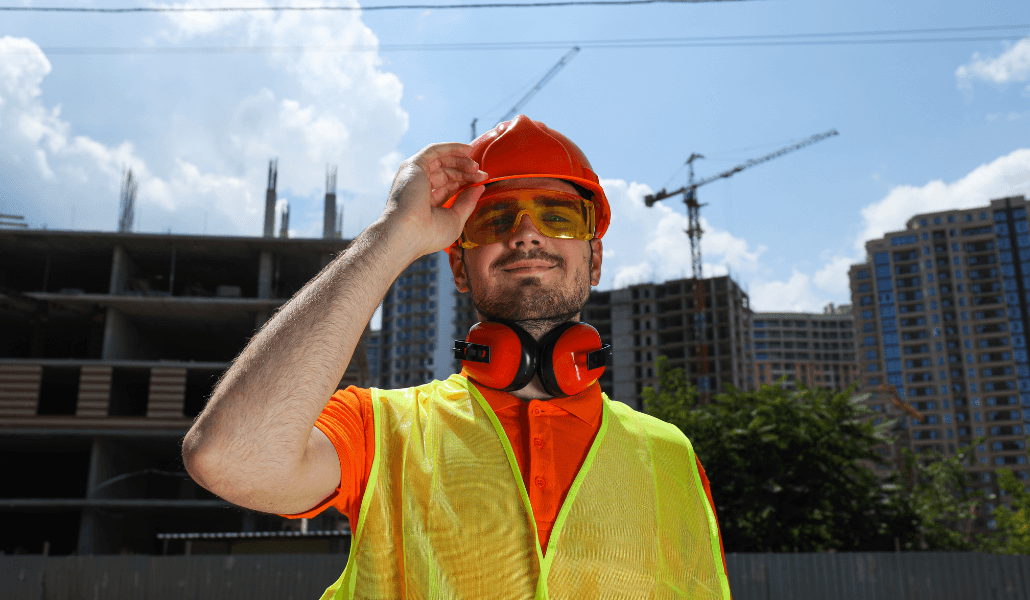
The sun damage from your job that won't show up for ten years
Share article
Outdoor workers face a 60% higher risk of non-melanoma skin cancer, per WHO and ILO research.
Heat index and UV index track different risks, so cloudy or cool days can still mean serious UV exposure.
Digital checklists help prevent accidents by logging UV index, shade, and PPE checks in real time.
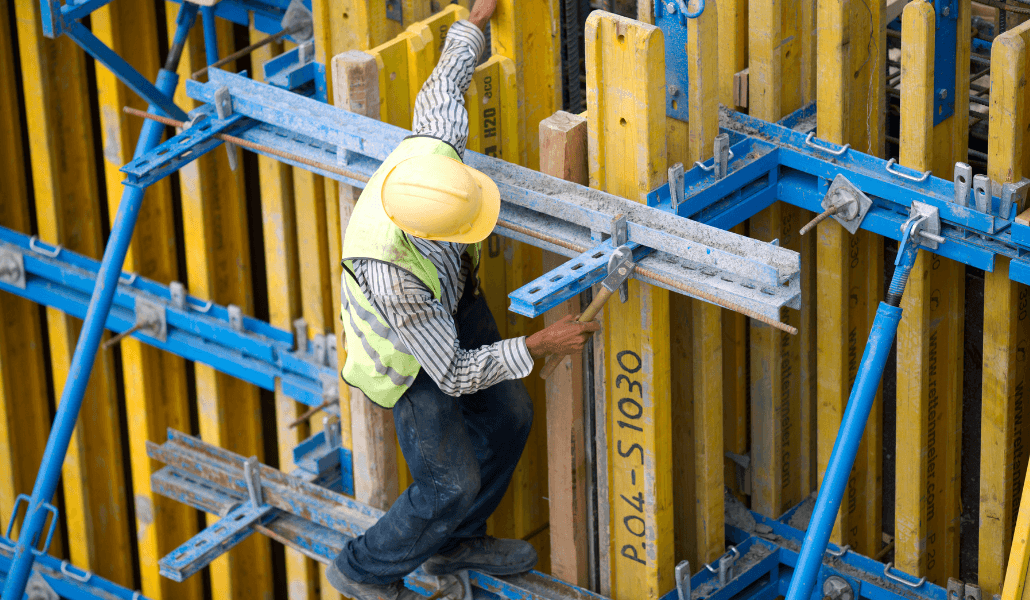
Steve Murray spent decades in construction, working under direct sunlight, without thinking much of it. To him, doing so was just part of the job. That is, until the late 1990s, when doctors diagnosed him with basal cell carcinoma.
Now, Steve is aware, but the damage has already been done. He still sees a dermatologist every three to six months and wears a hat, sunscreen, and long sleeves when outdoors.
The American Academy of Dermatology (AA) survey that documented his case didn't stop at construction. It also named landscaping, emergency medical services, and postal delivery as jobs that can lead to the same fate.
Everyone deals with the sun one way or another. But the people working under it all day are the ones actually paying for it.
Back in 2023, half of outdoor workers reported gettingsunburned, compared to 36% of the general population. Take note that temperatures can still rise. 2023, 2024, and 2025 are already the three hottest years ever recorded.
Occupational exposure to solar UV radiation raises a worker's risk of nonmelanoma skin cancer by 60%. In the US alone, about 45 million people spend a regular part of their job outdoors, roughly a third of the entire workforce, and heat exposure alone killed 55 workers in 2023.
A lot of managers treat sun safety and heat safety as the same issue, but they aren't. Heat safety is about keeping the body from overheating, while sun safety is about your skin soaking up radiation damage.
Heat-related illness covers a specific range of conditions, all tied to how hard the body is working to cool itself down. Some of them are the following:
Heat stroke: the most serious one, where the body stops sweating and core temperature can climb past 106°F (41°C) within 10 to 15 minutes.
Heat exhaustion: the body's response to heavy fluid and salt loss through sweating, often a warning sign before heat stroke sets in.
Rhabdomyolysis: rapid breakdown of muscle tissue tied to heat stress and prolonged exertion.
Heat syncope: fainting or dizziness, often linked to dehydration or standing too long in the heat.
Heat cramps and heat rash: painful muscle spasms or skin irritation from heavy sweating.
Excessive heat exposure leads to excessive UV as well. UV exposure causes an entirely separate set of problems, and most of them build up over a long time, not from how hot it is.
Common issues of excessive UV exposure are:
Sunburn: skin damage that can happen after just a few minutes in the sun without protection, even though it doesn't show up for hours.
Photokeratitis: essentially a sunburn of the eye, causing redness, pain, and a gritty feeling, sometimes called snow blindness in extreme cases.
Premature skin aging: wrinkles and age spots from years of cumulative UV damage.
Actinic keratosis: rough, reddish skin growths that count as a precursor to squamous cell carcinoma.
Skin cancer: basal cell carcinoma, squamous cell carcinoma, and melanoma, the most dangerous of the three.
Since you can't feel UV damage happening in the moment, the UV index is the easiest way to know your risk level before it's too late.
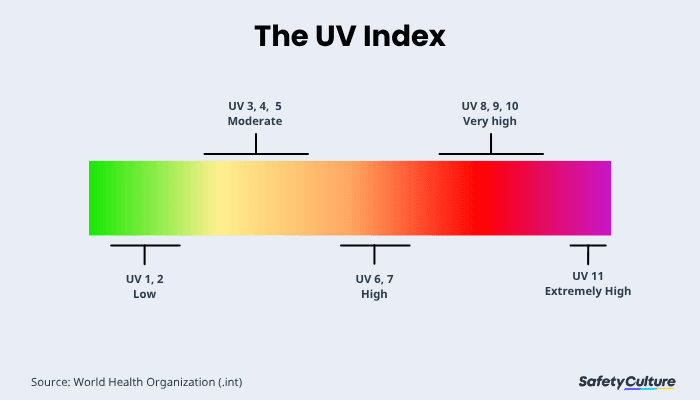
The UV Index
The UV Index measures radiation intensity on a given day.
UV 1-2 (Low): Minimal risk, and most people can be outside without much protection.
UV 3-5 (Moderate): Sunburn is possible with extended exposure, so it's worth throwing on some sunscreen and a hat.
UV 6-7 (High): Unprotected skin can burn in under an hour, especially between 10 AM and 4 PM.
UV 8-10 (Very High): Burn time drops fast, and shade stops being optional for anyone working outdoors.
UV 11+ (Extreme): This is the highest tier the scale goes to, and unprotected skin can burn in minutes.
With UV, a worker can be fully hydrated and showing zero signs of heat stress, and still be taking on UV damage that won't show up on a skin check for another ten years.
When people talk about outdoor jobs, the most common ones that pop up are construction workers or farmers. While they do make up a large portion of the workforce, there are industries out there that would also benefit from a sun safety checklist.
Construction and roofing: Direct sun is bad enough, but reflective surfaces like metal roofing and light-colored concrete make it worse. Logging shade access and rotation schedules on a checklist makes everyone aware of their time in the sun.
Agriculture: Long shifts in remote fields with little natural shade leave workers exposed for most of the workday. A checklist that prompts for water, rest breaks, and UV-protected clothing gives supervisors something to check on.
Transportation and logistics: Hours behind the wheel means hours of UV coming through the side window, plus time in and out of the truck at every stop. Something as simple as a working air conditioning check on a checklist or vehicle inspection matters a lot for fleets.
Landscaping and grounds maintenance: Groundskeepers, park maintenance teams, and right-of-way workers move between sites throughout their shift, sometimes with nowhere to set up shade. Scheduling checks around peak heat and UV hours cuts exposure without cutting productivity.
Oil, gas, and mining surface operations: Flame-resistant clothing is required around flammable vapors and hydrocarbons, and it's usually heavier than regular workwear. A checklist that confirms proper Personal Protective Equipment (PPE) and cooling vests can help prevent heat-related illness.
Hospitality: Resort and hotel outdoor staff, valets, and event crews face hours of continuous exposure with the public watching, which makes casual sunscreen reapplication easy to forget. Putting it on a shift checklist means someone actually has to check it.
Search, filter, and customize 60,000+ templates across industries and use cases.
Most sun safety programs don't fail from a lack of concern. They fail because the damage is invisible for years. You can't keep an eye on every worker's skin. A checklist helps keep most of it in check.
And these days, a checklist doesn't mean pen and paper anymore. Checklists can live on a phone, a tablet, or be built right into the systems your crew already uses.
Digital checklists help close all the gaps needed for heat safety. Pre-shift checks can log UV index, shade access, and PPE availability before a crew starts work, so there's an actual record instead of just someone's word. Wearable sensors can flag prolonged sun exposure in real time. Near-miss reporting lets a worker log something like skipped sunscreen or a missed shade break without waiting for a real incident to make it a problem.
“The SafetyCulture platform is an integral part of our processes. The data we are collecting is allowing our teams to become more aware of hazards they’re exposed to and preventing incidents. More than anything, we care about our people and want them to get home safely at the end of the day. When it comes to ROI, there is no dollar value to coming home to a hug from my son.”
Important notice
The information contained in this article is general in nature and you should consider whether the information is appropriate to your specific needs. Legal and other matters referred to in this article are based on our interpretation of laws existing at the time and should not be relied on in place of professional advice. We are not responsible for the content of any site owned by a third party that may be linked to this article. SafetyCulture disclaims all liability (except for any liability which by law cannot be excluded) for any error, inaccuracy, or omission from the information contained in this article, any site linked to this article, and any loss or damage suffered by any person directly or indirectly through relying on this information.