
Best Practices
The difference between a near miss and a tragedy is just luck
Share article
Near misses are not close calls to shrug off; they’re the last warning before something goes wrong.
A near miss report costs nothing to file, and an accident costs everything to recover from.
Workers stop reporting near misses when nothing changes after they do.
In April 2026, a chemical plant in Institute, West Virginia was weeks away from shutting down for good. Workers had been given until June, so they did what they always did before closing a plant: they started cleaning out the tanks.
Two workers were on the decommissioning crew. As part of the process, they mixed nitric acid with a chemical called M2000A, something the plant had done many times before without incident.
But this time, something was different. The tank released hydrogen sulfide, which is extremely poisonous. This resulted in the death of the two workers and injured more than 30 others in the process.
What made it worse was the paper trail. The signs had been there for nearly 20 years:
2007: A chemical explosion injured four workers. The US Occupational Safety and Health Administration (OSHA) found eight violations, with five of them serious.
2013: A nitric acid tank spilled and injured two more workers.
2015: The plant lost its operating license entirely.
2018: OSHA found that some operators hadn't been safety-evaluated in over a decade.
In fact, after 2018, the facility was never inspected again, right up until the day two people died.
That's exactly what near miss reporting failure looks like.
A near miss at work is any moment, incident, or close call that could’ve caused injury or damage but didn’t. Not because it was handled well, but because of timing, position, or plain luck.
Think of a forklift that clips a storage shelf without knocking it over. A worker who slips on a wet floor but catches themselves in time. A loose scaffold board that falls into a barricaded area with no one underneath. In all these cases, nothing technically happened, but something almost did.
The difference between a near miss and an accident is often just a few inches or a few seconds from a very different outcome. That's what makes them worth paying attention to.
No one got hurt this time, but that doesn't mean no one ever will. Most people assume accidents come out of nowhere, but research says otherwise.
Safety scientist Frank Bird once studied 1.7 million incident reports from over 300 companies. He found that behind every serious injury were 600 near misses nobody acted on. The accidents weren't random. Something almost happens, gets dismissed or forgotten, and then the actual accident follows.
Workers don't report near misses for all kinds of reasons: fear of blame, not wanting to get a colleague in trouble, no feedback from previous reports, or simply thinking nothing bad will happen anyway. None of those reasons make the next incident less likely.
Cultivate a safe working environment and streamline compliance with our EHS solutions.
Near misses happen everywhere like on your way to work or walking down the stairs. But some industries see a lot more of them because the work is just physically riskier.
Falls, dropped tools, equipment malfunctions, and scaffold failures make up a significant share of near misses on construction sites. Many go unreported because the pace of work is fast and workers are reluctant to slow things down.
Machine guarding failures, chemical exposures, and forklift incidents are so common in warehouses or power plants. Sometimes, near misses happen so often that workers stop noticing them. And by the time something does happen, it's too late.
Medication errors, slip-and-fall events, needle stick incidents, and ambulance road accidents are near miss scenarios in healthcare settings. These near misses often go unreported because nurses fear the consequences like losing their license.
Delivery drivers are pressured to meet time quotas, which leads to reckless driving and safety shortcuts. The US Bureau of Labor Statistics says that transportation incidents accounted for 38.2% of all occupational fatalities in the country in 2024.
Reporting a near miss doesn't have to be complicated. Here's a straightforward process most workplaces can follow:
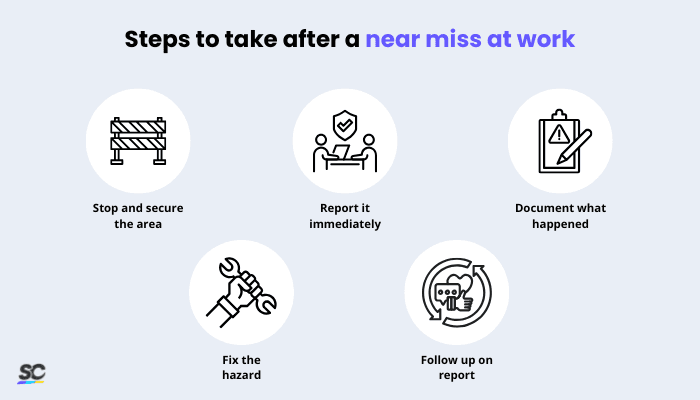
Steps to take after a near miss at work
Stop and secure the area: The moment a near miss happens, make sure to clear the area and put up safety signs so nobody goes near it until it's been checked out.
Report it immediately: Tell your supervisor or safety officer of the near miss as soon as possible, because the more time that passes, the more details get lost.
Document what happened: Take note of where the near miss happened, what time it happened, and who was involved. Add photos if you can, and include what you think caused the near miss.
Fix the hazard: Once a report is filed, the hazard needs to actually be fixed. The more serious it is, the faster it needs to be addressed.
Follow up on report: Check what's being done about it. When people report and never hear back, that’s when they stop reporting.
Incident management has gotten so much easier now that workers can use their phones on-site with no delay. You can also use a near miss reporting template to make sure nothing important gets left out. The quicker these near misses are spotted, the safer it becomes for everyone.
When a near miss report is filed, everyone in the company benefits.
Someone investigates, loose railings get fixed, and product labels get updated. For frontline workers, that's the most direct benefit, since they're the ones closest to the hazard. They're also the ones who get to go home safe because of it.
For companies, the math is equally clear. Workplace accidents cost far more than prevention. The US National Safety Council (NSC) put the total cost of work injuries in 2024 at $181.4 billion, and non-fatal injuries cost around $42,000 per case on average.
That figure accounts for lost productivity, medical claims, regulatory fines, and the time it takes to investigate and recover. None of that comes from filing a near miss report. It costs nothing to do that.
We chose SafetyCulture to make sure we are not only addressing hazards as they are identified, but also fully investing in safety training, equipment, and technology to drive continuous improvement.
Important notice
The information contained in this article is general in nature and you should consider whether the information is appropriate to your specific needs. Legal and other matters referred to in this article are based on our interpretation of laws existing at the time and should not be relied on in place of professional advice. We are not responsible for the content of any site owned by a third party that may be linked to this article. SafetyCulture disclaims all liability (except for any liability which by law cannot be excluded) for any error, inaccuracy, or omission from the information contained in this article, any site linked to this article, and any loss or damage suffered by any person directly or indirectly through relying on this information.


