
Best Practices
When does monitoring your employees cross that "dystopian" line?
Share article
Section 21A of the WHS Amendment (Digital Work Systems) Bill now makes businesses accountable for any digital tool that puts a worker's safety at risk.
Workplace monitoring crosses the line the moment it feeds into decisions about someone's job.
56% of monitored workers report feeling tense or stressed, compared to 40% of those who aren't.
When New South Wales (NSW) passed the Work Health and Safety Amendment (Digital Work Systems) Bill, Treasurer Daniel Mookhey put it plainly:
this law exists to make sure people "work for people, not computers."
Before this Bill, nothing in Work Health and Safety (WHS) law specifically named digital tools, algorithms, or AI as something businesses had to account for. This is extremely dangerous especially with the rise of the gig economy, with anyone being able to make their own app.
A good example is a delivery app that optimized for the quickest route, one that happened to run through illegal U-turns and no-stopping zones. There was no WHS law holding the business accountable for their algorithm.
Back then, nobody had to think about it. But tech keeps evolving, and eventually, these tools needed the same kind of oversight as anything else that can put a worker at risk.
The WHS Amendment (Digital Work Systems) Bill updates the WHS Act to bring all digital tools directly under workplace safety law. This gives unions the right to inspect a business's digital systems if they believe it is putting a worker at risk.
Since tools and algorithms have gotten advanced enough to quietly run someone's entire workday, Unions NSW secretary Mark Morey put it bluntly:"When an algorithm decides your hours, your pay and your pace of work, workers deserve clear rules and real protections."
A Redbridge poll of 1,507 NSW workers found 30% report being required to meet targets that feel unrealistic or unfair because of automated systems. That's the kind of pressure that leads straight to workplace fatigue and burnout.
But under section 21A, that type of pressure is on the business now.
Cultivate a safe working environment and streamline compliance with our EHS solutions.
Section 21A of the bill requires a business to make sure any digital tool it uses, including how it allocates work, doesn't create any psychosocial hazards in the workplace.
This means that a digital work system can’t:
Drive excessive workloads
Set unreasonable performance metrics
Enable discrimination or favoritism
Push workers into unsafe decisions
This also connects directly to the recently updated section 26A of the NSW WHS Act, when it comes to stricter safety measurements for psychosocial hazards and workplace fatigue. Which means, if you're not careful, you could violate both 21A and 26A by using digital technology that doesn't account for these same risks.
Tracking or monitoring your team isn't wrong on its own; after all, every manager needs some way to see how work is getting done. But there's a line, and it's easy to cross without noticing.
The line sits at how the tracking is used. Measuring how fast someone works, how much they produce, or how they stack up against teammates is one thing. Feeding that data straight into decisions about someone's job, their hours, their bonus, their standing on the team, is another. That's where it stops being oversight and starts creating real stress: job insecurity, unfair comparisons, lack of privacy, and even favoritism.
In fact, WorkSafe Victoria has already gone on record recognizing workplace surveillance as a psychosocial hazard.
There's no single moment where monitoring turns into a hazard. But the following are usually present:
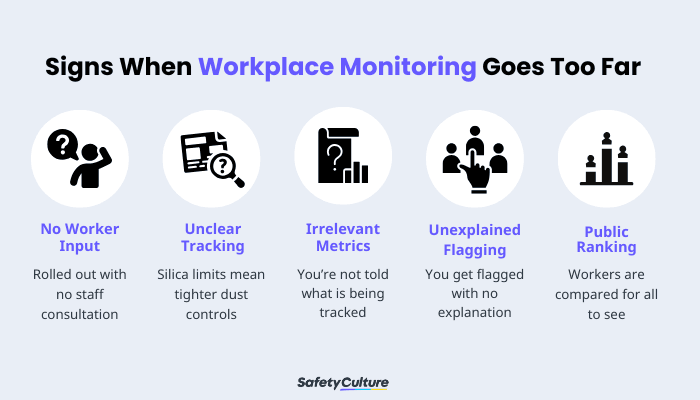
Signs When Workplace Monitoring Goes Too Far
Workers were never asked before it was rolled out.
Nobody can explain why a certain metric is being tracked.
It tracks things that have nothing to do with the actual job.
You get flagged and you don’t even know why.
It ranks or compares you against teammates for everyone to see.
If more than one of these sounds familiar, it's time for a proper review, and a lot more transparency with the people it's tracking.
Employees don't want an AI standing over them all day; they want to be trusted. A 2023 research shows that more than half (56%) of workers who are monitored say they feel tense or stressed, compared to about 40% of workers who aren't monitored.
Alternatively, Slack's survey of more than 10,000 desk workers worldwide found that when there is trust in that employee-employer relationship, employees are willing to put in the extra effort at work.
If you have any doubts about your monitoring software, start with a risk assessment on the software itself, not just the physical workplace. Be open with your team about it. Answer their questions honestly, and make sure the system actually holds up against WHS requirements.
Important notice
The information contained in this article is general in nature and you should consider whether the information is appropriate to your specific needs. Legal and other matters referred to in this article are based on our interpretation of laws existing at the time and should not be relied on in place of professional advice. We are not responsible for the content of any site owned by a third party that may be linked to this article. SafetyCulture disclaims all liability (except for any liability which by law cannot be excluded) for any error, inaccuracy, or omission from the information contained in this article, any site linked to this article, and any loss or damage suffered by any person directly or indirectly through relying on this information.


