Inside a Distribution Center: Its Role in SCM
Discover how vital distribution centers are for upply Chain Management (SCM) and how to make product movement more efficient through them.
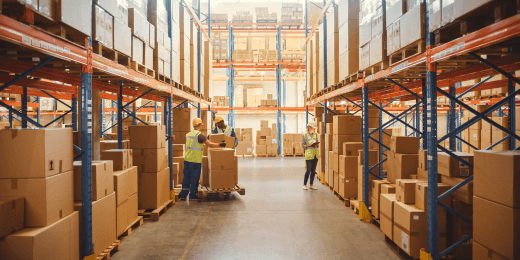
Discover how vital distribution centers are for upply Chain Management (SCM) and how to make product movement more efficient through them.
Published 28 Apr 2026
Article by
6 min read
A distribution center is a facility specifically designed to move products quickly. It combines several functions: to bring goods in, quickly move them through, gather items based on immediate customer needs, offer value-added service (e.g., labeling or kitting), and ship orders out to their destination.
Well-managed logistical hubs such as this help companies across the supply chain move goods faster and more efficiently, providing essential control over inventory flow and optimizing the final delivery process.
Many mistakenly lump warehouses and distribution centers together due to overlapping storage roles. Despite superficial similarities (e.g., they’re both large facilities), their functions in the supply chain are completely distinct. Learn more about distribution centers vs. warehouses:
Feature | Distribution Center | Warehouse |
Primary Purpose | Quick movement of goods for fast fulfillment and distribution | Extended period of storage to maintain stock levels |
Inventory Turnover | High turnover Products flow in and out rapidly | Low turnover Items remain for weeks/months |
Core Operations | Receiving Sorting Picking Packaging Labeling Shipping | Receiving Storage Issuing |
Facility Layout | Designed for speed: multiple docks, conveyors, and defined pick zones | Designed for storage: all racks, wide storage bays |
Labor Requirements | Cross-training needed for different tasks | Focuses on storage, stock checks, and equipment handling |
Technology Utilized | Utilizes automation: Warehouse Management Systems (WMS) Radio Frequency Identification (RFIDs) Autonomous Mobile Robots (AMRs) | Minimal technology (e.g., basic WMS), more conventional storage equipment |
Customer Focus | Prioritizes fast delivery and order accuracy | Focuses on preserving inventory and meeting replenishment needs |
Cultivate a culture of excellence with our digital solutions that enhance efficiency, agility, and continuous improvement across all operations.
Distribution centers come in various types, each designed to support specific logistics needs. They perform essential supply chain functions critical to effective product flow, reduce delays, and ensure goods reach end users quickly, safely, and efficiently.
This central depot manages nationwide inventories. It receives full-container shipments from manufacturers, stores bulk items, and dispatches stock to regional hubs. Most value-added tasks, such as repackaging seasonal bundles or adding specific labels, are part of the national distribution center operations.
Specific functions:
Inventory management: CDCs hold deep inventory across categories, from home appliances to food products.
Value-added services: They perform tasks that prepare goods for store-level sales or regional movement.
Safety and maintenance: Large-scale infrastructure and heavy machinery (e.g., pallet shuttles, forklifts, dock levelers) should operate under safety standards.
This center focuses on swift product delivery by locating inventory near local customer bases. It uses moderate storage capacity and advanced dispatch systems to optimize delivery routes. This results in shorter wait times and better service within a defined region.
Specific functions:
Receiving and unloading: Regional centers often accept varied shipments from national hubs or local suppliers.
Inventory management: Stocks are kept up, ensuring there are enough fast-moving items to meet local needs.
Shipping and dispatch: Also functioning as a retail distribution center, this hub consolidates orders to and from multiple stores in the region.
Fulfillment distribution centers for e-commerce handle orders by receiving different products from digital marketplaces or retail websites and shipping them directly to customers daily.
Specific functions:
Order picking and processing: Efficient item-level picking is crucial due to high and diverse stock-keeping.
Value-added services: Orders are usually assembled into parcel-ready packages with branding and insertions in this space.
Returns management: A vital element of logistics management, damage inspection, re-tagging, and clearance processing are also done here.
This hub is designed for fast product transfer with little to no storage time. Goods are taken from incoming trucks and then transferred onto outbound vehicles for delivery to retail spots or the end user. Cross-dock facilities highlight the difference between fulfillment centers vs. distribution centers.
Specific functions:
Receiving and unloading (inbound trucks)
Shipping and dispatch (outbound loading)
Basic order sorting
This warehouse distribution center handles sensitive products, such as pharmaceuticals and perishable foods. These goods should be stored under controlled conditions before shipping them to hospitals or specialty retailers.
Specific functions:
Safety and maintenance for refrigeration systems
Strict inventory management
Returns management, including regulated disposal
Build from scratch or choose from our collection of free, ready-to-download, and customizable templates.
Distribution centers can quickly become chaotic without strong operational practices. Several issues, from high order volumes to equipment bottlenecks, can stall productivity. These proven best practices help control workflows and ensure consistent performance:
Clear steps for unloading, checking quantities, and verifying product qualities are must-haves. This prevents hidden damages, incorrect shipments, and delays caused by inaccuracies.
Place fast-moving, heavy, or high-priority stocks in easily accessible locations. Doing this reduces picker travel time and minimizes congestion, hence speeding up order fulfillment.
Manual errors lead to stockouts, inventory inaccuracies, and poor departmental coordination. Utilizing a digital system for tracking stocks, directing workflows, and managing real-time data effectively avoids these operational problems.
Use efficient picking methods.
Applying a structured picking strategy cuts travel distances, prevents overlaps, and speeds up order preparation. Choose a strategy based on the overall stock volume and the typical order mix. Here are the most common picking options:
Batch: A single picker collects items for multiple orders in one optimized trip.
Wave: Orders are grouped by common criteria and released in schedules.
Zone: The warehouse is divided into specialized zones. Pickers stay in their area and pass the partial order to the next zone (e.g., value-added service) until the order’s complete.
Supplementary services usually add time to the whole process. Organize packing stations with necessary tools, standardized materials, and clear workflows to reduce packing time, prevent errors, and avoid rework.
Contrary to the common misconception that logistical hubs are relatively safe spaces, they actually have high accident rates with fatal injuries. Uphold distribution center safety by regularly inspecting and servicing the following:
Forklifts and material handling equipment
Conveyor systems and sorting machines
Loading docks and dock levelers
Ongoing skill development, especially in multiple tasks, prevents labor shortages during peak or high-demand seasons. Aside from building workforce flexibility through various warehousing and logistics training, this empowers workers to prioritize safety at all times.
PHX Ireland, a division of the country’s leading integrated healthcare provider, benefited from robust digital tools that significantly elevated safety, compliance, and communication standards.
By digitizing quality checks and implementing sensor alerts, they protected the integrity of their pharmaceutical stock and simultaneously allowed distribution teams to focus on efficient supply flow and patient care.
"We were lucky to have great support from SafetyCulture. It’s taken off quickly. What began as a few checklists has evolved into most stores and warehouses working smarter, not harder"
Ann-Marie Broderick, Retail Operations and Communications Manager at McCabes Pharmacy
SafetyCulture is a mobile-first operations platform adopted across industries such as manufacturing, mining, construction, retail, and hospitality. It’s designed to equip leaders and working teams with the knowledge and tools to do their best work—to the safest and highest standard.
Enhance safety and operational management in distribution centers through digital checklists, real-time audit capabilities, and streamlined reporting. Improve incident tracking, compliance audits, and workforce training documentation to reduce workplace incidents. Consistently apply safety and quality standards throughout the supply chain with a unified platform.
✓ Save time and reduce costs
✓ Stay on top of risks and incidents
✓ Boost productivity and efficiency
✓ Enhance communication and collaboration
✓ Discover improvement opportunities
✓ Make data-driven business decisions