5 Core Tools of Quality: The Ultimate Guide
Discover how key quality frameworks work together to streamline operations, reduce errors, and ensure consistent results across processes.

Discover how key quality frameworks work together to streamline operations, reduce errors, and ensure consistent results across processes.
Published 28 Apr 2026
Article by
6 min read
The 5 core tools of quality help manufacturing teams prevent defects and improve product quality. They bring structure to planning, surface risks early, and keep processes stable and reliable.
The Automotive Industry Action Group (AIAG) developed these tools for automotive and manufacturing teams and aligned them with IATF 16949 standards. Companies use them to meet customer requirements, control production quality, and support continuous improvement.
A strong Quality Management System (QMS) relies on proactive methods to prevent defects and process failures. The 5 core tools of quality enable companies to do just that.
Companies that apply these tools effectively reduce their Cost of Poor Quality (COPQ), which covers costs associated with process and product failures, from 5% to around 1%, thereby cutting expenses related to scrap, rework, defects, retesting, and recalls by up to five times.
The benefits of implementing the 5 core quality tools include:
Reduce the cost of poor quality: With these tools, teams can catch and fix problems early before they become costly failures. This approach reduces waste, rework, and defect-related costs.
Prevent defects before production: These tools focus on finding and correcting errors during design and planning. This way, teams can address risks before products reach the production line or customers.
Improve process stability: The core tools help teams monitor and control work using data and standard procedures. More stable processes mean less variation, downtime, and unexpected defects.
Ensure accurate measurements: These tools verify that measurement systems yield consistent, reliable results. Accurate data leads to better decisions and more dependable quality.
Strengthen customer and supplier communication: The tools set clear expectations for everyone involved. A shared understanding helps prevent misalignment that can lead to quality issues.
Support compliance and continuous improvement: These methods reinforce continuous improvement and make it easier to meet industry standards and regulatory requirements.
Below are five quality core tools that businesses in the automotive, aerospace, and medical industries use to improve processes and ensure consistent quality outcomes:
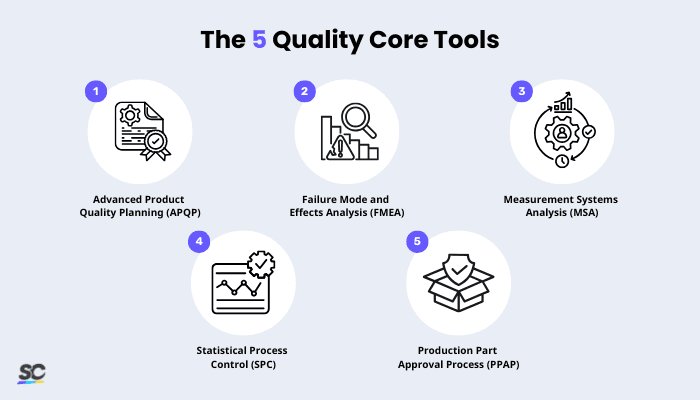
APQP is a structured approach for developing new products that meet customer expectations. It enables teams to understand the requirements clearly and plan their work in a coordinated way.
Think of APQP as a roadmap for product development that guides teams from planning through ongoing production. It consists of 5 phases:
Phase 1: Planning
Phase 2: Product Design and Development
Phase 3: Process Design and Development
Phase 4: Product and Process Validation
Phase 5: Feedback and Continuous Improvement
FMEA is a risk assessment method that identifies potential problems in a product or process and evaluates their impact. It helps teams prevent failures before they happen.
FMEA assesses risks across three categories:
Severity: How serious the impact is on the customer
Occurrence: How likely the failure is to happen
Detection: How easy it is to notice the issue
This risk assessment method has two types:
Design Failure Mode and Effects Analysis (DFMEA): It’s used during the design phase to identify potential design-related failures (e.g., materials, functions) and assess their impact on the customer. Teams often use a Risk Priority Number (RPN) to prioritize actions with this method.
Process Failure Mode and Effects Analysis (PFMEA): This proactive risk management tool allows teams to pinpoint, evaluate, and mitigate potential failures in manufacturing or operational processes before they impact quality or safety. By analyzing failure modes, causes, and effects, they can target the most critical actions.
MSA confirms that measurement tools, such as gauges, are accurate and reliable. It ensures that the collected data is trustworthy.
MSA evaluates five key parameters:
Bias: Measures how far a reading is from the true value. Calibration checks this against standards from organizations such as the National Institute of Standards and Technology (NIST).
Linearity: Indicates whether a device’s accuracy changes across its measurement range. A device may be more accurate at some points than others.
Stability: Checks if a device gives the same reading on the same part over time. A device is unstable if its results drift from earlier measurements.
Repeatability: Shows how consistently the same operator can measure the same part under the same conditions. Poor repeatability occurs when repeated measurements yield inconsistent results.
Reproducibility: Tests whether different operators can get similar readings on the same part. A system is reproducible when results are consistent across users.
SPC uses statistical techniques to measure and control the quality of manufacturing processes and production methods. It was developed in 1924 by William A. Shewhart of Bell Laboratories.
SPC uses 14 tools to monitor and control production processes, including:
Quality control tools:
Cause-and-effect diagram
Check sheet
Control chart
Histograms
Pareto chart
Scatter diagram
Stratification
Supplemental tools:
Data stratification
Defect map
Event logs
Process flowchart
Progress center
Randomization
Sample size determination
PPAP is a standardized quality assurance method used in the automotive and aerospace industries to ensure suppliers consistently produce parts that meet customer specifications. It requires suppliers to provide sample parts and documentation proving the process prevents non-conforming products from reaching customers.
The process consists of 18 elements:
Design Records
Engineering Change Documents
Customer Engineering Approval
Design Failure Mode and Effects Analysis (DFMEA)
Process Flow Diagrams
Process Failure Mode and Effects Analysis (PFMEA)
Control Plan
Measurement System Analysis (MSA)
Dimensional Results
Material / Performance Test Results
Initial Process Studies
Qualified Laboratory Documentation
Appearance Approval Report (AAR)
Sample Product
Master Sample
Checking Aids
Records of Compliance with Customer-Specific Requirements
Part Submission Warrant (PSW)
Additionally, PPAP classifies all the required documents into five levels, from Level 1 to Level 5. The level of submission is determined by the part's significance and associated risk. These levels include:
Level 1: Only the Part Submission Warrant (PSW) is submitted; the supplier retains other records for potential review.
Level 2: PSW plus product samples and limited supporting data submitted. Suitable for moderate changes, such as design tweaks.
Level 3: PSW, product samples, and complete supporting data (all 18 elements where applicable) provided. Standard for new parts or major revisions.
Level 4: PSW plus customer-specific requirements beyond standard elements. Addresses unique verification needs.
Level 5: PSW, samples, and full data available for customer review at the supplier's site. Reserved for high-risk, complex parts.
SafetyCulture is a mobile-first operations platform adopted across industries such as manufacturing, mining, construction, retail, and hospitality. It’s designed to equip leaders and working teams with the knowledge and tools to do their best work—to the safest and highest standard.
Streamline processes, eliminate bottlenecks, enhance resource utilization, and build an agile and scalable infrastructure with SafetyCulture. Strive for operational excellence to boost competitive advantage, foster sustainable growth, and deliver long-term value.
✓ Save time and reduce costs
✓ Stay on top of risks and incidents
✓ Boost productivity and efficiency
✓ Enhance communication and collaboration
✓ Discover improvement opportunities
✓ Make data-driven business decisions