
Deferred Maintenance: Short-Term Wins and Long-Term Costs
Understand the reasons for deferred maintenance, its consequences, and practical strategies to manage backlogs and prevent future risks.

Published 26 Nov 2025
Article by
6 min read
What is Deferred Maintenance?
Deferred maintenance refers to the deliberate postponement of routine maintenance, repairs, and replacements to equipment, buildings, or systems. Primarily driven by budgetary or operational constraints, this is adopted as a short-term financial tactic for managing current expenses. If left unaddressed, this backlog of work worsens the condition of assets, escalating the potential for major system failures and safety hazards.
Why is Maintenance Deferred?
According to some studies, every dollar saved in postponing maintenance is equivalent to $4 of fixing or replacing the damaged assets in the future. The accumulating repair backlogs lead to accelerated deterioration, which in turn worsens the company's financial strain. Understanding the following underlying causes is crucial in resolving this maintenance issue:
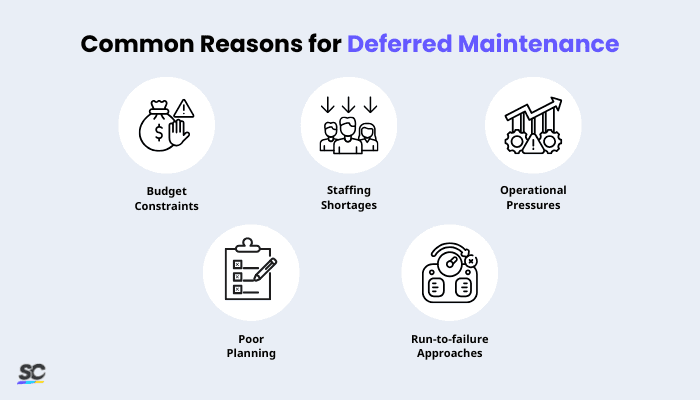
Common Reasons for Deferred Maintenance
Budget constraints - Limited financial resources are the number one reason behind postponements, especially in building maintenance . Some prioritize critical operations or urgent repairs over routine maintenance, viewing it as a way to manage short-term costs.
Staffing shortages - The lack of available personnel directly delays tasks. When repairs and calibrations cannot be addressed promptly, the backlog expands rapidly and significantly.
Operational priorities and emergencies - Some companies, especially those managing manufacturing facilities , defer maintenance to avoid interrupting production. This is usually the case during high-demand periods or critical projects.
Poor planning and asset management - The absence of robust asset management and scheduling systems can cause necessary maintenance tasks to be missed. In some cases, maintenance may even be postponed indefinitely.
Run-to-Failure approaches - Some building and property maintenance teams adopt policies that allow assets to run until they fail before repairing them. This saves money in the short term but can lead to expensive downtimes.
These problems, whether due to budget cuts or workforce deficits, directly lead to a predictable cycle of asset deterioration and increasing risks. This awareness is crucial in building a robust system for effective asset management, preventing issues from worsening.
Achieve operational excellence
Cultivate a culture of excellence with our digital solutions that enhance efficiency, agility, and continuous improvement across all operations.
How Deferred Maintenance Works
While there are several risks to deferring maintenance, some companies use it as a short-term tactic to manage costs and resources. If executed with careful oversight, this practice can offer a temporary way to maintain operations under budgetary pressure.
Here are the different ways deferred maintenance can work:
Strategic deferred maintenance
This is the intentional postponement of non-critical repairs or maintenance activities. The decision to defer maintenance is typically made after assessing that the risks are manageable, using data gathered from condition monitoring, asset health reports, or financial projections.
Here are some advantages and disadvantages of this maintenance type, and real-life deferred maintenance examples:
Pros | Cons |
Frees up funds and manpower for critical operations or high-risk assets | May normalize postponements, leading to poor long-term asset discipline |
Helps align maintenance timing with major operational or fiscal schedules | Risk of hidden damage or accelerated deterioration during the deferral period |
Prevents unnecessary early repairs on assets with low wear or extended lifespan | Increased likelihood of unplanned downtime if asset failure occurs sooner than expected |
Some examples of this type:
In accounting: Postponing the standard annual refresh cycle for non-essential accounting software for a few months allows the IT teams to focus their capacity on protecting core business functions.
In manufacturing: The scheduled maintenance and minor calibration of a high-volume assembly line machine are postponed during the company’s production rush to maximize short-term output and meet contractual delivery deadlines.
Involuntary deferred maintenance
This happens when repairs or maintenance tasks are unintentionally delayed due to budget shortages, staff constraints, or supply chain issues. This is often a sign of operational strain that, if left unaddressed, can lead to an expanding backlog.
While deferred maintenance is associated with significant long-term risks, the practice offers certain short-term advantages. Learn more about them below:
Pros | Cons |
Provides temporary cost relief when budgets are extremely tight | Increases risk of equipment failure, safety incidents, and compliance violations |
Allows essential operations to continue despite limited resources | Reduces overall asset value and operational efficiency |
Here is an example of deferred maintenance in real estate:
The property management team recognizes the immediate need for full roof replacement and exterior repairs following a severe hailstorm. However, execution is delayed while they await insurance claim funds because they can’t pay out of pocket at the moment.
Solutions to Address Deferred Maintenance
Postponing or rescheduling maintenance is occasionally inevitable. Though this temporarily buys companies time, it often introduces risks that become difficult to manage. These deferred maintenance solutions help companies mitigate subsequent issues during this delay:
Centralized asset management platform
It’s ideal to use an all-in-one platform to store all asset information, including service history, warranties, manuals, and condition reports. This helps teams achieve the following:
Spot high-risk assets and prioritize backlogs
Gain complete visibility into asset health and lifecycle stage for proactive planning
Simplify compliance by compiling inspection and audit results
Automated maintenance scheduling tools
Teams can transition from reactive to proactive maintenance with the right maintenance scheduling tools, preempting failures and supporting long-term asset health. Maintenance activities can be triggered based on calendar dates, runtime hours, or condition thresholds to:
Prevent new backlogs by eliminating missed or forgotten tasks
Extend asset lifespan by ensuring consistent care
Balance workloads and avoid scheduling conflicts for technicians
Task and work Order management solution
Once a maintenance need gets identified, it immediately becomes a trackable digital record that eliminates hidden backlogs with the right task and work order management solution. Managers can easily direct teams to high-risk and priority work orders once funding is available, making the following possible:
Cut down backlogs through structured workflows and prioritization
Improve team efficiency by setting clear roles and due dates
Quickly reroute work when unexpected failures occur
Issue reporting and corrective actions management tools
Frontline personnel can immediately report equipment and facility issues with help from issue reporting tools. They can even add photos, videos, and location data to ensure the following:
Prevent minor issues from turning into major failures
Enhance safety and compliance by documenting corrective actions
Set up fast communication and clear steps for handling emergencies
Digital analytical dashboards
Robust analytics replace subjective judgments and guesswork with objective evidence. These tools reveal the true scope, cost, and risks associated with maintenance backlogs, helping teams:
Predict which assets could fail next
Identify recurring issues and pinpoint root causes
Support audit by providing accurate reports, backed with photo or video logs and annotations.
Audit and compliance trail solutions
Complete documentation provides an undeniable source of truth. It clarifies what has been done, what is overdue, and what requires immediate action. Aside from supporting proactive planning, it also keeps everything organized for easy access and retrieval. When every action is recorded, compliance tasks become less of an administrative burden.
Digital tools with various integrations
Ensuring all company systems work effortlessly together with integration capabilities minimizes problems, including the buildup of compounding backlogs. By automatically integrating financial ledgers, inventory management tools, and Internet of Things (IoT) sensors with asset management systems, companies gain real-time visibility into deferred maintenance costs, material needs, and equipment health.
Mitigate the Risks of Deferred Maintenance with SafetyCulture
Why Use SafetyCulture?
SafetyCulture is a mobile-first operations platform adopted across industries such as manufacturing, mining, construction, retail, and hospitality. It’s designed to equip leaders and working teams with the knowledge and tools to do their best work—to the safest and highest standard.
Streamline processes, eliminate bottlenecks, enhance resource utilization, and build an agile and scalable infrastructure with SafetyCulture. Strive for operational excellence to boost competitive advantage, foster sustainable growth, and deliver long-term value.
✓ Save time and reduce costs
✓ Stay on top of risks and incidents
✓ Boost productivity and efficiency
✓ Enhance communication and collaboration
✓ Discover improvement opportunities
✓ Make data-driven business decisions
FAQs About Deferred Maintenance
Related articles
Facility Management
Maintenance

The Ultimate Guide to Warehouse Layout Optimization
Learn effective strategies in warehouse layout optimization to maximize space, streamline flow, and support efficient production operations.
Facility Management
Maintenance

Workplace Management: The Ultimate Guide
Learn how workplace management drives safe, efficient operations through frontline visibility, consistency, and continuous improvement.
Facility Management
Maintenance

A Guide to Retail Facility Management
Improve store performance with effective retail facility management, and learn its key components, challenges, and top solutions for success.