Mastering the Cleaning and Sanitizing of Food Service Equipment
Discover step-by-step procedures for effectively cleaning and sanitizing food service equipment to maintain safety standards and protect customer health.
Discover step-by-step procedures for effectively cleaning and sanitizing food service equipment to maintain safety standards and protect customer health.
Published 27 Apr 2026
Article by
6 min read
Cleaning and sanitizing food service equipment is a professional process that involves removing food debris from preparation surfaces, machinery, and tools before applying approved chemical sanitizers to eliminate harmful bacteria. This process ensures food production facilities stay compliant with health standards and ensures that all equipment is properly prepared for safe, sanitary food handling.
Cleaning and sanitizing serve different but equally important roles in professional kitchen safety. Understanding the key differences between them is vital for preventing contamination and ensuring that your food preparation environment remains completely hygienic and compliant with safety laws.
Factor | Cleaning | Sanitizing |
Primary Purpose | Removes visible dirt, food residue, and grease from surfaces | Reduces harmful bacteria on surfaces to safe levels |
Process Involved | Physically removing residue by washing and scrubbing with water and detergents | Applying chemical sanitizers and heat to kill remaining germs |
Chemicals Used | Detergents, degreasers, and abrasives that can lift and remove soil | Approved sanitizing agents, such as chlorine, quaternary ammonia, and heat |
Order in the Workflow | Done as the first step in maintenance | Performed as the final safety step |
Result | Equipment looks visibly clean, but may still contain microbes | Equipment is hygienic and safer for food contact |
Proper kitchen hygiene and structured sanitation protocols are vital tools for every food professional for numerous benefits. With over 600 million people falling ill every year from foodborne illnesses, food safety is a global priority. Children under five are the most vulnerable, often facing the most severe consequences.
Strictly implementing food hygiene is a strategic investment. A sterile kitchen environment does not just mitigate cross contamination. It is a preventive maintenance technique that extends equipment life and cuts capital expenses. On top of ensuring compliance with Hazard Analysis and Critical Control Points (HACCP) standards, ISO 22000, and local health codes, this fosters a strong food safety culture that builds lasting trust and loyalty with customers.
Keep food safe, your team on track, and operations running smoothly.
Not all kitchen tools carry the same contamination risk. Certain equipment come in contact with food more frequently than others, or have more complex parts where bacteria are more likely to thrive. The following need to be cleaned daily, and often immediately after use:
Food preparation surfaces: Prep tables and cutting boards have direct contact with raw and ready-to-eat foods, making them prime sites for cross-contamination. Grooves and surface scratches from knives can trap bacteria, which makes cleaning and sanitizing food contact surfaces a must.
Knives and hand tools: Blades, peelers, and kitchen shears move between ingredients quickly, spreading bacteria from raw meat to produce to cooked food. Their frequent sanitation ensures safe food transitions.
Food processors and mixers: Detachable parts and crevices easily trap food particles and moisture, which are perfect breeding grounds for bacteria. Thorough cleaning is essential to prevent microbial build up.
Refrigeration units and storage containers: Bacteria often thrive in storage compartments due to spills or condensation. Aside from preventing mold and odor buildup, this routine maintenance helps the equipment maintain proper cooling temperatures.
Dishwashers and sinks: While used for cleaning, these can accumulate grease, food debris, and biofilm. This practice ensures they can effectively clean other equipment instead of becoming a hidden source of contamination.
Build from scratch or choose from our collection of free, ready-to-download, and customizable templates.
Many teams overlook critical sanitation details due to heavy workloads and intense time pressure. However, it is vital to remember that a surface that looks clean is not necessarily safe. Following rigorous protocols is the only way to ensure a truly pathogen-free kitchen that stands up to the highest food safety and inspection standards.
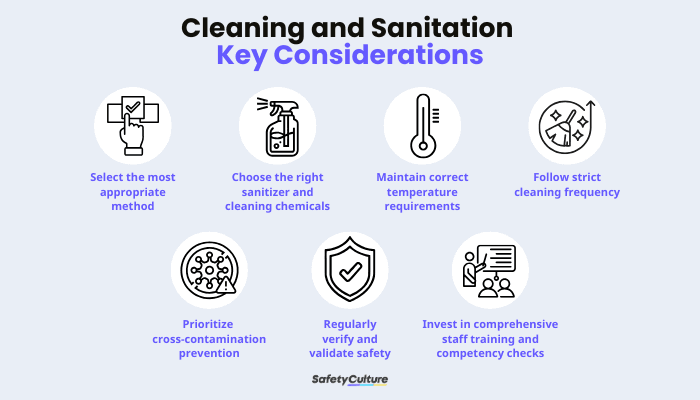
Every kitchen asset requires a specific cleaning strategy based on its complexity and function. This tailored approach is essential for preventing pathogen buildup. Here are the most common types:
Clean-in-Place (CIP) works on the internal pipes or pumps without disassembly.
Clean-out-of-Place (COP) deep soaks removable parts (e.g., slicers blades, fittings) in specialized wash tanks.
Manual cleaning, such as spraying and wiping, is for visible surface dirt.
The wrong product can damage equipment or leave unsafe residues. Pick the chemicals that are suitable for every surface or food environment. Here are some approved cleaners and sanitizers:
Detergents emulsify grease and lift organic soils from surfaces.
Degreasers penetrate and dissolve stubborn, heavy-duty oils.
Delimers descale and strip away mineral deposits or hard water buildup.
Sanitizers eradicate harmful bacteria and pathogens to ensure microbial safety.
Temperatures directly affect cleaning effectiveness. Too low reduces germ removal; too high may damage equipment or create hazards. To follow recommended heat ranges, monitor temperature with calibrated thermometers:
Type of Heat Sanitation | Temperature | Contact Time |
Manual | (171°F (77°C ) | Submerged for 30 seconds |
Mechanical (Dishwashers) | 180°F - 194°F (82°C - 90°C ) Rinse temperature 160°F (71°C) Surface temperature | Duration of the final rinse, usually 10–15 seconds |
To prevent residue buildup and bacterial growth, frequently used equipment must be cleaned at set intervals or after every use. Implementing a master cleaning schedule with assignments and completion logs ensures accountability and maintains a consistently safe environment.
Preventing the transfer of pathogens and allergens between surfaces ensures that sanitation efforts eliminate risk rather than spread them. The following systems can help:
Color-coded cutting boards
Dedicated prep zones
Frequent handwashing
Sanitizing tools between tasks
Storing raw proteins below ready-to-eat items
Cleaning must be measured, not assumed. Without verification, hidden pathogens can persist, leading to catastrophic outbreaks and legal liability.
Verification confirms compliance. It answers "Are we following our procedures?" by auditing kitchen cleanliness logs or monitoring temperatures. Validation determines efficacy by asking, “Is the process actually working?" This is proven through objective testing, such as Adenosine Triphosphate (ATP) swabs, to ensure surfaces are biologically free of harmful bacteria.
Even the best procedures fail without proper execution. Staff must understand both how and why cleaning is performed. These topics should be included in the in-house learning program:
HACCP principles for risk management
Chemical safety for proper handling
Personal hygiene standards to prevent human-to-food transmission
Transitioning to digital solutions helped Tablo Kitchen X Cafe ensure equipment cleanliness and sanitation through real-time visibility and accountability. Managers can monitor food safety protocols across multiple branches while data-driven analytics identify recurring issues. These digital tools empower the business to maintain rigorous standards, guaranteeing consistent food safety.
SafetyCulture is a mobile-first operations platform adopted across industries such as manufacturing, mining, construction, retail, and hospitality. It’s designed to equip leaders and working teams with the knowledge and tools to do their best work—to the safest and highest standard.
Streamline cleaning and sanitizing workflows with customizable inspection checklists and real-time audits. Automate reporting, capturing photo and video evidence, and assign appropriate and timely corrective actions. Reduce manual errors, especially in compliance documentation. Ensure consistent hygiene practices across equipment, improving food safety and operational outcomes, through a unified platform.
✓ Save and reduce costs
✓ Stay on top of risks and incidents
✓ Boost productivity and efficiency
✓ Enhance communication and collaboration
✓ Discover improvement opportunities
✓ Make data-driven business decisions
In this article