Industry Insights
Understanding New York’s Retail Worker Safety Act: What’s changing in 2027?
Share article
New York's Retail Worker Safety Act will have some changes in 2027.
By 2027, retail employers with over 500 workers will be required to provide their employees silent response buttons.
The change aims to strengthen the safety of retail employees at all times.
If you are a retail worker working in New York, whether on the floor or stockroom, chances are you've heard about the Retail Worker Safety Act (RWSA) at some point in your career. But what you're yet to hear is that there's change coming on January 1, 2027.
Let's talk about it. Firstly, whatisthe Retail Worker Safety Act ?
It’s a New York State law that requires retail employers with 10 or more employees to take concrete steps to reduce workplace violence risks and improve worker safety. This can range from implementing prevention policies, training employees, assessing risks, and putting safety hazard controls in place to reduce violence in stores. Safety training is to be held annually if the company has 50+ employees,and every 2 years if under 50 employees.
With that in mind, here’s a look at what’s changing in 2027 and what it means for retail employers and workers across New York.
So, what’s the biggest change? Let us introduce you to the silent response button.
It’s a newly introduced way for a retail worker to quietly call for immediate help if:
they feel unsafe and uncomfortable with a customer;
there’s a potential or actual emergency; or
they're working alone and need support.
The button doesn’t have to be a traditional “button” exactly. It can appear as a physical button easily accessible on the floor, it can be a wearable device in which employees can put in their person, or a mobile app installed on employer‑provided equipment only. To avoid breaching employees’ private times, these devices can only track the employee’s movements and location when the button is triggered.
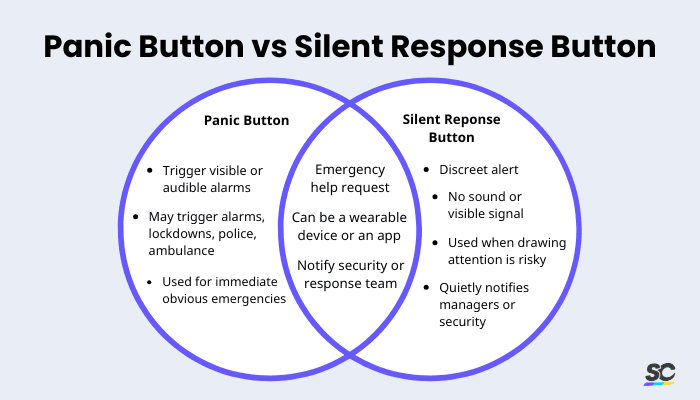
For a while, the New York State law debated “panic buttons” to contact 911 directly, but later agreed on silent response buttons that notify an internal responder tailored by the employer. These buttons can discreetly alert designated security personnel, manager, or supervisor who can quickly assess the situation and coordinate an appropriate response.
Now, whoisaffected? The 2027 changes don't hit every retailer in the state of New York. It only applies to retail employers with 500+ employees across all their New York retail locations combined, not per store.
Make sure your teams know what to do before an incident happens. Policies alone are not enough, there can be other considerations to be aware of in practice.
To prepare your employees, they should be trained on:
Where the button is and how to use it
If it’s physical: where it’s mounted and what it looks like
If it’s wearable or app‑based: how to wear it, log in or sign up into it, and trigger it
What situations justify pressing it
(These examples are up for discussions between employer and employees)
Threats or aggressive behavior from customers
Stalking or doxing
Feeling unsafe when working alone
What happens after pressing it
Who is supposed to respond (security, manager, supervisor, 911)?
What is the expected response time?
What should they expect once support arrives?
Since these situations are often unpredictable and subjective, a safety net must be put in place to ensure workers are not disciplined or penalized for accidentally triggering the button in situations they reasonably believed were emergencies.
Under the new changes, employees must not be punished for raising safety concerns or using the policy, training, or buttons in good faith. Retaliation is illegal under the Act. This includes being transferred, disciplined, or fired for reporting violence risks or exercising your rights.
By January 1, 2027, all retail employees with 500+ employees in the state of New York must provide covered retail workers access to a silent response button at the workplace and train employees on how, when, and where to use the button. For retailers with multiple sites and branches, this may require coordination across operations, HR, IT, and security teams to ensure consistency and documentation.
Of course, some smaller employers who don’t hit the 500 employee threshold can voluntarily adopt the silent response button or similar tools. The law doesn’t require them to do so, but it encourages proactive steps to strengthen workplace safety regardless of company size.
Identify, evaluate, and mitigate risks to create a safe and secure environment for your employees and customers.
January 1, 2027 marks a big shift in the retail industry in New York State.
Whether it’s a tense customer interaction late at night, working a solo shift in the stockroom, or a situation that simply doesn’t feel right, the message is clear: retail workers should never have to choose between doing their job and protecting their safety.
And these upcoming changes reinforce that workplace safety isn't just about reacting to violence, it's about prevention and preparedness.
Now is the time to review:
Current workplace violence prevention policies
Training frequency and documentation
Incident reporting and escalation processes
Technology options that meet the new requirements
Because at the end of the day, it’s not just compliance that keeps employees safe, it’s also good leadership.
Important notice
The information contained in this article is general in nature and you should consider whether the information is appropriate to your specific needs. Legal and other matters referred to in this article are based on our interpretation of laws existing at the time and should not be relied on in place of professional advice. We are not responsible for the content of any site owned by a third party that may be linked to this article. SafetyCulture disclaims all liability (except for any liability which by law cannot be excluded) for any error, inaccuracy, or omission from the information contained in this article, any site linked to this article, and any loss or damage suffered by any person directly or indirectly through relying on this information.