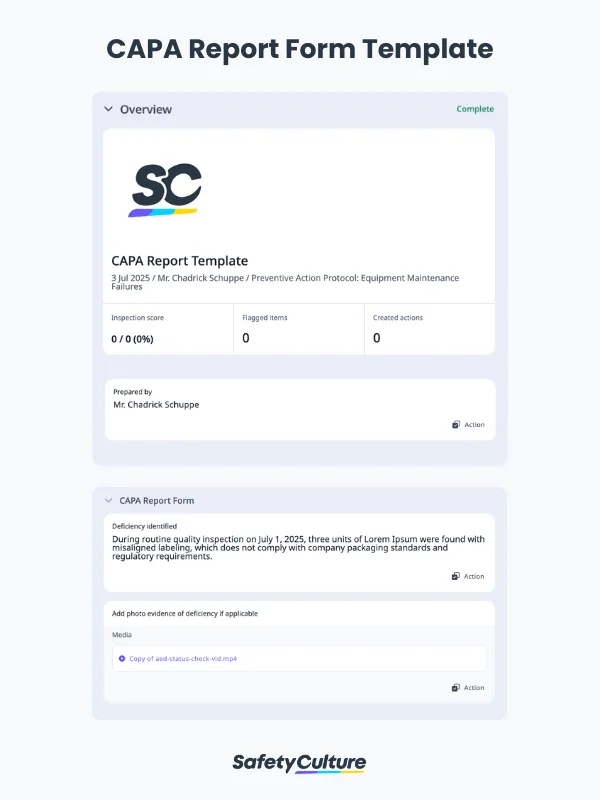
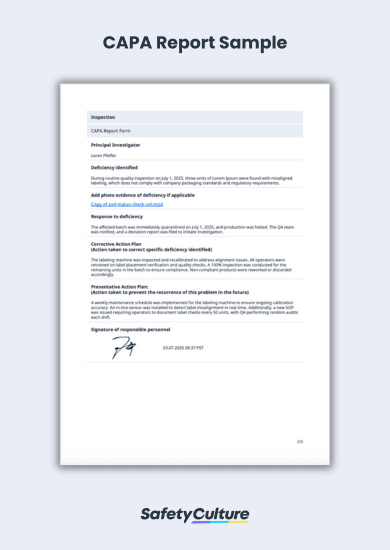
This CAPA report template can be used by compliance officers when formulating a corrective action to resolve issues and discuss preventive actions to lower the risk of its recurrence that can lead to regulatory and organizational non-conformance. This checklist also allows you to do the following:
Identify regulatory and organizational conformance deficiencies and gaps.
Record details of issues and incidents after adding the principal investigator assigned to the job.
Write corrective actions to address the problem and preventive actions to avoid future recurrence.
Add photo/video evidence of the problem if necessary.
Customize the CAPA report form to fit your business needs.
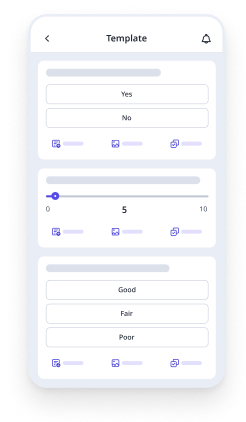
Downloadable on all devices, generate CAPA inspection reports and share them with relevant parties via PDF, email, or weblink.
A CAPA (Corrective and Preventive Action) Report is a tool used in identifying, addressing, and preventing regulatory and organizational non-conformance. Compliance officers record the details of an issue or incident on a CAPA Report form, which primarily includes a summary of the event, date of occurence, items and people involved, corrective actions taken, and preventive action established to avoid future recurrence.
When to Write a Report
A CAPA report is flexible and can be used for different types of issues and incidents. However, not every event warrants a CAPA report. Quality teams must utilize risk management techniques to determine the severity of an incident and decide if a CAPA report is needed.
Here are some situations wherein a CAPA report is beneficial:
If the issue is severe/urgent – Issues or events that have long-term negative effects on business, workers, and/or customers can be classified as severe or urgent. Examples include risk of severe injury, risk of significant financial loss, and non-conformance with regulatory and organizational standards.
If the issue is recurring – A recurring issue can often not be solved by quick fixes. An investigation must be conducted to find its root cause so the CAPA report can provide a permanent solution. An example would be consistent complaints from customers regarding the functionality of a laptop’s keyboard.
If the issue is systemic – In some cases, a recurring issue exists because of an inherent system or design flaw instead of an isolated error. Understanding the root cause before writing a CAPA report is essential to properly address the issue. An example would be if all units of a smartphone model were recalled because its batteries kept exploding.
Benefits
An effective CAPA Report can help an organization operate efficiently and minimize the risk of errors, accidents, and non-compliance with regulatory and organizational standards.
Here are some of the benefits of a good CAPA Report:
1. Encourages continuous improvement
Having an awareness of CAPA reporting helps organizations analyze their processes and systems critically to maximize their effectiveness.
2. Ensures SOP and legal compliance
One of a CAPA report’s primary functions is to ensure an organization complies with regulatory and company standards. It helps organizations implement protocols that are designed to meet compliance and standard requirements.
3. Lowers risk of errors
Errors often happen because of a lack of training, knowledge, or effective process. CAPA reports provide proactive solutions to anticipated errors and lower their risk of recurrence.
4. Provides a framework for problem solving
CAPA reports provide a unified system when approaching incidents and anticipated risks. It ensures that both corrective and preventive actions are taken to completely eliminate the problem.
5. Documents action plans
CAPA reporting helps an organization build a database of corrective and preventive actions against common and anticipated problems. The documentation of action plans,aside from helping prevent similar problems in the future, also help with employee accountability.
Thermosash was able to achieve ISO certification in six months using the SafetyCulture platform by centralizing workflows, boosting visibility, enhancing accountability, and streamlining quality control through QA checks and automatic corrective action alerts.
A well-documented CAPA report is essential for addressing safety and compliance issues effectively. To get the most detailed and actionable information, your report should include the following:
Protocol Title – Specify the type of investigation being conducted (e.g., deviation, customer complaint, equipment failure). This helps define the scope of the CAPA.
Deficiency Identified – Describe what went wrong, where and when it happened, and the potential impact on safety, operations, or compliance.
Corrective Action Plan – Outline the immediate response and actions taken to address the root cause of the issue.
Preventive Action Plan – Detail the steps implemented to ensure the problem doesn’ recur, such as process changes, new controls, or training.
Multimedia Evidence – Attach relevant photos or videos to support your findings and help speed up root cause analysis.
CAPA reports should be clear and detailed to properly address the issue at hand. The more information you include, the easier it is to understand what went wrong and prevent it from happening again.
A risk management plan template can be used to identify risks, record the risks’ impact on a project, assess the likelihood, seriousness, and grade. This can be used by project managers during project planning to address possible problems.
Use this 5 whys template to resolve the root cause of a problem so that your business teams can avoid encountering them again. Begin by clearly stating the problem and answer why the problem occurred until the root cause is discovered. To complete the 5 whys template, provide a solution to the root cause of the problem and create actions.
ISO 9001:2015 Risk Assessment & Preventive Action Form - Industry Vetted
Developed by our industry expert partner, this template aligns with ISO 9001:2015 requirements for a Quality Management System (QMS) in the workplace. It helps identify, assess, and mitigate risks in processes, products, or services.