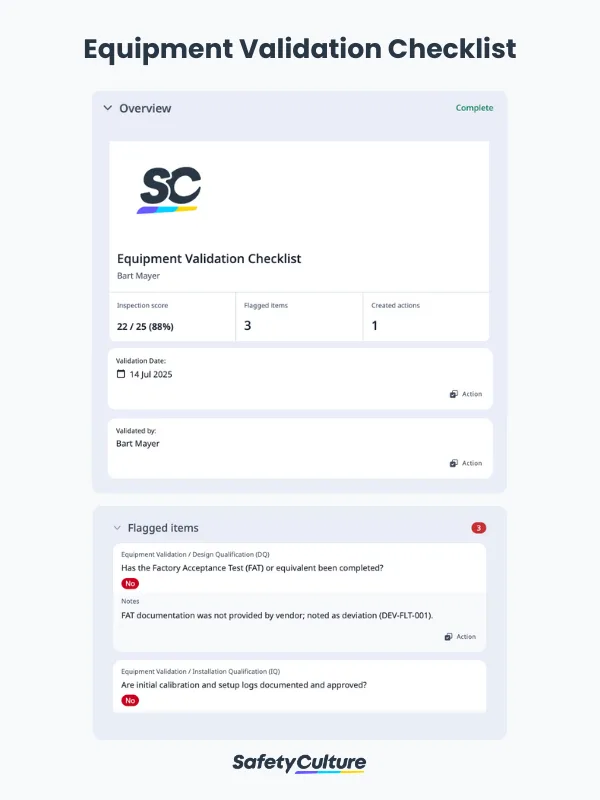
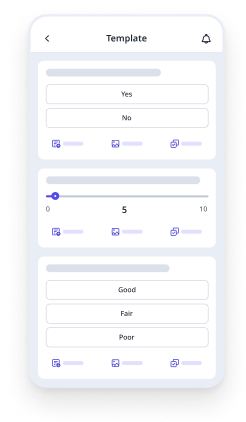
Download and use this equipment validation checklist to ensure your equipment meets design, installation, operational, and performance requirements in compliance with various industry standards and applicable regulations. It includes fields for recording test results, deviations, corrective actions, and approvals to support audit readiness. This is ideal for use during initial validation, post-maintenance checks, or requalification activities.
Customize the checklist to fit your organization’s specific needs.
Have real-time tracking on task completion.
Attach photos and videos for documentation.
Generate reports for easier compliance with health and safety regulations and conformance with standards.
An equipment validation checklist is a structured tool used to verify that pieces of equipment operate consistently within their defined parameters. By standardizing validation procedures, organizations can reduce downtime, improve audit readiness, and support continuous improvement initiatives in manufacturing or laboratory environments.
Benefits of an Equipment Validation Checklist
Following an equipment and machine validation checklist offers several critical benefits for regulated industries, helping organizations ensure consistent quality, compliance, and operational efficiency. Below are the key advantages, each explained in detail:
Ensures regulatory compliance – An equipment validation checklist helps organizations meet the regulatory standards set by agencies such as the Food and Drug Administration (FDA) and the Occupational Safety and Health Administration (OSHA). By systematically documenting each validation step, companies can demonstrate compliance during inspections or audits, thereby reducing the risk of penalties or production shutdowns.
Improves equipment reliability – By following proper equipment validation guidelines using a checklist, businesses can detect and correct potential issues before they affect operations. In fact, machine operators had the highest work fatalities in Australia in 2022, claiming 74 lives. The proactive approach of using an equipment validation checklist minimizes the risk of equipment failure, ensuring machines operate safely and consistently within specified parameters.
Streamlines quality assurance processes – Using a structured checklist simplifies the process equipment validation workflow and reduces human error. It ensures every step—from installation to performance testing—is completed thoroughly, promoting consistent quality across batches and reducing variability in production outcomes.
Enhances audit readiness – An equipment verification form provides well-documented proof of compliance and performance for auditors or regulatory bodies. This clear documentation improves transparency, builds trust, and allows companies to respond quickly and confidently during external audits.
Supports continuous improvement – Routine use of an equipment validation checklist encourages regular performance reviews and process optimization. By identifying trends or recurring issues, organizations can implement long-term improvements to enhance productivity and equipment lifecycle management.
The SafetyCulture platform is the life-blood of our quality and safety management systems. We are using it to report on everything—from QHSE (Quality Health Safety Environment) field audits, PPE (Personal Protective Equipment) inspections, contractor onboarding, equipment service and repair templates, asset tracking— along with all of our permits to work.
What Equipment Validation Guidelines are Included in the Checklist
An equipment validation checklist allows for systematic evaluation of equipment setup, calibration, and performance under expected conditions. Considering these, the following equipment validation guidelines should be incorporated into the checklist:
Design Qualification (DQ)
Installation Qualification (IQ)
Operational Qualification (OQ)
Performance Qualification (PQ)
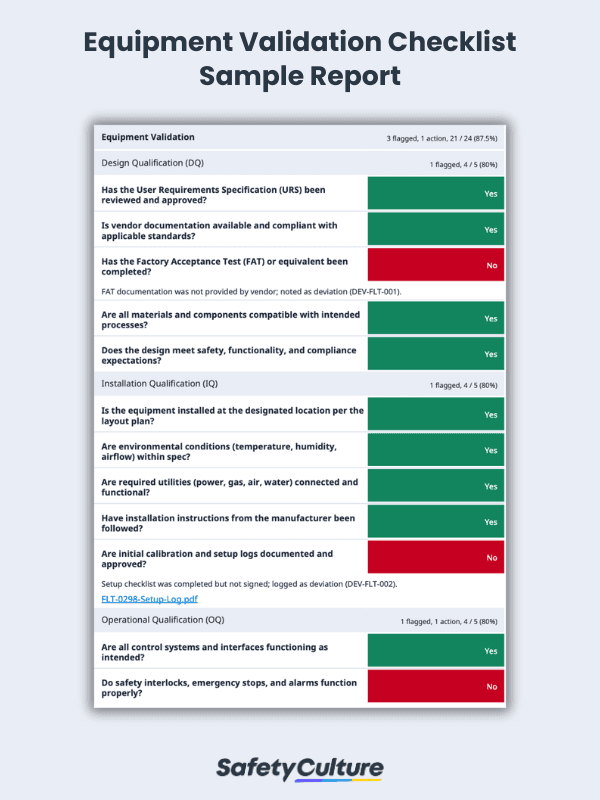
Equipment Validation Report Example
Using an equipment validation checklist streamlines the validation process by providing a repeatable framework that minimizes human error and ensures thorough inspection. See the equipment validation PDF report below:
An effective equipment validation checklist is essential for ensuring that equipment performs reliably. Below is a guide to utilizing a comprehensive and audit-ready document:
1. Confirm equipment design meets requirements.
Start by confirming that the equipment design meets user requirements and intended use before installation. Review the User Requirements Specification (URS), vendor documentation, and Factory Acceptance Test (FAT) records to ensure all performance expectations are clearly defined and aligned with operational needs. The checklist should include items related to equipment specifications, material compatibility, regulatory compliance, and risk assessments.
2. Validate proper equipment installation.
Verify that the equipment has been installed correctly and according to the manufacturer’s specifications. This includes checking proper location setup, environmental controls (e.g., temperature, humidity), and the availability of required utilities such as power and compressed air. The checklist should prompt documentation of installation procedures, calibration certificates, environmental verification, and utility connections.
3. Test equipment functionality.
Test the equipment’s functionality under controlled conditions to ensure it operates within defined operational parameters. Include validation steps for control systems, alarms, safety interlocks, and standard operating functions. The checklist should require recording of test results, observed deviations, and any necessary corrective actions, confirming the equipment’s readiness for performance testing.
4. Demonstrate real-world equipment performance.
Evaluate how the equipment performs under actual operating conditions using real products or materials. The checklist should guide users to conduct process runs or simulations that mirror routine production, validating the consistency, reliability, and repeatability of performance. Documentation should capture results, variability, and any required adjustments to optimize performance.
5. Document and review validation activities.
Conclude by compiling all validation data, test records, deviation logs, and approval signatures into a central validation report. The checklist should include sections to verify completeness, traceability, and compliance with regulatory expectations and internal Standard Operating Procedures (SOPs). This step ensures that the validation process is audit-ready and that all critical decisions are fully documented and reviewed.
Run consistent equipment servicing with proven resources
Dependable equipment servicing courses and templates that help teams work safely and cut repeat issues
Process Validation Protocol - Equipment Qualification Template
Download and use this process validation protocol – equipment qualification template to easily identify key items of equipment, utilities supply, and environmental requirements.
This equipment commissioning checklist is used for the commissioning of burners/boilers in an industrial or commercial power plant. Each inspection item can also be set to “mandatory” to make sure that every detail about the equipment commissioning is checked.