

Published 15 Oct 2025
Article by
4 min read
What is a Dry Food Storage Checklist?
A dry food storage checklist is a tool used to systematically inspect dry storage areas and keep them in a clean and well-ventilated condition. It runs through the essential tasks to uphold food safety standards in storage spaces, helping maintain a hygienic environment that prevents spoilage, contamination, and pests.
Importance
Dry foods, unlike frozen foods, are classified as non-perishable, meaning they have a longer shelf life and do not require strict refrigeration to remain safe. Their low moisture content makes it difficult for bacteria, yeast, or mold to grow. However, being non-perishable doesn’t mean they last forever or are completely free from the risk of bacterial growth.
A poorly maintained dry storage room can become a breeding ground for pests and bacteria, increasing the risk of spoilage and cross-contamination of foods. It would also result in noncompliance with food safety regulations, such as the FDA Food Code (US),Food Regulations (Canada),Food Safety Act 1990 (UK), and Food Standards Code 3.2.2 (Australia). Noncompliance can lead to fines, penalties, and even business closure.
This is why a food storage checklist —for both dry and cold storage —is essential in food service businesses. It ensures compliance, protects customers, builds trust with partners and stakeholders, and helps maintain food quality and taste. It also keeps processes organized, so no step is missed. When done digitally, it can integrate directly into your Quality Management System (QMS).
What to Include in a Dry Food Storage Checklist
When it comes to a comprehensive dry goods storage checklist, every detail matters, from pest control to accurate item documentation. Proper storage is essential to protect customers and prevent foodborne illnesses.
A dry foods storage checklist template should have the following:
Safety & Compliance
Have staff been trained on proper dry food handling and storage?
Are emergency procedures in place for contamination or infestation?
Is a food safety policy posted and accessible to all staff?
Are safety signs (e.g., "No Smoking," "Authorized Personnel Only") posted in the storage area?
Are fire extinguishers, smoke detectors, and first aid kits present and accessible?
Environment & Facility Conditions
Is the storage area temperature between 50°F and 70°F (10°C to 21°C)?
Are external doors/windows sealed properly?
Are storage shelves clear of overhead sewer lines?
Are all items at least 6" (15 cm) off the floor?
Are all the items clear of the walls?
Is the dry storage area dirty or disorganized?
Are the floors clean and clear of debris or empty cartons?
Storage Practices & Organization
Are items rotated using the FIFO (First In, First Out) method ?
Are the dry foods stored in airtight containers?
Are all containers properly closed?
Are paper products on designated shelves?
Are allergenic foods (e.g., nuts, wheat flour) stored separately to avoid cross-contact?
Are all items labeled or dated according to local policy?
Food Safety & Product Condition
Are there any chemicals stored next to the foods?
Are there any spoiled, rotten, or deteriorated foods?
Are canned products free of dents?
Are all dry foods labeled and dated?
Are any dry foods past their ‘use by’ date still being stored?
Pest Control
When was the last pest inspection performed?
Are there any signs of pest activity (droppings, gnaw marks, nests, insects)?
Is waste and rubbish removed regularly to avoid attracting pests?
Records & Documentation
Are inspection and cleaning schedules documented and updated?
Is proper food inventory management being followed (recording and logging data)?
Are all storage area keys accounted for and authorized?
Is there a dry storage food items list present for keeping track of stock?
How to Use a Dry Food Storage Checklist
It’s not enough to simply keep storage spaces clean before use — proper dry storage area management is essential to ensure food safety and compliance.
Here is how you can implement this checklist into your daily workflow:
Download and Customize - Download the checklist and adapt it to suit your storage area, whether large or small.
Set Inspection Schedules - Establish daily, weekly, and monthly inspections, and assign responsible personnel.
Flag and Notify - If issues are found during an inspection, flag them immediately and notify the person responsible for resolution.
Record and Log - Keep all inspections recorded and logged to maintain a reliable history for future reference.
Review and Improve - Regularly review completed checklists and inspection records to identify patterns, improve processes, and prevent recurring issues.
Dry Food Storage PDF Report
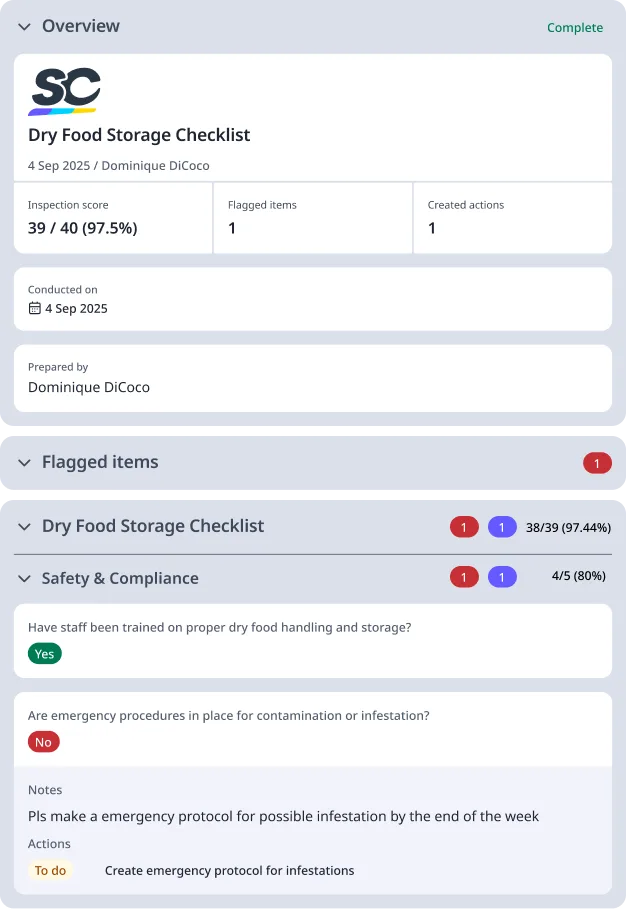
Below is an example of a completed dry food storage checklist template:


Still looking for a checklist?
Search, filter, and customize 60,000+ templates across industries and use cases.