
Best Practices
Your risk assessment was accurate five years ago. Now, not so much.
Share article
A dynamic risk assessment is only as good as the static risk assessment it draws from.
The gap between what the document says and what workers actually face is where accidents happen.
When training and processes stop keeping up, instinct stops being reliable too.
An air traffic manager is the aviation equivalent of a road traffic engineer. They design the conditions everyone else operates within. When those conditions are met, travel is safe. When they're not, the consequences in the air are final.
This is sadly what happened on January 29, 2025, when a passenger airline collided with a US Army Black Hawk helicopter. All 67 people on board died.
People thought it was a freak accident, but after investigations it was apparently pure negligence on The Federal Aviation Administration for not managing the chopper’s routes.
The National Transportation Safety Board Chair Jennifer Homendy put it plainly: “the conditions for this tragedy were in place long before the night of Jan. 29.”
That's the part that sticks. The system didn't fail in a moment; it had been quietly failing for years.
It's a pattern that shows up far beyond aviation; it also shows up in industries such as construction, manufacturing, logistics, and healthcare. Anywhere, workers are making safety calls on the ground. This is why dynamic risk assessments are more important now than ever.
Dynamic Risk Assessment (DRA) involves how workers respond to hazards in real time, rather than relying on set protocols that are probably outdated or written for a version of the job that no longer exists. Because when you're on the job, conditions can change on the fly, and you need to be ready for anything.
The problem is that most organizations treat standard risk assessments as a scheduled event. Once a quarter or once a year, they check its boxes, file the necessary documents, and move on.
But DRA doesn't operate in a vacuum. It draws on the training workers have received, the procedures they've been taught, and from previous risk assessments. However, if those are outdated, the DRA is already compromised before anyone starts the shift.
With how fast conditions change on the ground, the risk controls in place may no longer reflect reality. And it's not the workers' fault for making bad calls; they're just following what they were taught. It's the lack of updated protocols that gets them.
Cultivate a culture of excellence with our digital solutions that enhance efficiency, agility, and continuous improvement across all operations.
Outdated risk assessment processes don't usually look like negligence, because they're not wrong. They're just practices that worked before but didn't adapt to newer technology and practices.
The US Occupational Safety and Health Administration (OSHA) General Duty Clause requires employers to protect workers from all kinds of hazards, which means risk assessments need to reflect current conditions. But in higher-risk industries like construction and process safety management, OSHA goes further with explicit review requirements whenever there is change.
There are many conditions that would trigger a DRA. Such as:
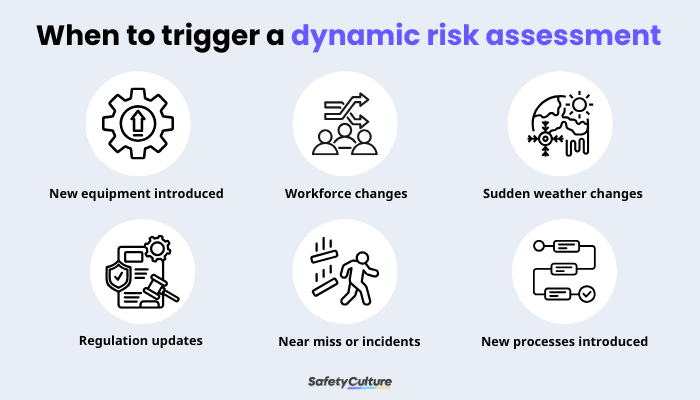
When to trigger a dynamic risk assessment
New equipment introduced
Workforce changes
Sudden weather changes
Regulation updates
Near miss or incidents
New processes introduced
When you're good at what you do, the instinct is to trust your gut when something goes wrong. But gut feeling isn't separate from process; it's built from training and experience. When those are outdated, the instinct is too.
An outdated risk assessment tells the story of a company that seems to assume the world still runs the same way it did, say, five years ago. That's a leadership and accountability problem, and the consequences go beyond safety.
Because as of 2025, OSHA charges up to $16,550 per violation for serious breaches, and up to $165,514 for willful or repeated offenses.
There's also a culture problem that builds quietly in the background. When workers notice that risk assessments never change regardless of what's happened on site, they stop trusting the process. Rather, they start working around it, improvising where they can. And improvisation isn't a safety strategy. It's just an accident waiting to happen.
The whole point of DRA is that workers make informed real-time judgments. Take away the reliable foundation, and "informed" is no longer part of it.
The fix isn't a more thorough annual review. It's changing what triggers a review in the first place. Consider doing the following:
Move from calendar-based assessments to condition-based: Reviews should happen when something changes so things are kept updated. A calendar review is useful, but should never be the only basis for changes.
Build a feedback loop from the field: Workers see things the risk register doesn't. When they complete a DRA, those observations need to feed back into the process.
Make "last reviewed" visible: Workers should be able to see whether the assessment is at the most current form. Burying that in document metadata doesn't help anyone.
Use digital tools to close the loop faster: With the power of digital documentation tools and AI tools now, organizations can capture field observations, flag overdue reviews, and train employees all in real time.
The accident between the plane and the helicopter is a good reminder that you always need to do your due-diligence and not just tick down the boxes. The people on duty that day were working inside a system that hadn't kept pace with reality. That's a leadership problem. And it's one that every organization managing dynamic risk has to own.
Important notice
The information contained in this article is general in nature and you should consider whether the information is appropriate to your specific needs. Legal and other matters referred to in this article are based on our interpretation of laws existing at the time and should not be relied on in place of professional advice. We are not responsible for the content of any site owned by a third party that may be linked to this article. SafetyCulture disclaims all liability (except for any liability which by law cannot be excluded) for any error, inaccuracy, or omission from the information contained in this article, any site linked to this article, and any loss or damage suffered by any person directly or indirectly through relying on this information.


