Dynamic Risk Assessment Training: A Guide
See how real-time hazard awareness and structured training help teams respond to changing risks and maintain safer daily operations.

See how real-time hazard awareness and structured training help teams respond to changing risks and maintain safer daily operations.
Published 27 Apr 2026
Article by
5 min read
Dynamic Risk Assessment (DRA) training equips individuals and organizations with the skills and mindset to assess and respond to risks in real time, especially in rapidly changing or unpredictable environments. This type of training often includes scenario-based exercises, decision-making under pressure, and the development of critical thinking skills, ultimately aiming to enhance participants' ability to make informed, quick, and effective decisions.
Real-time hazard recognition training enables workers to respond swiftly to changing workplace conditions. By improving situational awareness and decision-making through dynamic risk assessment, organizations can boost safety performance and better manage operational risks. This training also:
Improves hazard recognition in changing environments: Workers learn to detect emerging hazards early and take immediate action, which is critical in fast-paced industries such as construction, emergency response, and oil and gas.
Enhances decision-making in high-pressure situations: Practical exercises prepare workers to evaluate risks quickly and respond appropriately when unexpected situations arise.
Supports compliance with workplace safety requirements: It helps organizations demonstrate active risk management and adherence to health and safety regulations.
Builds employee confidence and accountability: Workers gain the skills needed to assess conditions independently, encouraging greater responsibility for maintaining workplace safety.
Strengthens overall safety culture: Teams become more proactive in identifying hazards and communicating risks, reinforcing a shared commitment to preventing incidents.
Reduces operational costs and disruptions: Faster hazard response helps minimize injuries, insurance claims, and downtime caused by workplace accidents.
Equip your team with the knowledge and skills to operate safely through extensive training programs.
Dynamic risk assessment training typically includes practical topics that help workers recognize hazards, evaluate risks, and respond to changing conditions in real time. These topics may include:
Hazards and workplace risks: Participants learn the difference between hazards and risks and how both influence workplace safety.
Static vs. real-time risk evaluation: This topic explains how traditional risk assessments differ from real-time evaluations and how both approaches support effective safety planning.
Risk calculation and evaluation methods: Workers learn to estimate risk by considering the severity of potential harm and the likelihood of an incident.
Structured steps for assessing risks in the field: Programs typically follow a step-by-step approach that includes observing conditions, identifying hazards, evaluating risks, applying controls, and reviewing outcomes.
Hierarchy of hazard controls: Participants study the different levels of hazard control and how to select the most effective measures to reduce workplace risks.
Decision-making during changing conditions: Exercises focus on improving judgment and response speed when workers encounter unexpected hazards.
Communication and teamwork in safety situations: Clear communication practices help teams share hazard information quickly and coordinate safe responses.
Scenario-based safety exercises: Realistic work scenarios allow participants to apply concepts learned in risk management training, strengthening practical hazard recognition and response skills.
There are no standalone certifications or standards for DRA training because organizations typically embed it within broader health and safety qualifications. However, it must comply with broader, established safety standards, such as the following:
ISO 31000:2018 (Risk Management): The ISO 31000:2018 standard provides general principles for risk management. It doesn't specifically address dynamic assessments but establishes a basis for risk management practices, such as identifying, analyzing, and treating risks.
ISO/IEC 31010:2019: This standard focuses on risk assessment techniques for evaluating potential threats and vulnerabilities. It supports organizations in selecting appropriate risk analysis methods for different operational contexts.
UK Health and Safety Executive (HSE) guidelines: The UK HSE requires employers to perform workplace risk assessments and train employees to identify hazards. The guidelines stress the need for continuous risk evaluation, particularly in fast-changing environments.
SLAM and STAR frameworks: Frameworks like SLAM (Stop, Look, Assess, Manage) and STAR (Stop, Think, Act, Review) guide workers in evaluating on-the-spot hazards. They promote a "pause and assess" approach before starting tasks.
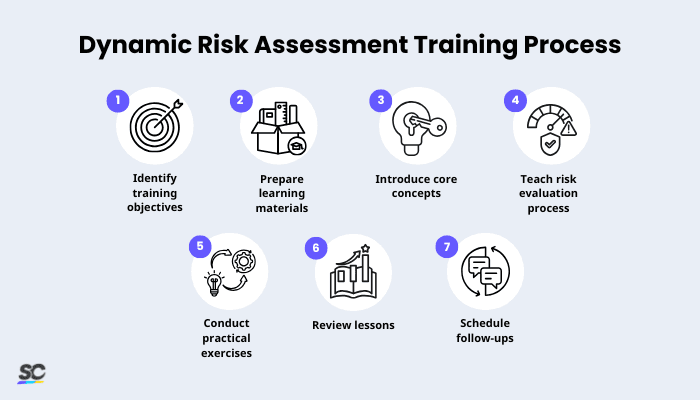
Conducting effective training requires a structured approach that combines theoretical knowledge with practical exercises. Here are some steps to help you conduct dynamic risk assessment training:
Determine who will attend the training, including frontline workers, supervisors, and safety personnel.
Define learning objectives based on workplace hazards, operational risks, and regulations.
Select a structured framework that participants can use when evaluating risks in changing environments.
Develop checklists, visual guides, and reference documents.
Use real workplace examples, videos, or case studies that reflect actual operational risks.
Reference relevant workplace safety rules or policies to keep training practical and compliant.
Explain the difference between traditional risk assessments and real-time hazard evaluation.
Discuss legal responsibilities, situational awareness, and the importance of quick decision-making.
Walk participants through the key steps used when identifying and responding to hazards.
Demonstrate how to observe conditions, evaluate risks, and apply control measures.
Use diagrams or flowcharts to help participants understand how the process works in practice.
Use role-playing activities and scenario-based drills to simulate changing workplace conditions (e.g., weather changes, equipment issues, unexpected hazards).
Have participants work in teams to identify risks and decide on appropriate responses.
Hold group discussions or debrief sessions to review the decisions made during exercises.
Use quizzes or assessments to measure participants' understanding of the concepts.
Provide feedback on improving hazard recognition and response.
Issue certificates or completion records where applicable.
Plan and schedule refresher sessions or additional training if needed.
Monitor workplace safety performance after training to ensure lessons are applied effectively.
SafetyCulture is a mobile-first operations platform adopted across industries such as manufacturing, mining, construction, retail, and hospitality. It’s designed to equip leaders and working teams with the knowledge and tools to do their best work—to the safest and highest standard.
Streamline processes, eliminate bottlenecks, enhance resource utilization, and build an agile and scalable infrastructure with SafetyCulture. Strive for operational excellence to boost competitive advantage, foster sustainable growth, and deliver long-term value.
✓ Save time and reduce costs
✓ Stay on top of risks and incidents
✓ Boost productivity and efficiency
✓ Enhance communication and collaboration
✓ Discover improvement opportunities
✓ Make data-driven business decisions
In this article