A Comprehensive Guide to Supplier Risk Assessment
Explore how structured supplier risk assessment strengthens supply chain reliability, reduces operational disruption, and supports consistent quality across supply chain functions.

Explore how structured supplier risk assessment strengthens supply chain reliability, reduces operational disruption, and supports consistent quality across supply chain functions.
Published 5 May 2026
Article by
7 min read
Supplier risk assessment is the process of evaluating and identifying potential risks when engaging with a supplier for goods or services. This assessment aims to verify that suppliers meet the company's standards for quality and reliability, while also complying with industry regulations. The risk assessment process generally involves analyzing various factors such as the supplier's financial stability, the company's capacity, historical performance, reputation, and compliance with legal and ethical guidelines.
Supplier risk assessment is a critical part of supply chain management. Conducting proactive risk assessments helps companies mitigate potential risks and protect their business interests without severely disrupting business operations.
This matters because research shows that 83% of compliance and legal leaders identify risks only after completing due diligence, underscoring the need for earlier, more structured risk evaluation.
Here are some more key reasons why supplier risk assessment is essential:
Reduces financial exposure: Identifies warning signs, such as credit instability, bankruptcy risk, or currency fluctuations, that could disrupt supply and lead to unexpected costs.
Prevents operational disruptions: Flags issues such as delivery delays, quality defects, or limited production capacity before they affect timelines and productivity.
Ensures regulatory and safety compliance: Verifies that suppliers meet health, safety, environmental, and industry standards to minimize legal penalties and audit failures.
Protects brand and reputation: Evaluates ethical practices, ESG performance, and cybersecurity safeguards to prevent data breaches and reputational damage.
Improves quality and performance: Uses structured audits and validation processes to ensure suppliers consistently meet required specifications and performance KPIs.
Supports proactive risk mitigation: Enables contingency planning, supplier diversification, and continuous monitoring to strengthen supplier risk mitigation efforts and address risks before they escalate.
Cultivate a culture of excellence with our digital solutions that enhance efficiency, agility, and continuous improvement across all operations.
Supplier risks can affect performance, compliance, financial stability, and brand reputation. A comprehensive risk assessment should evaluate each risk category to ensure a complete understanding of potential vulnerabilities across the supply chain.
Below are examples of supplier risks based on established risk management frameworks.
Strategic risk arises when a supplier's long-term direction no longer aligns with your organization's objectives. Changes such as mergers, leadership transitions, or shifts in suppliers may affect their ability to support your operations, leading to misalignment that weakens the partnership and disrupts long-term supply stability.
Operational and capacity risks involve failures in processes, systems, or workforce capabilities that affect performance. Delivery delays, quality defects, labor shortages, or production bottlenecks can directly disrupt operations. Without proper oversight, these issues can escalate into service or production interruptions.
Business continuity risk occurs when unforeseen events prevent a supplier from fulfilling contractual obligations.Natural disasters, facility shutdowns, financial collapse, or geopolitical instability can halt production or delivery. Strong contingency planning and backup sourcing strategies are essential to manage this risk.
Financial and credit risk focuses on the supplier's economic stability and ability to meet commitments.Declining financial performance, liquidity challenges, debt defaults, voluntary administration, liquidation, small business restructuring, or currency volatility signal increased vulnerability. Monitoring financial health helps detect early warning signs before disruptions occur.
Compliance and regulatory risk arise when suppliers fail to meet legal, industry, or contractual requirements. Violations of labor laws, data protection regulations, or industry standards can expose organizations to fines and legal consequences.Ongoing audits and due diligence also help reduce compliance-related exposure.
Cybersecurity risk emerges when suppliers with system or data access introduce digital vulnerabilities. Weak access controls, inadequate encryption, or past data breaches increase exposure to cyber threats.Assessing supplier security controls is critical as third-party incidents remain a leading cause of data breaches.
Reputational risk occurs when a supplier's actions negatively impact your organization's brand.Ethical misconduct, legal disputes, environmental violations, or public controversies affect the confidence of suppliers, customers, and investors. The organization's behavior reflects on your company; proactive screening and monitoring are essential.
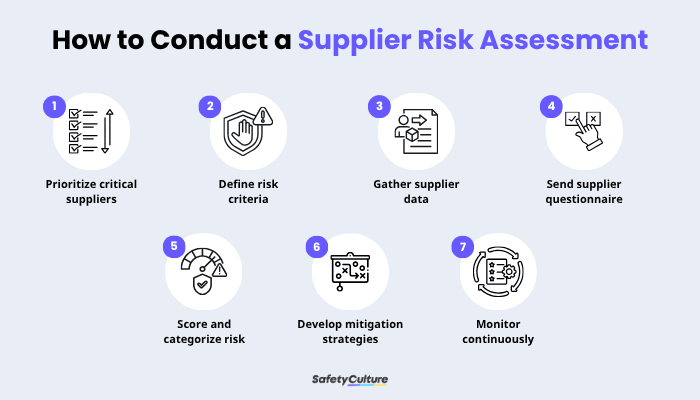
How to Conduct a Supplier Risk Assessment
A structured supplier risk assessment helps organizations identify vulnerabilities, prioritize high-risk vendors, and implement mitigation strategies before disruptions occur.
Here is a practical, step-by-step approach to conducting an effective assessment:
List all suppliers and segment them by operational importance and supply risk. Conduct deeper assessments on strategic and bottleneck suppliers whose failure would significantly impact the business.
Establish clear evaluation categories, including:
Financial stability
Operational capability
Regulatory and quality compliance
ESG performance
Cybersecurity readiness
Business continuity Align criteria with input from operations, finance, legal, and other relevant departments.
Collect internal records (financials, audits, KPIs, certifications) and external intelligence (credit reports, regulatory history, market data). Use relevant and timely information to ensure accurate evaluation.
Request standardized responses covering key areas. Typical questions include:
Can you provide your latest audited financial statements?
What is your current production capacity, and what is your contingency plan?
Have you faced regulatory penalties in the last three years?
Do you maintain documented ESG or sustainability targets?
What cybersecurity controls protect shared data?
Do you have a tested disaster recovery plan?
Businesses can use digital tools like checklists to streamline the verification process and create a standardized questionnaire for thorough assessment of supplier risks.
Build from scratch or choose from our collection of free, ready-to-download, and customizable templates.
Use a risk matrix to assess likelihood and impact. Classify suppliers as negligible, low, medium, high, or extreme risk. Prioritize high-likelihood and high-impact exposures.
Implement targeted controls such as:
Supplier diversification
Contingency inventory
Contractual safeguards
Financial guarantees
Cybersecurity enhancements
ESG improvement plans
If suppliers fail to fulfill these controls, they pose unmanageable risks and may require a replacement.
Reassess periodically and track supplier performance through audits, KPIs, and automated alerts. Continuous monitoring ensures early detection of emerging risks and strengthens long-term supply chain resilience.
As supply chains become increasingly global and complex, the challenges of effectively assessing supplier risk also increase. Here are some common challenges that organizations may face:
Companies may work with hundreds or even thousands of suppliers across multiple categories and regions. Assessing every supplier with the same depth can be overwhelming and time-consuming.
Best Practices: Segment suppliers based on criticality and risk exposure. Prioritize high-impact and strategic suppliers first, and apply lighter assessments to non-critical vendors.
Each organization operates in a unique industry environment with different regulatory, operational, and financial risk exposures. A framework that works for one company may not address another's specific vulnerabilities.
Best Practices: Define customized risk criteria aligned with your business model, regulatory landscape, and operational requirements. Involve cross-functional stakeholders to tailor the assessment process.
Many organizations lack dedicated risk management teams, standardized processes, or appropriate tools. Assessments can become inconsistent, incomplete, or reactive due to resource constraints.
Best Practices: Invest in structured frameworks, automation tools, and staff training. Consider assigning clear ownership of supplier risk management and leveraging external expertise when needed.
Modern supply chains span multiple countries and involve numerous subcontractors. Each layer introduces new operational, geopolitical, compliance, and ESG risks, making visibility difficult.
Best Practices: Increase supply chain transparency by mapping critical tiers of suppliers. Use technology solutions to monitor geopolitical, financial, and ESG risks across regions.
Effective assessments require financial records, compliance documentation, performance metrics, and cybersecurity information. Some suppliers are reluctant to share sensitive data or are unable to provide it.
Best Practices: Establish clear data requirements in contracts and supplier onboarding processes. Use confidentiality agreements to address privacy concerns and request supporting documentation to validate responses.
Risk is present in every supplier relationship. Some organizations underestimate their importance or avoid conducting a formal assessment altogether.
Best Practices: Shift the mindset from risk elimination to risk mitigation. Implement continuous monitoring, contingency planning, and diversified sourcing strategies to manage unavoidable exposure.
SafetyCulture is a mobile-first operations platform adopted across industries such as manufacturing, mining, construction, retail, and hospitality. It’s designed to equip leaders and working teams with the knowledge and tools to do their best work—to the safest and highest standard.
Streamline processes, eliminate bottlenecks, enhance resource utilization, and build an agile and scalable infrastructure with SafetyCulture. Strive for operational excellence to boost competitive advantage, foster sustainable growth, and deliver long-term value.
✓ Save time and reduce costs
✓ Stay on top of risks and incidents
✓ Boost productivity and efficiency
✓ Enhance communication and collaboration
✓ Discover improvement opportunities
✓ Make data-driven business decisions