
Risk Acceptance: Definition, Types, Examples & Process
Learn what risk acceptance means, when to use it, and how to document and monitor accepted risks within your organization.

Learn what risk acceptance means, when to use it, and how to document and monitor accepted risks within your organization.
Published 25 Jun 2026
Article by
5 min read
Risk acceptance is a formal risk management decision where an organization reviews a specific risk, determines it falls within its tolerance level, and formally agrees to live with it rather than treat it further.
It typically happens when the cost of reducing a risk outweighs the potential impact, when no practical mitigation option exists, or when the risk is too low in likelihood and consequence to warrant action. What makes it acceptable rather than neglect is the documentation and sign-off behind it.
Risk acceptance makes sense in specific circumstances. It's not a fallback when resources run out or a way to defer a hard decision. The standard test is simple: if the potential impact of a risk is lower than the cost of reducing or eliminating it, acceptance is a legitimate choice.
Three situations typically justify it:
The risk scores low on a risk matrix, with low likelihood and low impact, and sits within the organization's established threshold
No viable treatment option exists and trying to eliminate the risk would disrupt operations more than the risk itself
The risk is temporary with a clear end date, such as using a legacy system during a planned technology migration
Acceptance works best as part of a structured risk management process, not as a default when no one decides to act. Connecting each decision to the organization's broader framework makes the reasoning traceable and defensible.
There are two ways to accept a risk.
Active acceptance means the organization acknowledges the risk and prepares a response plan before anything happens. If the risk materializes, the team already knows what to do. This approach is common in project management: a contractor might accept the possibility of weather delays but build a schedule buffer in as a contingency.
Passive acceptance means the organization acknowledges the risk but doesn't plan a specific response. It's the right call for low-probability, low-consequence events where a contingency plan would cost more than the risk itself. A manufacturer choosing not to stock spare parts for a machine component that fails less than once a decade is a simple example.
The distinction matters. Active acceptance doesn't reduce the risk. It prepares the organization to respond if the risk occurs.
Most organizations define acceptable risks using likelihood and impact. A risk that scores low on both dimensions, with minor probability of occurring and minor consequences if it does, is a candidate for acceptance.
Two standards shape how organizations formalize this.
ISO 31000:2018 provides the foundational framework, including guidance on establishing risk acceptance criteria as part of a broader risk treatment strategy.
ISO/IEC 27001:2022 requires information security teams to define and apply formal risk acceptance criteria, making it a routine part of cybersecurity governance.
In practice, acceptance criteria usually cover four elements:
The likelihood threshold the risk must fall under
The maximum impact level tolerated
A cost-benefit justification showing treatment isn't proportionate
Alignment with the organization's documented risk appetite
A 5x5 risk matrix is one of the most common tools for making these calls. Risks scoring in the bottom two rows are typically within an acceptable range.
Not every risk can be eliminated. Once a risk has been assessed and treated, organizations need to decide whether what remains is tolerable — and document that decision. That's what risk acceptance is.
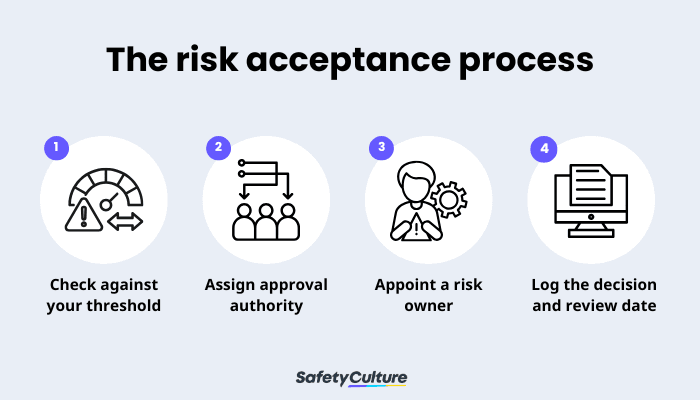
The risk acceptance process
The process starts with a defined threshold through risk identification. A risk that falls below an organization's acceptable level — based on its likelihood and consequence score — moves to formal acceptance. A risk above that threshold goes back for further treatment before it can be considered.
Acceptance decisions should never sit with one person. Most organizations assign acceptance authority based on the severity of the residual risk:
Low-risk items — accepted by frontline supervisors or team leads
Medium-risk items — reviewed and accepted by department managers
High-risk items — escalated to senior leadership or an executive risk committee
Once accepted, the risk needs a clear owner for regular reporting. That person is responsible for monitoring it over time and flagging any change in conditions that could affect its status. A construction firm might accept the low-probability risk of minor equipment delays during a project, while assigning a site manager to track weather forecasts and supplier timelines each week.
The decision should be recorded regardless of the risk level. This includes the residual risk score, the rationale for acceptance, the name of the approving authority, and a scheduled review date. Risks accepted today may not be acceptable in six months if the operating environment shifts.
SafetyCulture is a workplace operations platform adopted across industries such as manufacturing, mining, construction, retail, and hospitality. It's designed to equip leaders and working teams with the knowledge and tools to do their best work—to the safest and highest standard.
Promote a culture of accountability and transparency within your organization where every member takes ownership of their actions. Align governance practices, enhance risk management protocols, and ensure compliance with legal requirements and internal policies by streamlining and standardizing workflows through a unified platform.
✓ Save time and reduce costs
✓ Stay on top of risks and incidents
✓ Boost productivity and efficiency
✓ Enhance communication and collaboration
✓ Discover improvement opportunities
✓ Make data-driven business decisions