The 10 Kaizen Rules: A Guide to Continuous Improvement
Learn what the 10 Kaizen rules are, how they compare to Lean and Six Sigma, and how to put them into practice across your organization.

Learn what the 10 Kaizen rules are, how they compare to Lean and Six Sigma, and how to put them into practice across your organization.
Published 4 May 2026
Article by
6 min read
A Kaizen rule is a guiding principle that shapes how teams approach continuous improvement in their day-to-day operations. The 10 Kaizen rules give structure to the vague commitment of "doing better." They turn that intention into a clear, repeatable framework that anyone in your organisation can follow and act on.
Kaizen rules are often used interchangeably with Kaizen principles. Whichever term is used, they're always referring to the same set of 10 guidelines. The only real difference is "rules" tends to feel more action-oriented and structured, while "principles" are more philosophical.
Kaizen, Lean, and Six Sigma are three of the most widely used continuous improvement methodologies in business today. They share the same goal of improving processes and eliminating waste, but they go about it in very different ways.
Kaizen gives every person in your organisation a mindset and a set of rules to work by every day. Lean gives teams a focused lens for eliminating waste. Six Sigma gives analysts a data-driven framework for reducing defects.
Here's how they compare at a glance:
Kaizen | Lean | Six Sigma | |
Core focus | Continuous, incremental improvement at every level | Eliminating waste and maximising value | Reducing defects and process variation |
Approach | Philosophy and mindset | Methodology and toolset | Data-driven project framework |
Who's involved | Everyone — from frontline teams to senior leaders | Process owners and operations teams | Trained specialists (Green Belts, Black Belts) |
Speed of results | Fast — small changes implemented quickly | Medium — depends on process mapping scope | Slower — requires rigorous analysis cycles |
Best for | Building a culture of continuous improvement | Streamlining workflows and reducing inefficiency | Solving complex, data-heavy quality problems |
Works well with | Lean and Six Sigma | Kaizen and Six Sigma | Lean and Kaizen |
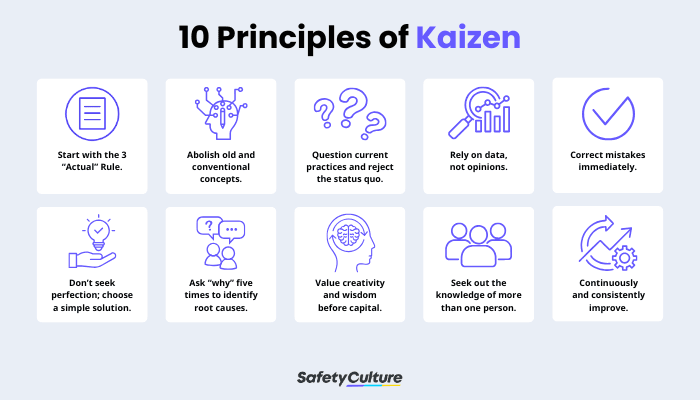
1. Start with the 3 "Actual" Rule. Before making any decisions, go directly to where the work happens. Talk to the people doing it, and observe the process as it actually runs. Don’t just rely on documentation and how it’s assumed to run. In summary, the 3 “Actual” rules are as follows:
Go to the place where the process is performed
Talk to the people involved
Observe and chart the actual process
2. Abolish old and conventional concepts. Don't let current practices get in the way of better outcomes. Outdated methods and assumptions are often the biggest barriers to improvement in established organisations.
3. Question current practices and reject the status quo. Treat every existing process as a starting point rather than a standard. Regularly asking "could this be done better?" is what keeps improvement moving forward.
4. Rely on data, not opinions. Improvement decisions should be grounded in facts. Collecting and reviewing real data from your operations gives you a clear, objective basis for change.
5. Correct mistakes immediately. When an issue is identified, address it straight away. Letting small problems sit unresolved allows them to compound into larger, costlier ones, especially across multi-site or multi-team operations.
6. Don't seek perfection; choose a simple solution. A good solution implemented today is more valuable than a perfect solution that never gets off the ground. Start with simple, practical fixes and build from there.
7. Ask "why" five times to identify root causes. Surface-level fixes rarely stick. Using the 5 Whys technique helps you dig past the symptom and find the real cause of a problem. That way, you only need to solve it once.
8. Value creativity and wisdom before capital. The best improvements often come from the people closest to the work, not from expensive tools or major investments. Encourage your teams to contribute ideas before reaching for a budget solution.
9. Seek out the knowledge of more than just one person. No single person has the full picture. Drawing on the collective experience and insight of your team leads to better decisions and stronger buy-in across departments.
10. Continuously and consistently improve. Kaizen is an ongoing commitment. Small, regular improvements across every level of your organisation add up to significant, lasting change over time.
Putting the 10 Kaizen rules into practice across a real organisation can be a challenge. For teams managing multiple sites or departments, the key is to roll out Kaizen in a way that's structured enough to stick, but flexible enough to fit how your teams work.
Here's how to get started:
Kaizen only works when the people at the top are genuinely behind it. Before rolling anything out, make sure senior leaders and department heads understand what Kaizen is, why it matters, and what their role is in sustaining it. This means leaders actively modelling the behaviour they want to see, like going to the floor to observe processes (Rule 1) or encouraging teams to flag problems without fear of blame (Rule 5).
Don't try to improve everything at once. Start by mapping out your current processes and identifying where the biggest inefficiencies, errors, or bottlenecks sit. Use real data where possible (Rule 4), like error rates, turnaround times, or repeat complaints. This gives your improvement efforts a clear focus from day one.
Pilot Kaizen rules in one team or site first. Work through the rules, see what lands, and refine your approach before expanding. When you do roll out more broadly, assign a Kaizen champion in each department. This person will be in charge of keeping the momentum going, acting as a point of contact for questions and ideas.
Kaizen depends on people speaking up. Build regular checkpoints into your team's routine. That could be a weekly 15-minute standup, a shared digital log for flagging issues, or a monthly review of what's improved and what hasn't. The goal is to make improvement a habit, not an event (Rule 10).
What gets measured gets managed. Set clear baselines before you start, then track the same metrics at regular intervals to see whether things are actually improving. Sharing results with your team regularly also reinforces the value of the effort and keeps engagement high.
No implementation goes perfectly the first time. Kaizen is built on the idea that improvement is ongoing (Rule 10), so expect to revisit your approach, adjust what isn't working, and build on what you have. Schedule a formal review at the 3-month and 6-month marks to assess progress and set new improvement targets.
SafetyCulture is a mobile-first operations platform adopted across industries such as manufacturing, mining, construction, retail, and hospitality. It’s designed to equip leaders and working teams with the knowledge and tools to do their best work—to the safest and highest standard.
Implement the 10 Kaizen rules with ease using SafetyCulture. Log issues, track improvements, and monitor progress across your teams — all from one mobile-ready platform.
✓ Save time and reduce costs
✓ Stay on top of risks and incidents
✓ Boost productivity and efficiency
✓ Enhance communication and collaboration
✓ Discover improvement opportunities
✓ Make data-driven business decisions