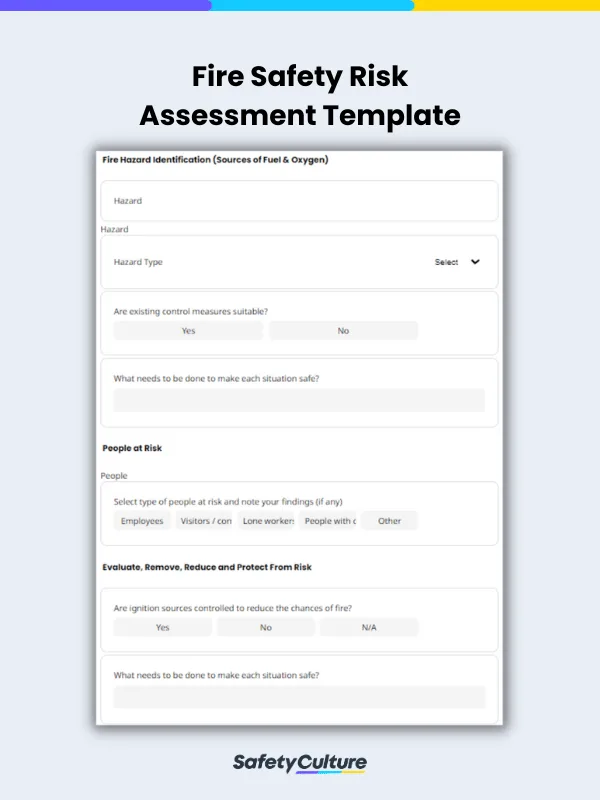
This fire safety risk assessment template is used to identify fire hazards and evaluate current fire safety protocols on a site to improve emergency plans. This template follows a simple 5-step guide provided by the UK Government. Conduct a fire safety risk assessment using this template on your mobile device by following the points below:
Take or attach a photo of the premises.
Provide general information aboutthe establishment.
Identify and log potential fire hazards within the premises (source of ignition & source of fuel and oxygen) in a structured table format.
Identify people at risk and record your findings by adding notes (if any).
A fire risk assessment template is a documentation tool used by trained safety officials to identify fire hazards and risks on any site. It assists safety officials as they do a visual check on the site and investigates various areas where fire incidents are more likely to occur.
Importance of Fire Risk Assessment Template
Using a fire risk assessment template is important because it provides a structured, consistent, and efficient way to identify and evaluate fire hazards, ensuring legal compliance and helping organizations prioritize safety measures. By systematically documenting risks, it supports effective emergency planning, resource allocation, and employee training, ultimately protecting lives, property, and business continuity while reducing the likelihood and impact of fire incidents.
What to Include in a Fire Risk Assessment Template?
Fire risk assessment records should be kept up to date so that precautionary measures are adequate at all times. Here are the key components of what a fire risk assessment template should have:
Site Information: Basic details about the premises, such as location, purpose, and responsible persons.
Fire Hazards: A list of all potential fire sources and combustible materials present on site.
People at Risk: Identification of individuals who could be affected, including employees, visitors, and vulnerable groups.
Review Schedule: A clear timeline for when the next assessment should be conducted to keep safety measures current.
Validation: Sign-off by the assigned safety official to confirm the assessment’s accuracy and completion.
How to Conduct Fire Risk Assessment with a Checklist: A Step-by-Step Guide
Evaluate, remove, reduce, and protect people from risk
Record, plan, inform, instruct, and train
Review fire risk assessment
Step 1: Identify Fire Hazards
Observe and log the type of fire hazard in a structured table format. A fire usually starts when heat comes into contact with anything that burns. The three things you need to look for in identifying fire hazards are sources of ignition, fuel, and oxygen. Take measures to avoid these three coming together to reduce the chances of a fire occurring.
Different Types of Fire Hazards
Fire hazards are grouped according to the activity in which they manifest. Activities that are highly likely to cause fire are known as different types of fire hazards.
Heating Substances – Heating near combustibles (like wood) can lead to Class A fires. Use water or foam extinguishers.
Handling Chemicals/Explosives – Flammable liquids and gases can cause Class B fires. Use foam, CO₂, or powder extinguishers. Never use water.
Using Electrical Equipment – Faulty wiring, appliances, or circuits may cause Class C fires. Use CO₂ or dry powder extinguishers. Avoid water and foam.
Metalworking – Reactive metals (e.g., sodium, potassium) can ignite, causing Class D fires. Use only dry powder extinguishers. Never use water or foam.
In your table, identify people at risk and where they are likely to be found around the premises. This step may require evaluating people with disabilities to discuss individual needs. These people could be:
employees;
visitors/contractors;
people with disabilities, elderly customers, or parents with children; and
other persons in the immediate vicinity of the premises.
Using the information gathered from steps 1 and 2, begin evaluating the management of the premises to identify situations and any acts or omissions that may present a fire risk. It is also essential to evaluate fire escapes and other fire precautions to ensure that they are up to date or adequate. Once you’ve evaluated the risks, remove or reduce the hazards you’ve identified by recommending actions and preventive measures.
Example questions for evaluating:
Is your fire alarm system adequate for your premises?
Will everybody be warned if the fire alarm operates?
Are all fire exits easily identified by the correct signs?
Are escape routes free from obstruction and storage?
Step 4: Record, Plan, Inform, Instruct, and Train
This step involves documenting all the significant findings and actions you’ve taken or will take when you conduct the fire risk assessment. Significant findings refer to fire hazards, actions taken, or preventive measures put in place.
Having a good recordkeeping program for your fire risk assessments is good practice and will be helpful to management and safety officers in case of fire incidents. This step also involves giving staff and employers clear and relevant information and appropriate instructions on fire safety arrangements.
Step 5: Review Fire Risk Assessment
Review your current assessment to determine if fire safety systems implemented are effectively controlling fire hazards and risks in the premises. If, during your review, you find that your fire risk assessment is no longer suitable for your premises and the type of work done onsite, revise it accordingly.
Fire Risk Assessment Example
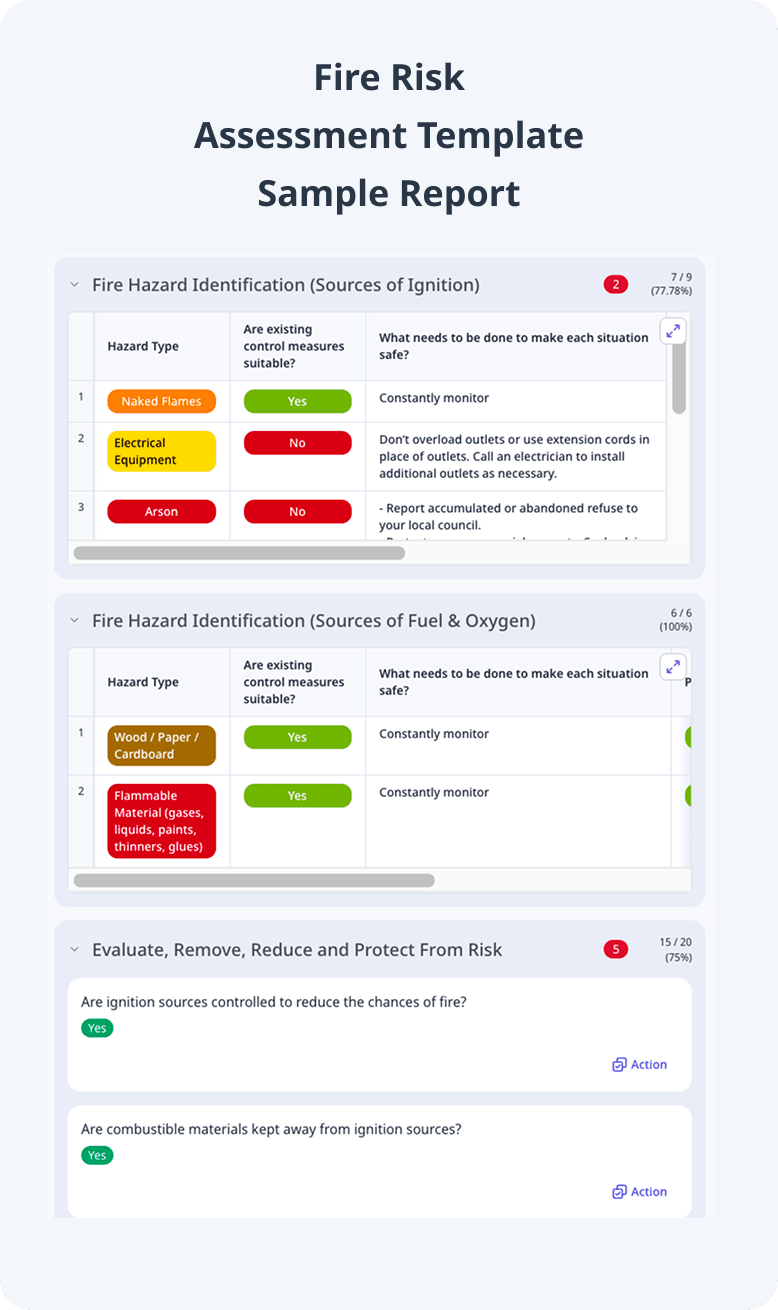
To get a better visualization of what a completed fire risk assessment should look like, preview this sample report:
Byblos Construction digitized safety checklists, compliance checks, and risk assessments with SafetyCulture, letting teams quickly notify leaders of risks for faster action and fewer blind spots. This improved risk management, communication, and visibility for safer job sites.
This is a general fire risk assessment form used to identify and reduce risks of fire on various properties or buildings. Use this checklist to identify hazards and recommend control measures.
A fire investigation template is conducted after a fire incident occurs. Fire departments can use this template to conduct an operational review of the incident and collect data to determine the cause of fire. Data from a fire investigation can also improve fire prevention programs and fire risk assessments.
Use this fire incident template for notification of any fire or fire related incidents. This template can be used by building occupants and staff to report any fire incidents and shared with relevant fire safety officials or regulatory authorities.
This monthly fire extinguisher inspection template can be used by building occupants and safety staff to conduct regular self-inspections. Regular equipment checks will help ensure fire extinguishers meet the standards and safety measures needed in case of a fire incident. View =more templates for conducting fire extinguisher inspections.