Importance
Handling a large commercial vehicle is far more challenging than driving a personal car, and not every driver is qualified to do it. A proper road test ensures the driver possesses the knowledge, skills, and judgment to operate a commercial motor vehicle safely and responsibly on public roads.
The CDL driver road test is challenging, with nearly 80% of people failing on their first attempt. Many struggle with the pre-trip inspection and vehicle maneuvering portions of the test, both of which can be improved through study and practice. That’s why having a checklist of all the important information is a must-have for a higher success rate. It can also serve as an online training resource that managers and instructors can easily share with their teams.
What to Include in a CDL Road Test Checklist
There’s a lot to remember when taking the CDL road exam, especially during the pre-trip inspection. A CDL road test checklist can guide you through the process, helping you avoid missed steps while offering a few helpful reminders for the practical test.
Here’s what you need to know in a CDL road test checklist:
Pre-Trip Inspection
General (In-Cab)
Check if all seat belts are secure and latch properly.
See if safety equipment, including a charged fire extinguisher, spare fuses, and reflective triangles, is in good condition.
Test all external lights and reflectors (headlights, turn signals, brake lights, hazards, and clearance lights).
Engine Compartment
Check if all fluid levels for oil, coolant, power steering, and washer fluid are within safe ranges and not leaking.
Inspect belts and hoses to ensure they are secure, not cracked, frayed, or leaking.
Verify the battery is secure and the terminals are clean.
Front Brakes
Inspect brake drum and lining to make sure there are no cracks, no contaminants, and a minimum lining thickness of ¼ inch.
Check the slack adjuster to confirm proper angle with no more than one inch of play.
Make sure that the brake chamber and hoses are secure and free of leaks or cracks.
Air Brakes (In-Cab / Operational)
Check air pressure builds to 120–140 PSI.
Perform a static air loss check to confirm loss is not more than 2–4 PSI in one minute.
Conduct an applied pressure test to ensure air loss is not more than 3–4 PSI per minute when brakes are applied.
Wheels and Tires
Inspect tires to make sure that there are no cuts, bulges, or exposed cords, and verify proper inflation with a gauge.
Measure tread depth to confirm steer tires are at least 4/32 inch and drive tires are at least 2/32 inch.
Check lug nuts, hub seal, and valve caps to confirm they are tight, not leaking, and free of rust trails or shiny threads.
Coupling System (Class A)
Inspect the fifth wheel and kingpin to confirm jaws are locked, properly greased, and there is no gap between the apron and skid plate.
Check all air and electrical lines to confirm they are connected, not dragging, free of leaks, and have no exposed wires.
Suspension & Steering
Inspect springs, shocks, and linkage to confirm they are secure, not cracked, bent, missing, or leaking.
Check the steering column to ensure it is not bent, has no excessive play, and components are secure.
Inspect the frame and chassis to confirm there are no cracks, bends, or unauthorized welds.
Trailer (If Present)
Check doors and handles to ensure they are secure, not bent, and operate properly.
Inspect trailer lights and reflective tape to confirm they are clean, visible, and meet
DOT requirements.
Inspect trailer brakes, chambers, and pads to confirm they meet the same standards as the tractor brakes.
Basic Driving Control and Maneuver Skills
Straight Line Backing: Reverse straight through a marked lane without touching boundaries or cones.
Offset Backing: Back into a space offset to the left or right from the starting position. Demonstrates spatial awareness and trailer control.
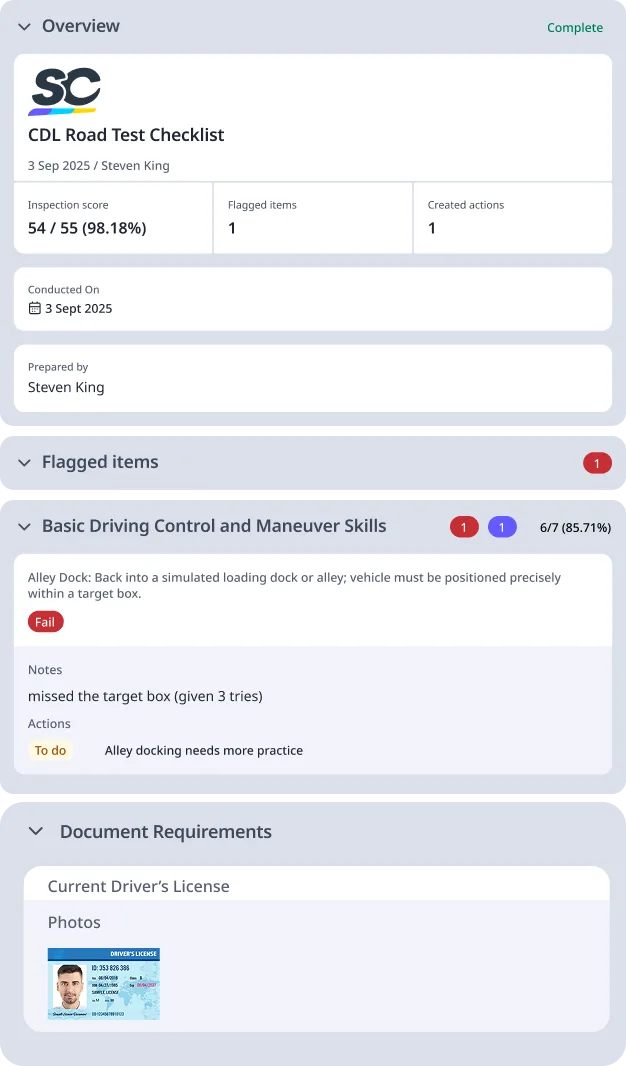
Alley Dock: Back into a simulated loading dock or alley; vehicle must be positioned precisely within a target box.
Parallel Parking (Conventional and Sight-Side): Back into a simulated curb space on either the blind side or sight side; shows ability to maneuver the trailer into tight spaces.
Forward Stop: Move forward and stop with the front bumper precisely within a designated box; demonstrates smooth stopping control.
On-Road Driving Test
Obey all traffic signs, signals, and speed limits.
Use proper lane positioning at all times.
Signal early and consistently for turns and lane changes.
Check mirrors frequently and before every maneuver.
Maintain a safe following distance and space around the vehicle.
Document Requirements
Current Driver’s License
Medical Examiner’s Certificate
Commercial Learner’s Permit (CLP)
Vehicle Registration and Insurance
Appropriate Vehicle Class with Gross Vehicle Weight Rating (GVWR)
* Requirements may differ by country or region. Always check your local licensing authority’s CDL test guidelines to confirm what you need to bring.
How to Use this Checklist
For fleet managers, creating a CDL driver road test reviewer for your team can be challenging and often incomplete. That’s why a digital checklist that promotes fleet safety and can be shared with everyone works best. Follow these steps to help your drivers prepare and pass the CDL practical road test:
Confirm your drivers have all the required documents and licenses before proceeding.
Download and customize the checklist for your industry by adding specific questions or reference documents.
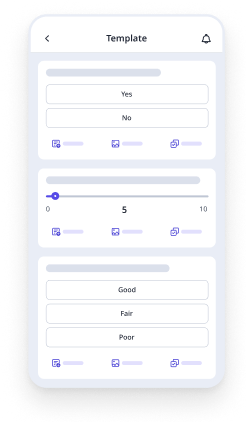
Distribute the checklist digitally to all drivers and have them complete it.
Review completed checklists and flag any mistakes or missing information. Ensure incomplete files are corrected.
Share the finalized template, which your team can use as an ongoing reference.
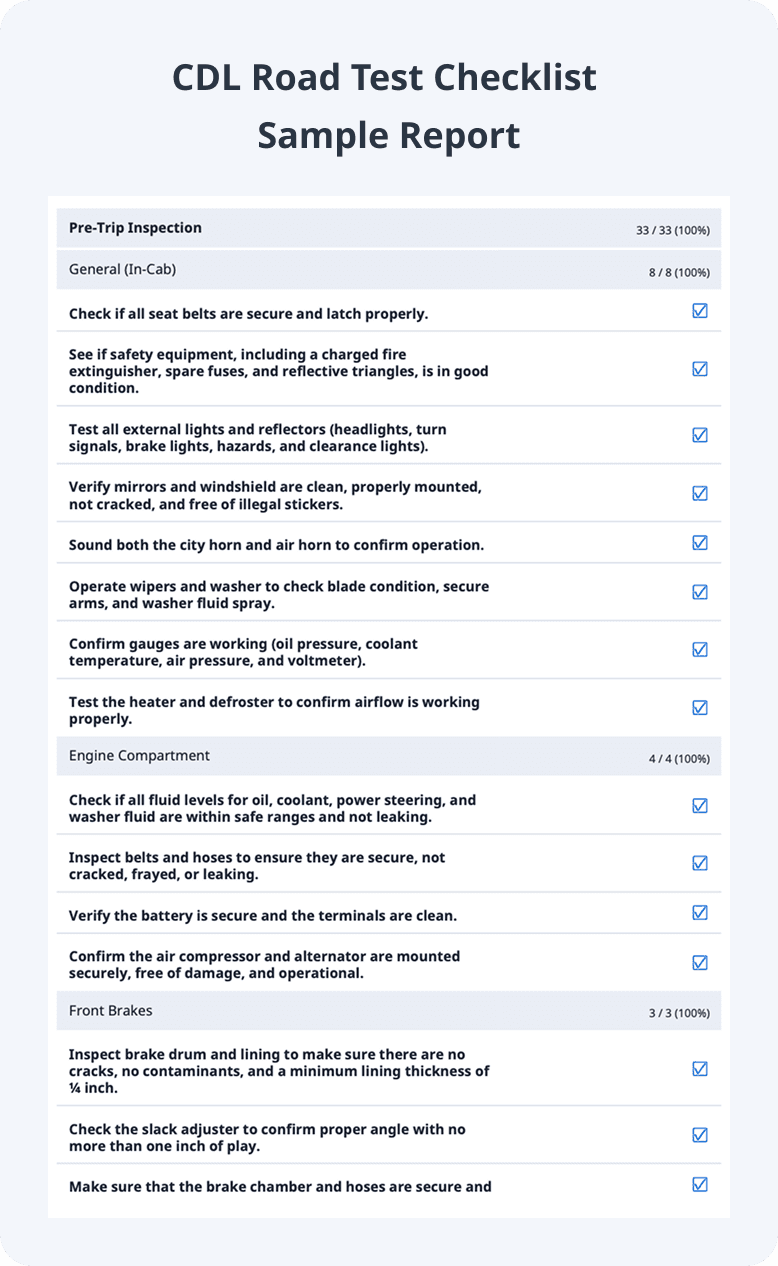
Sample CDL Road Test Report PDF
Below is a completed CDL road test checklist template, which includes all three parts:
Preview CDL Road Test PDF Report